
Ellipsoptera hamata monti
(Vaurie, 1951)
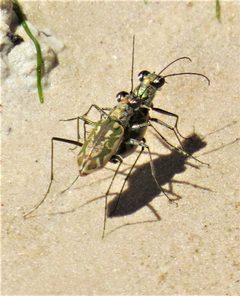
Ellipsoptera hamata monti is a of the Coastal Tiger , a member of the Ellipsoptera characterized by relatively large and long legs adapted to extreme sandy and saline . As part of the E. hamata , it shares the diffuse middle elytral band that distinguishes this from . The subspecies was described by Vaurie in 1951. Members of this genus are ecologically tied to coastal and saline environments with sparse vegetation.
Pronunciation
How to pronounce Ellipsoptera hamata monti: /ɛˌlɪpsɔˈpiːtə raɪˈpoʊdi/
These audio files are automatically generated. While they are not always 100% accurate, they are a good starting point.
Identification
Distinguished from the closely related and sympatric E. marginata along the Gulf Coast of Florida by: males lack the distinct tooth on the underside of the right (present in E. marginata); females have straight elytral apices not bent downward at 90° (E. marginata females have distinctly bent elytral tips). E. hamata monti has an olive pronotal cast versus the bronze cast typical of E. marginata. The diffuse middle elytral band separates both from other Ellipsoptera with more defined maculation patterns.
Images
Habitat
Coastal with sandy and/or saline substrates, including coastal beaches, mud flats, salt marshes, and intertidal areas with sparse vegetation. Associated with red mangrove (Rhizophora mangle) thickets and black mangrove (Avicennia germinans) woodlands in high scrub areas, with moist, briney, barren ground between.
Distribution
Gulf Coast of Florida and adjacent regions; occurs where the ranges of E. hamata and E. marginata overlap along the lower Gulf Coast of Florida. Distribution records include Mexico and the United States (southeastern coastal regions).
Seasonality
Active during summer months; have been observed in July and August. Peak activity during warmer periods.
Behavior
Diurnally active but attracted to lights at night, a thought to relate to to avoid daytime risks. Nocturnally perches on grass stems and foliage, sometimes clamping around stems. Extremely wary, with fast running and strong capabilities that make approach difficult. Exhibits mate guarding behavior.
Ecological Role
in coastal saline ; serves as prey for larger nocturnally-active tiger beetles such as Habroscelimorpha severa and Tetracha virginica.
Human Relevance
Subject of entomological study and photography; of interest to tiger collectors and naturalists. Difficult to approach and photograph due to wariness and capability.
Similar Taxa
- Ellipsoptera marginata with overlapping range along Florida Gulf Coast; distinguished by male right tooth (present in marginata, absent in hamata), female elytral apices bent downward at 90° in marginata versus straight in hamata, and bronze pronotal cast in marginata versus olive in hamata
- Ellipsoptera hamata lacerataAnother of E. hamata; lacerata is the nominate subspecies occurring along the Gulf Coast from Florida to Texas, while monti is restricted to more specific coastal areas
More Details
Taxonomic History
Ellipsoptera was elevated from subgenus of Cicindela to full rank by Erwin & Pearson (2008), formalizing classification that had been proposed by Rivalier in the 1950s but long treated as subgeneric in North American literature.
Identification Challenges
Where E. hamata and E. marginata co-occur along the Florida Gulf Coast, geography alone is insufficient for identification; close examination of mandibular and elytral characters is required, ideally with specimens in hand or high-magnification photography.