
Omus dejeanii
Reiche, 1838
Greater Night-stalking Tiger Beetle
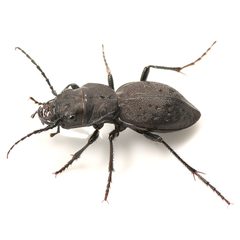
Omus dejeanii is a flightless tiger and the largest in its , measuring 15–20 mm. It inhabits dense coastal forests from British Columbia to northern California. The species is and exhibits exceptionally long mating durations averaging 29.4 hours, far exceeding most other tiger beetles. Males possess enlarged used both for prey capture and for grasping females during prolonged amplexus.
Pronunciation
How to pronounce Omus dejeanii: /ˈo.mus də.ʒe.ˈa.ni/
These audio files are automatically generated. While they are not always 100% accurate, they are a good starting point.
Identification
Distinguished from sympatric Omus audouini by larger body size (scaling factor of 1.3×) and proportionally longer (scaling factor of 1.5×). Geometric morphometric analysis shows interspecific differences in the mandibular region (terebral teeth), likely associated with prey processing. As the largest Omus at 15–20 mm, size alone can be diagnostic where ranges overlap.
Images
Habitat
Dense coastal forests; forest floor in forested areas. Specifically documented from Powell Butte Nature Park, Portland, Oregon in sympatry with O. audouini.
Distribution
Pacific coast of North America from British Columbia south to northern California.
Diet
Predatory; captures and processes prey using .
Behavior
. Exhibits obligatory male-superior mounted mating with average duration of 29.4 (± 5.6) hours—substantially longer than O. audouini and an order of magnitude greater than most other tiger beetles. Males use to grasp females and maintain amplexus throughout copulation. Mating duration is unaffected by time of initiation, food deprivation, or operational sex ratio, suggesting no mate guarding behavior.
Ecological Role
Conspicuous within terrestrial . partitioning with sympatric O. audouini supported by body size and length differences consistent with Hutchinsonian Ratios.
Similar Taxa
- Omus audouiniSympatric congeneric distinguished by smaller body size (1.3× smaller), shorter (1.5× shorter), and significantly shorter mating duration.
More Details
Mandible Function
serve dual role in feeding (prey capture/processing) and as secondary sexual organs for grasping females during amplexus, with geometric morphometric differences in the terebral teeth region between .
Reproductive Biology
Syn-copulatory courtship is suggested as the female-choice reproductive mechanism. The extreme mating duration appears to be a -specific trait rather than conditional on environmental or social factors.
Sources and further reading
- BugGuide
- GBIF taxonomy match
- iNaturalist taxon
- NCBI Taxonomy
- Catalogue of Life
- A rare opportunity to do fall insect collecting in western North America | Beetles In The Bush
- Diversity in Tiger Beetle Larval Burrows | Beetles In The Bush
- Amblycheila cylindriformis on white | Beetles In The Bush
- How to collect larvae of Amblycheila cylindriformis | Beetles In The Bush
- The Coleopterists Bulletin | Beetles In The Bush
- Ecomorphology and Mating Behavior of Two Species of Night-stalking Tiger Beetles, Omus audouini and O. dejeanii