
Myrmecoblatta
Mann, 1914
Ant Cockroaches
Species Guides
1- Myrmecoblatta wheeleri(Wheeler's Ant Cockroach)
Myrmecoblatta is a of small in the Corydiidae, commonly called cockroaches. These insects are myrmecophiles, living in close association with ant colonies. The genus was established by Mann in 1914 and contains found in the southern United States, Mexico, and Central America. They represent a specialized evolutionary lineage adapted to life within ant nests.
Pronunciation
How to pronounce Myrmecoblatta: /mɪrˌmɛkoʊˈblætə/
These audio files are automatically generated. While they are not always 100% accurate, they are a good starting point.
Identification
Distinguished from other Corydiidae by their small size, myrmecophilous habits, and association with nests. Wing reduction or absence separates them from many related . Pale coloration and compact body form differ from the typically darker, more robust free-living corydiids. Definitive identification requires examination of genitalic structures and comparison with .
Images
Appearance
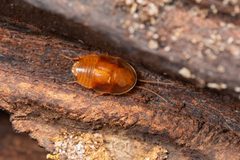
Small, compact with reduced or absent wings. Body form is often flattened and adapted for moving through narrow spaces within nests. Coloration tends toward pale or translucent shades, sometimes with reduced pigmentation compared to free-living cockroaches. are relatively long and .
Habitat
Found exclusively within nests, including those of various ant . Occupies the interior chambers and galleries of ant colonies. Microhabitat includes nest refuse areas and foraging trails where they scavenge on colony debris.
Distribution
Recorded from Florida (USA), Mexico, Guatemala, and Rica. Distribution corresponds to the range of in subtropical and tropical regions of North and Central America.
Diet
Scavenges on organic debris within nests, including colony refuse, discarded food, and possibly dead ants. Exact dietary composition varies by ant .
Host Associations
- ant colonies - myrmecophilelives within nests of various
Life Cycle
Hemimetabolous development with , nymph, and stages. Nymphs develop within the protective environment of nests. Specific details of egg deposition and nymphal development are poorly documented.
Behavior
Myrmecophilous includes following trails, remaining within nest confines, and avoiding ant aggression through chemical mimicry or stealth. activity patterns within nests. Does not construct independent shelters.
Ecological Role
Commensal or within colonies. Functions as a , processing organic waste materials. May serve as prey for ants in some circumstances, though chemical and behavioral adaptations likely reduce risk.
Human Relevance
No direct economic or medical significance. Occasionally encountered by myrmecologists and entomologists studying nest . Not a household pest.
Similar Taxa
- AttaphilaAnother myrmecophilous in Corydiidae; differs in specificity (leaf-cutter ants) and geographic range (primarily South America)
- free-living Corydiidae generaNon-myrmecophilous corydiids lack wing reduction, pale coloration, and nest association; typically larger and darker with fully developed wings
More Details
Family placement
Myrmecoblatta has been placed in both Corydiidae and in different taxonomic treatments. Current consensus based on molecular and morphological data supports placement in Corydiidae, Latindiinae.