
Incisitermes minor
(Hagen, 1858)
Western Drywood Termite
Incisitermes minor, commonly known as the western , is a drywood termite in the Kalotermitidae. Native to western North America, it has become established across much of the United States and has been introduced to Hawaii, China, and Japan. It is a significant structural pest, ranking as the second most destructive in California after the western subterranean termite (Reticulitermes hesperus), with estimated economic impact of approximately $250 million in California and Arizona combined. The species forms one-piece nests entirely within dry wood, does not require soil contact, and exhibits temperature-driven seasonal and daily activity patterns.
Identification
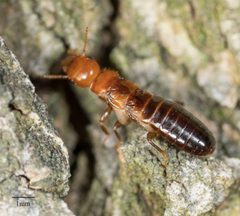
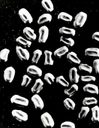
Distinguished from other drywood termites by the soldier's enlarged third antennal segment and two teeth on the left . have orange-brown contrasting with dark brown . Fecal pellets are hard, evenly shaped, and accumulate in conical piles or scattered on horizontal surfaces. Galleries typically feature a thin outer layer of intact wood concealing cavernous internal excavations. Distinguished from subterranean termites by the absence of soil contact requirements and the presence of fecal pellets rather than soil-packed tunnels.
Images
Appearance
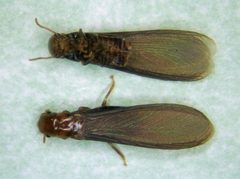
Colony members exhibit distinct morphologies. (swarmers) have orange-brown and pronota with dark brown , measuring 11–12.5 mm in length. Soldiers are larger (8–12 mm), reddish-brown with broad red heads and black ; they possess two visible teeth on the left mandible and a characteristically enlarged third antennal segment. Pseudergates (false ) and nymphs lack the specialized features of reproductive or defensive castes. The overall body coloration is dark brown with orange head regions in many castes.
Habitat
Native to Mediterranean climate regions of California and surrounding areas with hot, dry summers. Naturally inhabits dead portions of trees including California bay laurel, willows, cottonwoods, oaks, and sycamores, as well as stumps, fallen branches, and logs. In urban environments, colonizes wooden structures including flooring, window frames, door frames, fascia boards, soffits, and utility poles. Also found in wooden furniture, tatami mats (Japan), and miscellaneous wooden objects. Does not require soil contact or external moisture sources.
Distribution
Native to western North America including western United States and northern Mexico. Established in California (particularly Central Valley), Oregon, Washington, Arizona, and Baja California/Sonora. Disjunct reported in Florida, Arkansas, Iowa, Maryland, New Jersey, New York, Oklahoma, Ohio, Georgia, South Carolina, and Louisiana. Introduced to Hawaii, China, and Japan; reported from Toronto, Canada. Spread occurs primarily through human transport of infested wood materials.
Seasonality
Colony activity peaks during spring and summer months, with daily activity highest in late afternoon (approximately 1800 hours). swarming occurs in late September through November in Southern California, triggered by temperatures between 26.7–37.8°C (80–100°F). Activity increases with temperature even during winter warm spells. Colony development from founding to visible damage requires 5–7 years.
Diet
Feeds exclusively on wood cellulose. Shows preference for Douglas fir among tested wood ; avoids wood with repellent extractives such as Karamatsu wood. Excavates galleries while feeding, leaving thin outer wood layers intact. Feeding hierarchy exists within colonies: nymphs are primary donors/recipients in trophallactic food transfer.
Host Associations
- Eriobotrya japonica - food sourceloquat wood used in acoustic monitoring studies
- Douglas fir - preferred food sourcemost preferred wood in feeding trials
- Karamatsu wood - avoidedcommercial timber with repellent properties causing increased mortality when consumed
Life Cycle
Development includes , seven instars, and stages; approximately one year from egg to maturity. Colonies contain (reproductives), soldiers, and pseudergates/nymphs. Pseudergates can differentiate into neotenic reproductives or soldiers through molting, including sex change capability. Alates emerge from wood, shed wings, and engage in tandem courtship with females leading males. Mated pairs excavate royal chambers in wood, seal entrances with gut contents, and undergo ~9 months of inactivity before egg-laying. Secondary reproductive pairs rarely occur. Isolated groups of 50 can establish functional colonies with differentiation within 12 months.
Behavior
Exhibits temperature-driven activity patterns with strong correlation between ambient temperature and movement/feeding. Constructs galleries with distinct phases: initial exploration, chamber construction, and expansion. Excavation follows earlywood radially toward wood surfaces, then longitudinally 0.3–3.0 cm beneath the surface with occasional lateral deviations. Avoids knots, compression wood, and high- regions. Seals tunnel approaches to outer wood surfaces and reopens them dynamically (stigmergic fortification ). Accumulates fecal pellets in specific chambers beneath wood surfaces. Ejects fecal pellets through small surface holes. Does not forage outside nest; remains entirely within wood. Locomotion speed measured at 1.4 cm/s. -banging vibratory movements observed in and soldiers.
Ecological Role
Decomposer of dead wood in native California oak woodland and riparian . Contributes to nutrient cycling through wood decomposition. Maintains very low bacterial and fungal loads in nests compared to dampwood termites due to dry wood . Minimal role in promoting microbial growth in nesting substrate. In urban environments, functions as significant structural pest with economic impacts secondary only to subterranean termites in western North America.
Human Relevance
Major economic pest of wooden structures in western North America. Estimated impact of $250 million in California and Arizona. Represents approximately half of wood-destroying organism reports in Southern California, with higher frequency near coastlines. Spread facilitated by movement of wooden furniture, lumber, and boats. Control methods include whole-structure with sulfuryl fluoride, spot treatments with or imidacloprid, heat treatment, liquid nitrogen application, microwave treatment, and physical removal of infested wood. Gel baits containing hydramethylnon have shown experimental efficacy.
Similar Taxa
- Reticulitermes hesperusWestern subterranean termite; distinguished by soil contact requirement, mud tubes, and different soldier (narrow without enlarged third antennal segment). More economically damaging in California but different ecological requirements.
- Cryptotermes brevisAnother ; distinguished by soldier and geographic distribution. Less established in western North America.
- Incisitermes schwarziCongeneric ; similar but different distribution and subtle morphological differences in soldier .
More Details
Acoustic detection
Activity monitoring using acoustic emission technology confirms temperature-driven patterns and enables non-destructive detection of . Heating wood to at least 25°C enhances detection probability during inspections.
Caste flexibility
Unusual among insects in that pseudergates can change sex through molting when differentiating into , and can develop into reproductives or soldiers without -derived inhibitory typical of many .
Gallery construction constraints
Tunneling patterns are physically constrained by wood anatomy; avoid knots, compression wood, and regions with high extractive or lignin content, resulting in predictable gallery architectures exploitable for detection.
Sources and further reading
- BugGuide
- Wikipedia
- GBIF taxonomy match
- iNaturalist taxon
- NCBI Taxonomy
- Catalogue of Life
- Six new Dracula ants from Madagascar: Minor workers become queens in Mystrium | Blog
- Litaneutria minor – agile ground mantid | Beetles In The Bush
- Bug Eric: Priocnemis minorata
- The Best of 2024 on Entomology Today
- New ant species explodes to defend its colony | Blog
- physiology | Blog
- Seasonal and Daily Patterns in Activity of the Western Drywood Termite, Incisitermes minor (Hagen)
- Nesting ecology and cuticular microbial loads in dampwood (Zootermopsis angusticollis) and drywood termites (Incisitermes minor, I. schwarzi, Cryptotermes cavifrons)
- Nest-Gallery Development and Caste Composition of Isolated Foraging Groups of the Drywood Termite, Incisitermes minor (Isoptera: Kalotermitidae)
- Biology and control measure of the Western drywood termite <I>Incisitermes minor</I> in Japan
- Nesting ecology and cuticular microbial loads in dampwood (Zootermopsis angusticollis) and drywood termites (Incisitermes minor, I. schwarzi, Cryptotermes cavifrons)
- Quantitative observation of the foraging tunnels in Sitka spruce and Japanese cypress caused by the drywood termite Incisitermes minor (Hagen) by 2D and 3D X-ray computer tomography (CT)
- X-ray tomographic analysis of the initial structure of the royal chamber and the nest-founding behavior of the drywood termite Incisitermes minor