
Incisitermes
Krishna, 1961
Species Guides
5- Incisitermes arizonensis
- Incisitermes banksi
- Incisitermes minor(Western Drywood Termite)
- Incisitermes schwarzi(Schwarz's Drywood Termite)
- Incisitermes snyderi(Southeastern Drywood Termite)
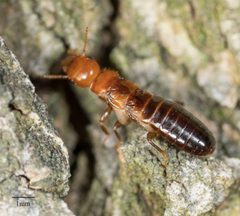
Incisitermes is a of drywood termites in the Kalotermitidae, established by Krishna in 1961. in this genus are distributed across the Americas, Asia, and the Pacific, including notable pests such as the western (I. minor) and the light southeastern drywood termite (I. snyderi). These exhibit the characteristic of drywood termites, living entirely within wood without requiring soil contact.
Pronunciation
How to pronounce Incisitermes: //ɪnˌsiːsiˈtɜːrmiːz//
These audio files are automatically generated. While they are not always 100% accurate, they are a good starting point.
Identification
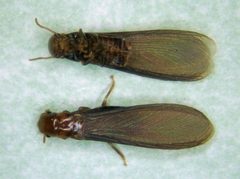
Soldiers of Incisitermes possess with a distinct notch or indentation on the inner margin, a key diagnostic feature for the . The genus is distinguished from related Kalotermitidae by this mandibular , though -level identification typically requires examination of winged or detailed morphometric analysis.
Images
Habitat
inhabit dead wood in various environments, from forest to structural timber. Incisitermes minor has been documented in loquat logs and structural wood in urban settings. Incisitermes fruticavus has been recorded from jojoba shrubs.
Distribution
The occurs in North America (southwestern and southeastern United States), Central America, the Caribbean, South America, and Asia including Japan, China, Taiwan, and the Philippines. Specific distributions vary: I. minor is established in California and Japan as an introduced pest; I. inamurae is restricted to tropical southern Taiwan; I. schwarzi occurs in the Caribbean and southern United States.
Diet
Wood; feed on cellulose in dead wood, excavating galleries while consuming wood fibers.
Ecological Role
Wood decomposers that recycle cellulose in dead wood; some are significant structural pests causing economic damage to buildings and wooden structures.
Human Relevance
Several are important pests of structural wood. Incisitermes minor (western ) is the second most economically damaging pest in the United States after subterranean termites. The has been subject to extensive research on detection methods, including acoustic emission technology and X-ray computed tomography for monitoring .
Similar Taxa
- KalotermesSimilar in the same ; distinguished by mandibular and wing venation patterns
- CryptotermesAnother Kalotermitidae with similar cryptic wood-dwelling habits; soldiers typically have phragmotic adapted for blocking tunnels rather than notched
- NeotermesRelated Kalotermitidae ; Incisitermes was historically confused with Neotermes and Kalotermes, leading to taxonomic revisions
Sources and further reading
- BugGuide
- Wikipedia
- GBIF taxonomy match
- iNaturalist taxon
- NCBI Taxonomy
- Catalogue of Life
- How Termites 'Looking for Love' Landed in the News | Bug Squad
- Bravo to Vernard Lewis and Margaret Collins: Two Legendary Entomologists | Bug Squad
- taxonomy | Blog - Part 18
- What's That Termite? Artificial Intelligence Might Have the Answer
- Spatial Distribution of Castes Within Colonies of the Termite Incisitermes Schwarzi
- Seasonal and Daily Patterns in Activity of the Western Drywood Termite, Incisitermes minor (Hagen)
- Redescription of the Drywood Termite Incisitermes inamurae (Isoptera: Kalotermitidae) From Southern Taiwan
- Nesting ecology and cuticular microbial loads in dampwood (Zootermopsis angusticollis) and drywood termites (Incisitermes minor, I. schwarzi, Cryptotermes cavifrons)
- Nest-Gallery Development and Caste Composition of Isolated Foraging Groups of the Drywood Termite, Incisitermes minor (Isoptera: Kalotermitidae)
- Disease Resistance in the Drywood Termite,Incisitermes schwarzi: Does Nesting Ecology Affect Immunocompetence?
- Biology and control measure of the Western drywood termite <I>Incisitermes minor</I> in Japan
- X-ray tomographic analysis of the initial structure of the royal chamber and the nest-founding behavior of the drywood termite Incisitermes minor
- Quantitative observation of the foraging tunnels in Sitka spruce and Japanese cypress caused by the drywood termite Incisitermes minor (Hagen) by 2D and 3D X-ray computer tomography (CT)
- Nesting ecology and cuticular microbial loads in dampwood (Zootermopsis angusticollis) and drywood termites (Incisitermes minor, I. schwarzi, Cryptotermes cavifrons)