
Neotermes
Holmgren, 1911
Species Guides
2- Neotermes castaneus(Florida dampwood termite)
- Neotermes jouteli(Joutel's drywood termite)
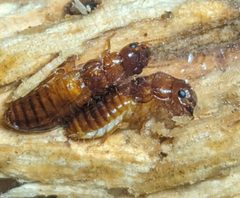
Neotermes is a of drywood termites in the Kalotermitidae, established by Nils Holmgren in 1911. are obligate wood-nesters that inhabit dead wood, including branches of living trees. The genus includes over 100 described species distributed across tropical and subtropical regions worldwide. Some species exhibit facultative , though they lack the system found in other parthenogenetic . Neotermes castaneus is the type species.
Pronunciation
How to pronounce Neotermes: /ˌniːoʊˈtɜr.miːz/
These audio files are automatically generated. While they are not always 100% accurate, they are a good starting point.
Identification
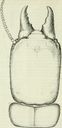
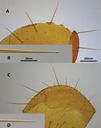
Members of Neotermes can be distinguished from other Kalotermitidae by a combination of morphological features including structure and pronotum shape. -level identification requires examination of soldier characteristics, particularly mandible and capsule proportions. possess characteristic wing venation patterns typical of the . Accurate identification to species generally requires microscopic examination and reference to original descriptions or taxonomic revisions.
Images
Habitat
Dead wood, including dead branches of living trees and standing dead wood. do not require contact with soil. Some species inhabit specific trees; for example, Neotermes sonneratiae is associated with Sonneratia mangroves, and Neotermes mangiferae with mango (Mangifera indica).
Distribution
Pantropical and subtropical distribution spanning Africa, Asia, Australia, Oceania, and the Americas. Specific documented localities include: Okinawa Island (Japan), West Africa (Ghana, Nigeria, Cameroon), East Africa (Kenya, Tanzania), South Asia (India, Pakistan, Sri Lanka), Southeast Asia (Malaysia, Indonesia, Philippines), China (Fujian, Yunnan), Taiwan, Pacific islands (Samoa, Hawaii), and the Neotropics (Brazil, Caribbean, Central America).
Diet
Wood. feed on dead wood and do not forage outside their nesting substrate. Cellulose digestion is facilitated by gut .
Host Associations
- Sonneratia - Neotermes sonneratiae specifically associated with this mangrove
- Mangifera indica - Neotermes mangiferae associated with mango trees
Life Cycle
Development follows the linear characteristic of Kalotermitidae: pseudergates (functional capable of developing into reproductives or soldiers) progress through two nymphal stages (first nymphs, then pre- nymphs) before becoming alates. Colony founding occurs when alate pairs establish new colonies in wood. In Neotermes koshunensis, -to-larva development takes approximately 60-70 days under laboratory conditions.
Behavior
Colonies exhibit cooperative nest construction without central coordination. and colony founders of the same share identical tunneling , suggesting these behaviors are inherited rather than size-dependent. In at least one species (Neotermes koshunensis), females suppress differentiation of male secondary reproductives when a male primary reproductive is present. Parthenogenetic -laying occurs when females are isolated from males, but hatching rates are lower than for sexually produced eggs.
Ecological Role
Decomposition of dead wood in forest and woodland . By inhabiting dead branches of living trees, contribute to nutrient cycling and wood breakdown in and subcanopy without killing the tree.
Human Relevance
Some are pests of timber and wooden structures. Neotermes castaneus and related species can damage wooden buildings, furniture, and other cellulose materials. Research on Neotermes has contributed to understanding , including pioneering work on desiccation resistance by Margaret Collins and detection methods by Vernard Lewis.
Similar Taxa
- ParaneotermesAlso in Kalotermitidae and shares wood-nesting ; distinguished by morphological differences in structure and soldier shape. Paraneotermes simplicicornis exhibits distinctive 'kicking' tunneling not reported in Neotermes.
- CryptotermesAnother Kalotermitidae with similar linear development and drywood habits; separated by differences in pronotum shape, , and wing characteristics.
More Details
Parthenogenesis
Facultative has been documented in Neotermes koshunensis via terminal fusion automixis, producing highly homozygous offspring with only maternal . Unlike some other parthenogenetic , this has not evolved the (AQS) system; colonies typically maintain strict monogamy with a single queen.
Taxonomic history
Originally described as a subgenus by Holmgren in 1911, later elevated to rank. The genus now contains over 100 described , with numerous species described by Chinese entomologists Han and Xu in the 1980s based on morphological characteristics.