
Neotermes jouteli
(Banks, 1919)
Joutel's drywood termite
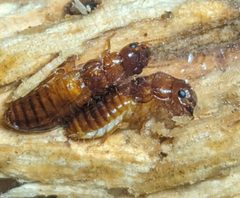
Neotermes jouteli is a large Neotropical native to South Florida and the West Indies. It is the largest in Florida, with soldiers reaching 13.35 mm and winged approximately 16.05 mm. The species is notable for its distinctive deeply depressed, in the stage.
Pronunciation
How to pronounce Neotermes jouteli: /ˌniːoʊˈtɜrmiːz ˈʒaʊtəlaɪ/
These audio files are automatically generated. While they are not always 100% accurate, they are a good starting point.
Identification
Distinguished from other Florida by its large size—soldiers exceed 13 mm, larger than any other Florida termite . The deeply depressed, of the is a key diagnostic character separating it from .
Images
Appearance
Soldiers are large, reaching a maximum length of 13.35 mm. Winged () measure approximately 16.05 mm. The imago possesses a deeply depressed (the area of the directly above the ) with a (wrinkled) texture. Swarming alates have with approximately 200 featuring eucone-type cones and rhabdomeres.
Habitat
Inhabits dead wood and wooden structures in tropical and subtropical environments. As a kalotermitid , colonies are established entirely within wood without soil contact.
Distribution
Native to South Florida and surrounding West Indian nations.
Diet
Wood; as a , it feeds on sound or decayed wood of various tree .
Life Cycle
involves swarming of , typically following rainfall events. After mating, the royal pair establishes a new colony in wood and enters a concealed, dark existence. During this reproductive phase, the royal pair experiences long-term light deprivation, which triggers progressive degeneration of the until complete destruction.
Behavior
exhibit swarming following rainfall. Colony founders and engage in tunneling behavior for nest construction. The royal pair lives in complete darkness during the reproductive phase, leading to dramatic morphological changes including degeneration.
Ecological Role
Decomposer of wood in tropical and subtropical forest . Harbors symbiotic protists including Staurojoenina mulleri, which assist in cellulose digestion.
Human Relevance
Structural pest in South Florida and the Caribbean due to its wood-feeding habits. Its large size makes more conspicuous than smaller .
Similar Taxa
- Incisitermes minorOverlapping distribution in North America; distinguished by smaller size and different in the .
- Other Neotermes speciesN. jouteli is distinguished by its larger size and the deeply depressed, of the .
Sources and further reading
- BugGuide
- Wikipedia
- GBIF taxonomy match
- iNaturalist taxon
- NCBI Taxonomy
- Catalogue of Life
- Bravo to Vernard Lewis and Margaret Collins: Two Legendary Entomologists | Bug Squad
- Digging Deep: The Secrets Within Termite Nests
- Degeneration of the compound eye of the termite Neotermes jouteli (Isoptera) in darkness during the phase of reproduction
- Morphology and Molecular Phylogeny of Staurojoenina mulleri sp. nov. (Trichonymphida, Parabasalia) from the Hindgut of the Kalotermitid Neotermes jouteli