
Cryptotermes
Banks, 1906
drywood termites
Species Guides
2- Cryptotermes brevis(West Indian drywood termite)
- Cryptotermes cavifrons(Florida Drywood Termite)
Cryptotermes is a of drywood termites in the Kalotermitidae, comprising approximately 70 described with significant economic importance as structural pests. Unlike subterranean termites, species in this genus do not require soil contact and infest dry, seasoned wood directly. The genus has a global distribution spanning tropical and subtropical regions, with notable pest species including C. brevis (West Indian ) and C. dudleyi. Some species exhibit distinctive morphological adaptations, such as the recently described C. mobydicki with its elongated, whale-like soldier .
Pronunciation
How to pronounce Cryptotermes: //krɪptoʊˈtɜrmiːz//
These audio files are automatically generated. While they are not always 100% accurate, they are a good starting point.
Identification
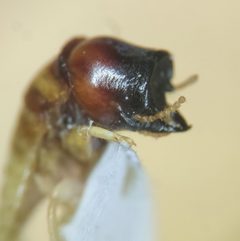
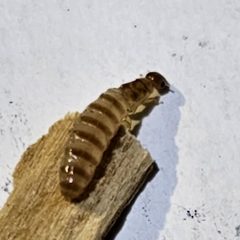
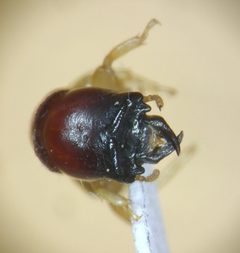
Distinguished from other kalotermitid by soldier , particularly the development of frontal and genal horns and the angle of the relative to the vertex. C. brevis soldiers have a distinctly wrinkled, pear-shaped head with a constricted frontal margin. Genetic analysis supports -level identification, with some species showing transoceanic relationships suggestive of driftwood . Imagos are difficult to distinguish without microscopic examination of wing venation and antennal segmentation.
Images
Habitat
Strictly associated with dry wood ; colonies establish directly in seasoned timber, dead standing trees, or structural wood without soil contact. Found in tropical dry forests, mangrove habitats (C. cylindroceps), and urban environments where wooden structures and furniture provide suitable substrate. C. mobydicki inhabits rainforest in dead, standing trees approximately 8 meters above ground.
Distribution
Pantropical and subtropical distribution. Neotropical region: 34 (28 , 4 introduced, 2 fossil). South America: at least 16 species including Colombia, French Guiana, Trinidad, and Dominican Republic. North America: C. brevis established in Florida and other southern states; C. cavifrons native to southeastern United States. Australia: 10+ species including 8 endemic and 2 (C. brevis, C. dudleyi). Widespread introduced of C. brevis across Caribbean, Pacific islands, Africa, and Europe (Spain).
Seasonality
Swarming varies by and climate; C. brevis swarms during warm evenings, typically spring through summer in temperate regions, year-round in tropical areas. are attracted to light.
Diet
Cellulose from dry, seasoned wood; feeds on structural timber, wooden furniture, and dead wood in natural . Does not require external water sources, obtaining moisture metabolically from wood digestion.
Life Cycle
Hemimetabolous development with . Colony founded by a single pair of primary reproductives (king and ) after swarming and dealation. No true ; pseudergates (false workers) perform labor and can differentiate into reproductives or soldiers. Colonies remain entirely within the wood substrate; no foraging outside the nest.
Behavior
Colonies are confined to single pieces of wood or connected wooden structures; no ground-foraging . Soldiers use phragmotic to block nest entrances when disturbed. exhibit positive during swarming. C. brevis has been documented engaging in courtship behavior prior to colony foundation.
Ecological Role
Primary decomposers of dead wood in tropical and subtropical forest ; contribute to nutrient cycling through cellulose breakdown. Some facilitate wood decomposition in mangrove . In natural settings, colonize dead branches and standing dead trees without killing living vegetation.
Human Relevance
Major economic pest responsible for significant structural damage globally. C. brevis (West Indian ) causes extensive damage to buildings, furniture, and wooden artifacts across its introduced range; intercepted frequently in international trade, including wood packaging material from the Dominican Republic. C. dudleyi and C. brevis are established pests in Florida. are difficult to detect due to concealed gallery systems; or localized heat treatment typically required for control. C. mobydicki and other recently described from undisturbed rainforest do not appear to pose structural pest threats.
Similar Taxa
- KalotermesAlso in Kalotermitidae with drywood habits; distinguished by soldier , particularly the shape of the frontal flange and structure.
- IncisitermesFormerly included in Cryptotermes; separated based on soldier and characteristics.
- CoptotermesSubterranean termites in ; require soil contact, build mud tubes, and have different soldier with fontanelle gland.
More Details
Taxonomic History
The has undergone significant revision, with transferred to Incisitermes and other genera. Australian fauna revised to recognize C. secundus as distinct from C. dudleyi and synonymize C. arcanus with C. primus.
Dispersal Biology
Genetic evidence suggests some pairs (e.g., C. colombianus and C. havilandi) may have achieved transoceanic distribution through rafting on driftwood, with p-distances indicating relatively recent divergence despite geographic separation.
Sources and further reading
- BugGuide
- Wikipedia
- GBIF taxonomy match
- iNaturalist taxon
- NCBI Taxonomy
- Catalogue of Life
- New Moby Dick-like termite species discovered | Blog
- Destructive Termite Species Intercepted in Philadelphia
- As Termite Range Expands, Half of Structures in South Florida May Be at Risk by 2040
- Cryptotermes colombianus a new drywood termite and distribution record of Cryptotermes in Colombia
- Cryptotermes brevis . [Distribution map].
- A New Cryptotermes (Blattodea (Isoptera): Kalotermitidae) from Honduras and Known Distribution of New World Cryptotermes Species
- The genus Cryptotermes in Australia (Isoptera : Kalotermitidae)
- Figure 3 from: Casalla R, Scheffrahn R, Korb J (2016) Cryptotermes colombianus a new drywood termite and distribution record of Cryptotermes in Colombia. ZooKeys 596: 39-52. https://doi.org/10.3897/zookeys.596.9080
- Supplementary material 1 from: Casalla R, Scheffrahn R, Korb J (2016) Cryptotermes colombianus a new drywood termite and distribution record of Cryptotermes in Colombia. ZooKeys 596: 39-52. https://doi.org/10.3897/zookeys.596.9080
- Figure 4 from: Casalla R, Scheffrahn R, Korb J (2016) Cryptotermes colombianus a new drywood termite and distribution record of Cryptotermes in Colombia. ZooKeys 596: 39-52. https://doi.org/10.3897/zookeys.596.9080
- Figure 1 from: Casalla R, Scheffrahn R, Korb J (2016) Cryptotermes colombianus a new drywood termite and distribution record of Cryptotermes in Colombia. ZooKeys 596: 39-52. https://doi.org/10.3897/zookeys.596.9080
- Potential distribution and cost estimation of the damage caused byCryptotermes brevis(Isoptera: Kalotermitidae) in the Azores
- West Indian Drywood Termite Cryptotermes brevis (Walker) (Insecta: Isoptera: Kalotermitidae)
- The Flight and Courtship Behavior of the Drywood Termite, Cryptotermes brevis1 , 2