
Cryptotermes brevis
(Walker, 1853)
West Indian drywood termite, powderpost termite
Cryptotermes brevis is a in the Kalotermitidae. Unlike subterranean termites, it does not require soil contact and can complete its entire within dry wood. The is a significant pest, having been anthropogenically dispersed from its probable Neotropical origin to tropical and subtropical regions worldwide. It infests structural timbers, furniture, and wooden objects, causing substantial economic damage. Colonies remain entirely within infested wood pieces, making detection difficult until damage is advanced.
Pronunciation
How to pronounce Cryptotermes brevis: //ˌkrɪptoʊˈtɜːrmiːz ˈbrɛvɪs//
These audio files are automatically generated. While they are not always 100% accurate, they are a good starting point.
Identification
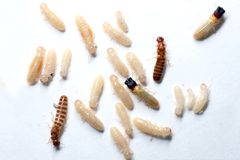
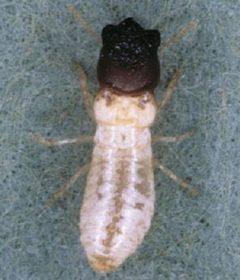
identification relies primarily on soldier , as with other Cryptotermes species. The distinctive hexagonal fecal pellets with six longitudinal ridges and characteristic shape (one rounded end, one tapered end) are diagnostic. Unlike subterranean termites, C. brevis does not construct mud tubes. are often detected by accumulated conical piles of below "kick-out holes" (1–2 mm diameter) in wood surfaces, or by bulging/blistering of wood surfaces in advanced infestations.
Images
Habitat
Strictly associated with dry wood environments. Colonies inhabit seasoned timber, structural lumber, wooden furniture, and wooden containers. Does not require soil contact or external moisture sources. In natural settings, inhabits dead wood; in human-modified environments, thrives in buildings, storage areas, and transported wooden goods.
Distribution
Probable Neotropical origin; first described from Jamaica in 1853 but likely introduced there. Now widely distributed in tropical and subtropical regions worldwide: Caribbean, southeastern United States (Florida, Hawaii), Central and South America, tropical Africa, South Africa, Madagascar, Australia (since 1966), New Zealand, New Caledonia, French Polynesia, Fiji, and parts of Southern Europe (Spain, Portugal, Italy). Frequently introduced to new locations via human transport of infested wood.
Seasonality
occur at night during specific seasons; in Florida, flights occur from April to June. Flight timing varies by geographic location. Colonies persist year-round within wood.
Diet
Cellulose from dry wood. Feeds on both softwood and hardwood timbers, including structural lumber, furniture, wooden crates, and historical wooden objects. Extracts sufficient moisture from wood for survival without external water sources.
Host Associations
- Pinus sp. - feeds onWooden crates used for fruit transport documented in Argentina
- Seasoned timber - inhabitsPrimary for colonies
Life Cycle
Hemimetabolous development with , nymph, and stages. lays kidney-shaped eggs cared for by pseudergates. After several moults, larvae become pseudergates (false ) that perform colony tasks. Some pseudergates develop into nymphs with wing pads, then after three further moults; others become presoldiers with white , then soldiers with black heads after another moult. Colony foundation by pair after : pair sheds wings, enters wood through crack or hole, seals entrance with intestinal secretion, and excavates chamber. First batch cared for by founding pair; subsequent brood reared by developing pseudergates. First soldiers appear in year 2–3; alates develop around year 5. Mature colonies contain 1,000+ individuals and may persist 10+ years.
Behavior
Colonies are strictly contained within single wood pieces or structures; no external foraging. Soldiers use to block galleries against intrusion. Pseudergates excavate galleries while leaving thin surface veneer intact, making cryptic. pushed out through small "kick-out holes" as conical piles. are poor fliers and shed wings shortly after landing. Multiple colonies can coexist in single structures.
Ecological Role
In natural , functions as a decomposer of dead wood. In human-modified environments, acts as a destructive structural pest with significant economic impact. No documented beneficial ecosystem services in invaded ranges.
Human Relevance
Major economic pest causing structural damage to buildings and wooden objects. Damage in the United States exceeds $100 million annually; global costs substantially higher. difficult to detect due to cryptic habit. Control complicated by multiple colonies in single structures and ability to infest small wooden objects (e.g., picture frames). Transported globally via wooden shipping materials and furniture, making it one of the most frequently introduced worldwide.
Similar Taxa
- Cryptotermes primus Australian ; morphologically similar and historically confused with C. brevis in Queensland, complicating survey and efforts
- Other Cryptotermes speciesRequire moister environments and are less destructive in habitations; distinguished by preferences and soldier
- Subterranean termites (Rhinotermitidae)Require soil contact and construct mud tubes; C. brevis lacks these features and has distinct fecal pellet
More Details
Frass characteristics
Fecal pellets are hexagonal in cross-section with six longitudinal ridges, distinctive shape with one rounded and one tapered end. Pellet color varies. These characteristics are used for identification and aging of .
Invasion biology
More frequently introduced to new locations than any other globally. Spread via wooden ships, furniture, and cargo containers. Established on remote oceanic islands demonstrate effective long-distance capability.
Colony detection challenges
A single wooden door was documented containing 20 separate colonies. Objects as small as picture frames can sustain independent colonies, complicating management and efforts.
Sources and further reading
- BugGuide
- Wikipedia
- GBIF taxonomy match
- iNaturalist taxon
- NCBI Taxonomy
- Catalogue of Life
- Name That Bug! | Bug Squad
- Zookeys | Blog - Part 2
- Secrets of the "Subnivium": Arthropod Community Thrives Beneath Winter Snowpack
- Bug of the Week
- Safeguarding Biodiversity: An Entomologist's Goal as Government Policy Analyst
- Cryptotermes brevis . [Distribution map].
- NEW DISTRIBUTION RECORD OF Cryptotermes brevis (ISOPTERA, KALOTERMITIDAE) IN ARGENTINA
- West Indian Drywood Termite Cryptotermes brevis (Walker) (Insecta: Isoptera: Kalotermitidae)
- Potential distribution and cost estimation of the damage caused byCryptotermes brevis(Isoptera: Kalotermitidae) in the Azores
- Potential of Gas-Propelled Aerosol Containing Synergized Pyrethrins for Localized Treatment of Cryptotermes brevis (Kalotermitidae: Blattodea)
- THE EXOTIC DRYWOOD TERMITE CRYPTOTERMES BREVIS (WALKER) (ISOPTERA: KALOTERMITIDAE) AND ENDEMIC AUSTRALIAN DRYWOOD TERMITES IN QUEENSLAND
- Use of Chemical and Colorimetric Changes to Age Cryptotermes brevis Frass for Termite Management.