
Shelfordella lateralis
(Walker, 1868)
Turkestan cockroach, red runner cockroach, rusty red cockroach
Shelfordella lateralis, commonly known as the Turkestan cockroach, is an native to Central Asia that has established in the southwestern United States, Europe, and other regions. It is primarily an outdoor species that inhabits water meter boxes, concrete cracks, compost piles, leaf litter, and sewer systems. The species exhibits : males are winged and capable of , while females have reduced wings. S. lateralis is displacing the oriental cockroach (Blatta orientalis) in many areas of California and the southwestern U.S. due to faster maturation and higher reproductive output. It has become a significant urban pest in some regions and carries - pathogenic bacteria, raising public health concerns.
Pronunciation
How to pronounce Shelfordella lateralis: /ʃɛlˈfɔrdɛlːa læˈtɛrælɪs/
These audio files are automatically generated. While they are not always 100% accurate, they are a good starting point.
Identification
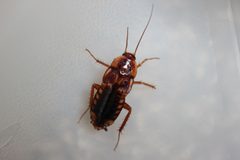
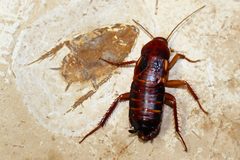
Distinguished from oriental cockroach by cream-colored markings on female wing edges and faster reproductive rate. Males distinguished from American cockroach by smaller size and cream-colored wing stripes. Females recognized by short rounded wings with pale marginal markings. Nymphs identified by dark body with contrasting reddish and .
Images
Appearance
Medium-sized with distinct . Males have yellowish-beige wings with cream-colored stripes along the edges and are capable of . Females have short, rounded wings with cream-colored markings along the edges behind the ; they cannot fly. Nymphs are dark brown to black with reddish heads, , and legs. Body length approximately 20-25 mm. Coloration generally rusty red to dark brown.
Habitat
Primarily outdoor including water meter boxes, cracks in concrete structures, compost piles, leaf litter, potted plants, and sewer systems. Occasionally enters buildings but does not normally reproduce indoors. Prefers warm, dry environments. In urban areas, found on sidewalks at night.
Distribution
Native to Central Asia (Afghanistan, Iran, Iraq, Egypt, Gulf States). Introduced to United States in 1978 at Sharpe Army Depot, California, believed to have arrived on military equipment from Central Asia. Established in California, especially southern California and Central Valley, and spreading throughout southwestern U.S. Also introduced to Europe and Pakistan. Displacing oriental cockroach in many areas.
Seasonality
Active year-round in suitable climates; more active during warm periods. activity pattern.
Life Cycle
Females reach maturity faster than oriental cockroach females and produce more during their lifetime. () produced by females. Nymphs develop through multiple instars before reaching adulthood.
Behavior
. Males fly to lights at night. Does not normally reproduce indoors despite occasional indoor presence. Capable of traveling through sewers and drainpipes.
Ecological Role
and herbivore in outdoor . Prey for various . Gut includes Bacteroidetes, Firmicutes (mainly Clostridia), and Deltaproteobacteria, reflecting evolutionary relationship with .
Human Relevance
Emerging urban pest of public health concern. Carries pathogenic bacteria including - strains (e.g., Helicobacter spp. resistant to eight antibiotics). Mechanical for though transmission not definitively proven. Sold online as food for insectivorous pets. Displacing oriental cockroach in urban environments of southwestern U.S.
Similar Taxa
- Blatta orientalisSimilar size and preference; distinguished by lack of cream wing markings in females and slower reproductive rate
- Periplaneta americanaSimilar male winged form; distinguished by larger size and lack of cream-colored wing stripes
- Blattella germanicaBoth are urban ; distinguished by smaller size, indoor preference, and different coloration
More Details
Invasion history
First detected in United States in 1978 at Sharpe Army Depot, Lathrop, California, likely arriving on military equipment returning from Central Asia. Now established throughout California and spreading.
Competitive displacement
Actively displacing oriental cockroach (Blatta orientalis) in southern California, Central Valley, and other warm, dry parts of the state due to faster maturation and higher .
Public health significance
Study in Quetta, Pakistan found S. lateralis in 37.1% of residences surveyed, with kitchen as most frequent indoor location. Carries - bacteria including Helicobacter spp. resistant to eight of ten antibiotics tested.
Evolutionary significance
Gut studies support close evolutionary relationship between cockroaches and termites, with S. lateralis gut bacteria showing phylogenetic clustering with gut bacteria despite absence of typical termite like Spirochaetes and Fibrobacteres.
Sources and further reading
- BugGuide
- GBIF taxonomy match
- A New Cockroach in Town? | Bug Squad
- The Day That Cockroaches Stole the Show | Bug Squad
- Bug Eric: How Humanity Manufactures Its Own Pests
- Bug Eric: 2019
- Bug Eric: The Black Corsair
- Recent literature – The Coleopterists Bulletin | Beetles In The Bush
- The Bacterial Community in the Gut of the Cockroach Shelfordella lateralis Reflects the Close Evolutionary Relatedness of Cockroaches and Termites
- Spatial distribution of synanthropic cockroaches found in Quetta, Pakistan and antibiotic‐resistant bacteria strains found in Shelfordella lateralis (Walker, 1868) (Blattodea: Blattidae)
- Direct and delayed effect of the plant Cleome amblyocarpa Barratte & Murb (Capparidaceae) on the two species of (Blattodea) Blattella germanica (Linnaeus, 1767) and Shelfordella lateralis (Walker, 1868)