
Jaera
Leach, 1814
Species Guides
1Jaera is a of small marine isopods in the Janiridae, comprising more than 20 described . The genus is notable for the Jaera albifrons , a group of closely related, sympatric species that exhibit fine- partitioning along intertidal shores. These isopods are euryhaline, capable of across wide salinity ranges from freshwater-influenced areas to fully marine conditions. The group has been extensively studied for its ecological differentiation, reproductive isolation, and as a model for understanding speciation processes in marine environments.
Pronunciation
How to pronounce Jaera: /ˈjaɪərə/
These audio files are automatically generated. While they are not always 100% accurate, they are a good starting point.
Identification
Identification to level within Jaera, particularly in the Jaera albifrons complex, requires examination of subtle morphological characters including setation patterns and body proportions. Ecological context aids identification: J. ischiosetosa occurs in freshwater seepage zones, J. albifrons in water-retained pools around mean tide level, J. praehirsuta on Fucus serratus , and J. forsmani in drier areas around low water tide marks. Molecular methods (microsatellites, SNPs) may be necessary to distinguish cryptic species where morphological intermediates occur.
Images
Appearance
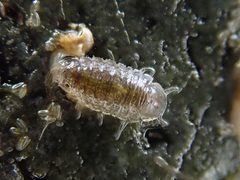
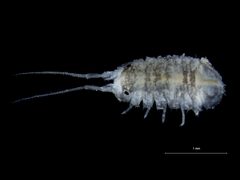
Small, dorsoventrally flattened isopods typical of the suborder Asellota. Body form is compact with seven pairs of legs. in body size is present, with females generally larger than males in many . Specific morphological features distinguishing species within the Jaera albifrons complex include subtle differences in setation patterns and body proportions.
Habitat
Primarily intertidal marine and estuarine environments. within the Jaera albifrons complex exhibit distinct microhabitat preferences: rocky substrates in areas affected by freshwater seepage, stones in tide pools or water-retained areas around mean tide level, Fucus serratus , and under stones in low intertidal zones with limited water retention. The as a whole tolerates wide salinity variation, occurring from estuarine conditions with freshwater influence to fully marine localities.
Distribution
North Atlantic coastal regions including Britain, northwestern Europe, and the Atlantic coast of Canada. Some have broader distributions spanning cold to temperate shores. Jaera tyleri has been recorded from whale bones in the Southern Ocean deep sea, representing an unusual deep-sea occurrence for a otherwise characteristic of shallow intertidal .
Seasonality
Reproductive activity concentrated in spring and summer months. In Jaera ischiosetosa, oogonia enlarge in April, first hatched young appear in June, and continues until August. Females enter a resting stage from September to March, lacking oostegites during this period.
Diet
Detritivorous; feeds on decomposing organic material and associated microalgae including diatoms. Jaera ischiosetosa has been observed feeding on detritus associated with fucoid .
Life Cycle
Direct development without free-living larval stages. Females possess a marsupium (oostegites) for embryos. Juveniles emerge as miniature . are not continuous; females lose oostegites after each brood and must redevelop them. Maximum lifespan approximately one year in at least some .
Behavior
Aggregates in dense clusters under and stones to maintain moisture and avoid desiccation. Exhibits strong microhabitat fidelity, with -specific preferences for particular intertidal zones persisting over multi-year periods. Sexual contributes to reproductive isolation between closely related sympatric species.
Ecological Role
Common and often abundant component of estuarine and intertidal faunas. Functions as a in coastal , processing decomposing organic matter. Serves as prey for various intertidal . The exemplifies fine- ecological partitioning, with multiple coexisting through segregation.
Human Relevance
Studied as a model system for speciation research, particularly regarding the evolution of reproductive isolation and ecological differentiation in sympatry. The Jaera albifrons complex has contributed to understanding of hybridization, , and the genomic architecture of boundaries. No direct economic or medical significance.
Similar Taxa
- Other Janiridae generaShare the asellote body plan and intertidal habits; distinguished by specific morphological features and preferences where known
- IdoteaAnother common intertidal isopod ; Idotea are generally larger, more elongate, and associated with different algal substrates rather than the specific microhabitat partitioning seen in Jaera
More Details
Speciation Research Model
The Jaera albifrons complex is a prominent study system in evolutionary . Research has demonstrated that reproductive isolation varies geographically, from near-complete isolation to introgressive hybridization. Sexual isolation remains strong even in hybridizing , while postzygotic barriers are relatively weak. bacteria have been detected in these . and chromosomal rearrangements appear to limit in genomic regions contributing to species divergence.
Biogeographic Patterns
On the Atlantic coast of Canada, three (J. albifrons, J. ischiosetosa, J. praehirsuta) occur across cold to temperate shores with abundance affected by salinity and exposure, while J. posthirsuta is restricted to warm, shallow waters protected from arctic currents, suggesting a postglacial origin for its disjunct distribution.
Sources and further reading
- BugGuide
- Wikipedia
- iNaturalist taxon
- NCBI Taxonomy
- Catalogue of Life
- The biology of Jaera spp. (Crustacea, Isopoda) in the northwestern Atlantic. 1. Jaera ischiosetosa
- On the ecology of theJaera albifronsgroup (Isopoda)
- Osmoregulation inthe Jaera AlbifronsGroup of Species [Isopoda, Asellota]
- Correction: Shallow-Water Northern Hemisphere Jaera (Crustacea, Isopoda, Janiridae) Found on Whale Bones in the Southern Ocean Deep Sea: Ecology and Description of Jaera tyleri sp. nov
- Shallow-Water Northern Hemisphere Jaera (Crustacea, Isopoda, Janiridae) Found on Whale Bones in the Southern Ocean Deep Sea: Ecology and Description of Jaera tyleri sp. nov
- Quantitative ecological distribution of the Jaera albifrons group of species in the Baltic
- Population Density, Size, Age, Reproduction and Microdistribution in the Jaera albifrons Group (Isopoda)
- Isolement reproductif et architecture génomique de la différenciation chez deux espèces du complexe Jaera albifrons (isopodes marins) - Etude de populations mixtes présentant des niveaux d'isolement interspécifique contrastés
- Sexual behaviour and evolution of sexual dimorphism in body size in Jaera (Isopoda Asellota)
- Decision Revise: Sex chromosomes and chromosomal rearrangements are key to behavioural sexual isolation in Jaera albifrons marine isopods. Round#1
- Review of: Sex chromosomes and chromosomal rearrangements are key to behavioural sexual isolation in Jaera albifrons marine isopods. Round#1/Reviewer#1
- Review of: Sex chromosomes and chromosomal rearrangements are key to behavioural sexual isolation in Jaera albifrons marine isopods. Round#2/Reviewer#2
- Review of: Sex chromosomes and chromosomal rearrangements are key to behavioural sexual isolation in Jaera albifrons marine isopods. Round#1/Reviewer#2
- Biogeography of the Jaera albifrons superspecies (Isopoda, Asellota) on the Atlantic coast of Canada
- Habitat Preferences and Interspersion of Species within the Superspecies Jaera albifrons Leach (Crustacea: Isopoda)