Jaera albifrons
Leach, 1814
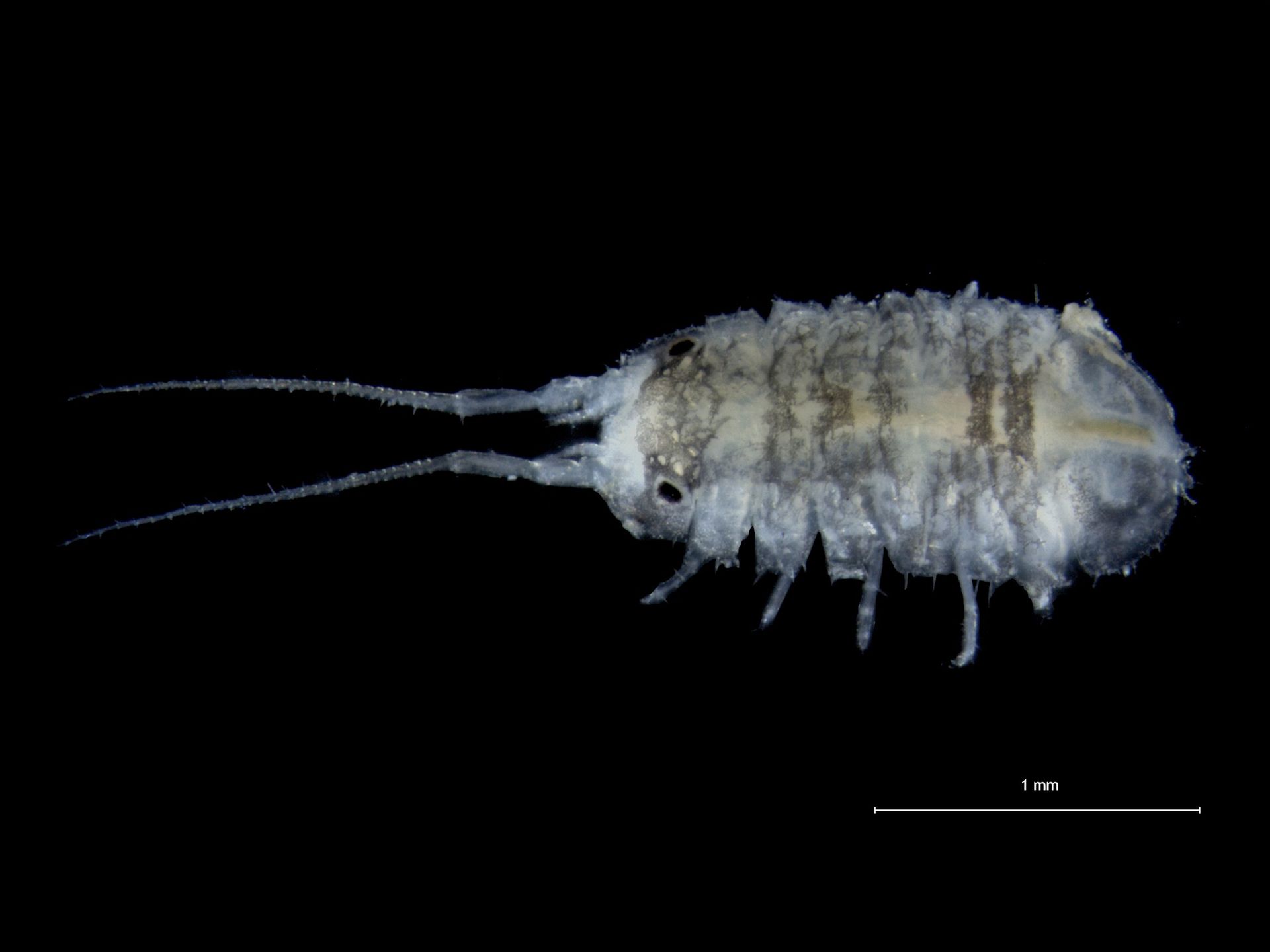
Jaera albifrons is a marine isopod in the Janiridae, part of a group of four British members that are common components of estuarine faunas. The species occupies specific microhabitats on stones in pools or water-retained areas around mean tide level. It is euryhaline, capable of surviving in wide ranges of salinity from variable estuarine conditions to stable marine environments. The species shows persistent preferences and can successfully reproduce under fluctuating conditions of salinity, temperature, and air exposure. It is found in Europe and North America, with studied extensively in Britain and the Atlantic coast of Canada.
Pronunciation
How to pronounce Jaera albifrons: //ˈdʒaɪərə ælˈbɪfrɒnz//
These audio files are automatically generated. While they are not always 100% accurate, they are a good starting point.
Identification
Males are distinguished by secondary sexual characters; females and juveniles cannot be reliably separated from other members of the Jaera albifrons group without examination of male specimens. The four British in this group (J. albifrons, J. ischiosetosa, J. praehirsuta, and J. forsmani) show overlapping ecological distributions and require careful sampling to ensure single-species for study. J. albifrons can be found mixed with J. ischiosetosa, particularly when stream dry in summer.
Images
Habitat
Estuarine shores on stones in pools or areas where water is retained around mean tide level (M.t.l.); also occurs in less variable marine localities. Shows strong microhabitat specificity with persistent preferences over multi-year periods.
Distribution
Europe (including Britain, France, Baltic region) and North America (Atlantic coast of Canada). In Canada, occurs from cold to temperate shores along the entire Atlantic coast.
Seasonality
Gravid females present every month with breeding peaks in spring and summer. Young liberated throughout the year with summer peaks.
Life Cycle
Breeding occurs year-round with spring and summer peaks. Juveniles released throughout the year, with summer peaks. Development successful under characteristic patterns of fluctuating salinity, temperature, and air exposure.
Behavior
Occupies persistent microhabitat on stones in pools or water-retained areas; shows stable preferences over 2-year periods. Sexual isolation is a strong reproductive barrier between sympatric in this group.
Ecological Role
Common component of estuarine faunas, often occurring in considerable numbers. Part of a group that collectively contributes significantly to intertidal structure in estuarine systems.
Similar Taxa
- Jaera ischiosetosaOverlapping ecological distribution; occurs on stones in areas affected by freshwater seepage. Hybrids with J. albifrons have been documented, though rare (1 hybrid in 6,214 specimens).
- Jaera praehirsutaOccurs on Fucus serratus rather than stones; has patchy distribution and more limited summer period for release; sex ratio remains stable at ~1.5:1 unlike J. albifrons.
- Jaera forsmaniFound under stones around low water spring tide to low water neap tide where little water is retained; consistently largest in group with restricted geographical distribution.
More Details
Reproductive isolation
Strong sexual isolation maintains boundaries between J. albifrons and J. praehirsuta where they coexist in sympatry, even in showing introgressive hybridization. and chromosomal rearrangements contribute to behavioral sexual isolation.
Population structure
Sex ratio of males to females is never 1:1; females outnumber males by up to 14:1, with ratio varying throughout the year.
Taxonomic status
Treated as a within the Jaera albifrons superspecies or species group; some sources list as synonym or complex due to close relationships with other group members.
Sources and further reading
- BugGuide
- Wikipedia
- GBIF taxonomy match
- iNaturalist taxon
- NCBI Taxonomy
- Catalogue of Life
- A Summit to Save the Butterflies | Bug Squad
- Encyrtid Holdings | Entomology Research Museum
- The Brilliance of Brownfields - Buglife Blog - Buglife
- On the ecology of theJaera albifronsgroup (Isopoda)
- Osmoregulation inthe Jaera AlbifronsGroup of Species [Isopoda, Asellota]
- Population Density, Size, Age, Reproduction and Microdistribution in the Jaera albifrons Group (Isopoda)
- Quantitative ecological distribution of the Jaera albifrons group of species in the Baltic
- Habitat Preferences and Interspersion of Species within the Superspecies Jaera albifrons Leach (Crustacea: Isopoda)
- Isolement reproductif et architecture génomique de la différenciation chez deux espèces du complexe Jaera albifrons (isopodes marins) - Etude de populations mixtes présentant des niveaux d'isolement interspécifique contrastés
- Review of: Sex chromosomes and chromosomal rearrangements are key to behavioural sexual isolation in Jaera albifrons marine isopods. Round#1/Reviewer#1
- Decision Revise: Sex chromosomes and chromosomal rearrangements are key to behavioural sexual isolation in Jaera albifrons marine isopods. Round#1
- Review of: Sex chromosomes and chromosomal rearrangements are key to behavioural sexual isolation in Jaera albifrons marine isopods. Round#2/Reviewer#2
- Review of: Sex chromosomes and chromosomal rearrangements are key to behavioural sexual isolation in Jaera albifrons marine isopods. Round#1/Reviewer#2
- Biogeography of the Jaera albifrons superspecies (Isopoda, Asellota) on the Atlantic coast of Canada
- Review of: Sex chromosomes and chromosomal rearrangements are key to behavioural sexual isolation in Jaera albifrons marine isopods. Round#2/Reviewer#1
- Recommendation of: Sex chromosomes and chromosomal rearrangements are key to behavioural sexual isolation in Jaera albifrons marine isopods. Round#2
- Breeding and bionomics of the British members of the Jaera albifrons group of species (Isopoda: Asellota)
- Microgeographic genetic differentiation in the intertidal isopod Jaera albifrons Leach. I. Spatial distribution of allozyme variation