
Janiridae
G. O. Sars, 1897
Genus Guides
2Janiridae is a globally distributed of marine isopods in the suborder Asellota, comprising over 170 across approximately 23 . The family exhibits remarkable bathymetric range, from intertidal zones to hadal depths exceeding 6,000 meters. Most species inhabit shallow shelf waters within 100 meters depth, though several genera have colonized deep-sea environments including whale falls, hydrothermal vents, and abyssal plains. The genus *Jaera*, predominantly northern hemisphere in distribution, includes the notable deep-sea *Jaera tyleri*, discovered on whale bones in the Southern Ocean at 1,445 meters depth—the first *Jaera* species documented in the southern hemisphere. Janiridae demonstrates broad environmental to salinity, temperature, and oxygen stress.
Pronunciation
How to pronounce Janiridae: /d͡ʒænɪˈrɪdiː/
These audio files are automatically generated. While they are not always 100% accurate, they are a good starting point.
Identification
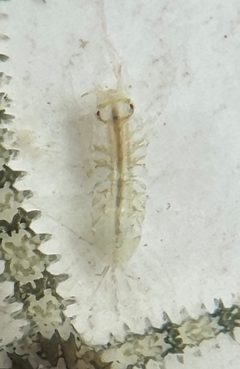
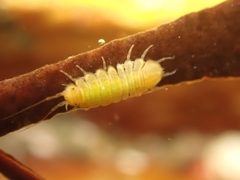
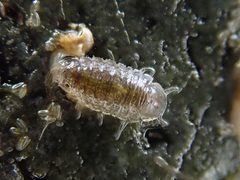
Janiridae can be distinguished from other asellote by the combination of: body dorsoventrally flattened with distinct segmentation; typically well-developed; uropods positioned terminally on the pleotelson; and male first pleopod modified as a copulatory structure. The *Jaera* is characterized by small body size and specific antennal segmentation. Deep-sea such as *Janiralata* exhibit reduced or complete eyelessness. Species-level identification requires examination of male pleopod 1 , particularly the shape of the articles and presence of setal patterns. The anterolateral and distolateral projections on the and pleotelson serve as diagnostic features for *Janiralata* species.
Images
Habitat
Marine environments spanning intertidal zones to hadal depths. The majority of occupy shallow waters within 100 meters depth on continental shelves. Specific include: rocky intertidal substrates; estuarine systems; salt springs; anchialine caves; soft sediments in bathyal and abyssal zones; and specialized deep-sea habitats including whale carcasses and hydrothermal vent peripheries. Some species of *Janiralata* associate with including sea anemones (Hormathiidae) and asteroids (*Crossaster borealis*).
Distribution
Circumglobal distribution from Arctic to Antarctic waters, occurring in Atlantic, Indian, and Pacific Oceans. Shallow-water diversity is concentrated in temperate and regions. The *Jaera* is primarily distributed in the northern hemisphere, with *Jaera tyleri* representing the sole documented southern hemisphere occurrence at 59°41.6'S, 28°21.1'W in the Kemp Caldera, Southern Ocean. Records from Nordic countries (Denmark, Norway, Sweden) indicate established in northeastern Atlantic and adjacent seas.
Diet
Shallow-water and intertidal are herbivores and grazers, consuming seaweed, dead wood, and bacterial films. Feeding strategies of deep-water species remain unknown.
Life Cycle
Development proceeds through distinct morphological stages: Manca I (6 pereomeres, 6 legs, tiny 7th pereonite); Manca II (small 7th pereonite, short 7th leg); male (short, undeveloped 1st pleopod); mature male (fully developed 1st pleopod); immature female (1st pleopod absent, 2nd pleopod formed as , no oostegites); mature female (oostegites present); and ovigerous female ( carried in pouch). exhibit multimodal structure with continuous breeding activity throughout the year. is low, consistent with patterns observed in polar and small-bodied isopods.
Behavior
Some demonstrate strong fidelity: *Jaera tyleri* densely colonizes whale bones and is absent from adjacent habitats, indicating specialization to whale-fall . Members of the *Janiralata* exhibit facultative associations with benthic , attaching to sea anemones and asteroids. The demonstrates broad physiological to environmental stressors including salinity variation, temperature extremes, and hypoxia. Genetic studies of *Janiralata plana* indicate limited ability with genetic structure detectable over relatively narrow geographic despite wide bathymetric ranges.
Ecological Role
In shallow marine systems, Janiridae functions as primary consumers and , processing algal material and microbial films. In deep-sea whale-fall , *Jaera tyleri* participates in enrichment-opportunistic or sulphophilic successional stages, contributing to bone degradation and nutrient cycling. Symbiotic associations of *Janiralata* with echinoderms and cnidarians represent poorly characterized interactions that may involve cleaning or commensalism.
Similar Taxa
- AsellidaeOverlaps in suborder Asellota and general body plan; distinguished by uropod position and pleopod , with Asellidae typically lacking the terminal uropod placement and specific male pleopod 1 structure of Janiridae.
- MunnidaeAnother asellote with dorsoventrally flattened body form; separated by differences in antennal peduncle structure, pleotelson shape, and details of pereopod .
More Details
Taxonomic Diversity
The contains approximately 23 and 174 described , making it among the more species-rich families in Asellota. Generic diversity includes both shallow-water (*Jaera*) and deep-sea radiations (*Janiralata*).
Deep-Sea Colonization
Only 5 of 23 contain exceeding 1,000 meters depth, indicating that deep-sea has occurred independently in limited lineages. Maximum recorded depth exceeds 6,000 meters in some species.
Phylogeographic Patterns
Molecular data from *Janiralata plana* reveal genetic differentiation over small spatial (neighboring sites share haplotypes), suggesting that limitation and local shape structure in deep-sea janirids.
Sources and further reading
- BugGuide
- Wikipedia
- GBIF taxonomy match
- iNaturalist taxon
- NCBI Taxonomy
- Catalogue of Life
- Shallow-Water Northern Hemisphere Jaera (Crustacea, Isopoda, Janiridae) Found on Whale Bones in the Southern Ocean Deep Sea: Ecology and Description of Jaera tyleri sp. nov
- Correction: Shallow-Water Northern Hemisphere Jaera (Crustacea, Isopoda, Janiridae) Found on Whale Bones in the Southern Ocean Deep Sea: Ecology and Description of Jaera tyleri sp. nov
- A new species of Janiralata Menzies, 1951 (Isopoda: Janiridae) from Japanese bathyal waters, with a review of the associations with invertebrates among the species of Janiralata