
Carpias
Richardson, 1902
Species Guides
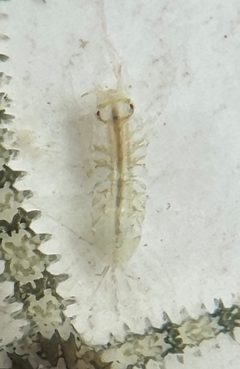
1- Carpias minutus(Sargasso Witcher)
Carpias is a of small marine isopods in the Janiridae, established by Richardson in 1902. Members of this genus belong to the suborder Asellota, a diverse group of mostly benthic crustaceans. The genus contains multiple described found in marine environments. Records of this genus in biodiversity databases remain limited, with few documented observations.
Pronunciation
How to pronounce Carpias: //ˈkɑr.pi.əs//
These audio files are automatically generated. While they are not always 100% accurate, they are a good starting point.
Identification
Carpias can be distinguished from other Janiridae by characteristics of the male reproductive appendages (pleopods), particularly the structure of the pleopod 1 endopod and exopod. Asellote isopods generally exhibit reduced or modified pleopods compared to other isopod groups. Specific diagnostic features for the genus include details of segmentation and pereopod , though species-level identification requires examination of fine structural characters.
Images
Habitat
Marine benthic environments, typically in coastal or continental shelf sediments. Members of the Janiridae are predominantly sublittoral, occurring in soft-bottom .
Distribution
Marine waters; specific distribution records are sparse but include localities in the North Atlantic region. The has been documented from depths ranging from shallow coastal areas to deeper shelf zones.
Ecological Role
As benthic or scavengers, members of this likely contribute to nutrient cycling in marine sediment . Their role in is presumed similar to other small asellote isopods, serving as prey for larger and small fish.
Similar Taxa
More Details
Taxonomic History
The was established by Harriet Richardson in her 1902 monograph on isopods. Asellote isopods, including Carpias, have historically been understudied due to their small size and deep-water or sediment-dwelling habits. Modern molecular has begun to clarify relationships within Janiridae, though many genera remain poorly sampled.