
Talitroides alluaudi
(Chevreux, 1896)
Alluaudi's landhopper
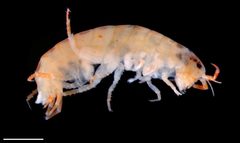
A terrestrial amphipod (landhopper) native to the Atlantic forests of southeastern Brazil, now distributed worldwide through human-mediated . Found in leaf litter of tropical and subtropical forests, urban parks, greenhouses, and silviculture areas. Females dominate with a strongly female-biased sex ratio observed in field . Exhibits highly stereotyped for hygiene maintenance.
Pronunciation
How to pronounce Talitroides alluaudi: /ˌtælɪˈtrɔɪdiːz ˌæljʊˈɔːdi/
These audio files are automatically generated. While they are not always 100% accurate, they are a good starting point.
Identification
Distinguished from the sympatric T. topitotum by subtle morphological differences; examination of gnathopod 2 shows no in this (unlike some ). Females possess oostegites on pereopods 3–5. Detailed identification requires examination of appendage and body proportions; less common than T. topitotum in Brazilian Atlantic forest surveys.
Images
Habitat
Atlantic forest leaf litter in native range; occupy urban parks, greenhouses, silviculture areas, and disturbed terrestrial environments. Soil-dwelling in terrestrial microhabitats with adequate moisture and organic matter.
Distribution
Native to Atlantic rain forests of southeastern Brazil (Rio de Janeiro, São Paulo, Minas Gerais, Paraná, Santa Catarina, Rio Grande do Sul). Introduced worldwide to tropics, subtropics, and warm temperate regions via . Documented in Belgium and other regions outside native range.
Diet
Detritivorous; feeds on decaying organic matter in soil and leaf litter.
Life Cycle
Developmental stages include juveniles and ; ovigerous females carry in pouches formed by oostegites. Sex ratio strongly female-biased in examined material (4 males, 41 females, 12 ovigerous).
Behavior
Highly stereotyped consisting of antennal grooming, body grooming, and limb cleaning sequences performed in specific order. Grooming serves critical hygiene functions for soil-dwelling lifestyle. or cryptic activity patterns typical of soil-dwelling amphipods.
Ecological Role
Decomposer; contributes to nutrient cycling and breakdown of organic matter in forest floor and soil .
Human Relevance
spread globally through human activity; established in greenhouses, urban parks, and agricultural settings. No documented direct economic impact; presence indicates disturbed or modified terrestrial .
Similar Taxa
- Talitroides topitotumSympatric in Brazilian Atlantic forests; T. alluaudi is less common and differs in subtle morphological features of gnathopods and body proportions.
- Other Talitroides speciesRequires examination of appendage , body shape, and male secondary sexual characteristics for accurate identification.
Sources and further reading
- BugGuide
- GBIF taxonomy match
- iNaturalist taxon
- NCBI Taxonomy
- Catalogue of Life
- Meloidae Holdings | Entomology Research Museum
- Plagiolepis alluaudi forager scouting a plant - Entomology Today
- Plagiolepis alluaudi forager on hibiscus flower - Entomology Today
- Group of Plagiolepis alluaudi feeding - Entomology Today
- Plagiolepis alluaudi with U.S. penny for scale - Entomology Today
- Talitroides Archives - Entomology Today
- The Grooming Behavior of the Terrestrial Amphipod Talitroides Alluaudi
- Taxonomy and distribution of Talitroides alluaudi (Chevreux, 1896) and T. topitotum (Burt, 1934) (Amphipoda, Talitridae) in Atlantic rain forests of southeastern Brazil