
Hyperiidea
H. Milne Edwards, 1830
hyperiid amphipods
Family Guides
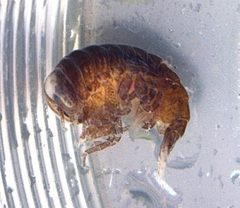
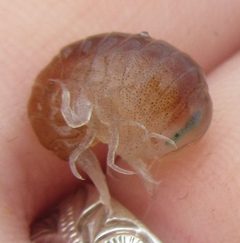
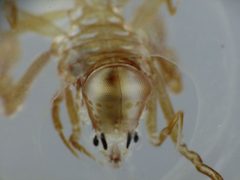
2Hyperiidea is a suborder of exclusively marine amphipod crustaceans characterized by large and a planktonic lifestyle. Unlike other amphipod suborders, they do not occur in freshwater. The group comprises approximately 284 across 20-23 . Most species are associated with gelatinous zooplankton as or of salps and jellyfish, though some members such as Themisto gaudichaudii are free-swimming predators of copepods and other small planktonic animals.
Pronunciation
How to pronounce Hyperiidea: /ˌhaɪpəˈrɪdiːə/
These audio files are automatically generated. While they are not always 100% accurate, they are a good starting point.
Images
Habitat
Exclusively marine; planktonic. occupy pelagic zones from surface waters to depths exceeding 1500 m. Some species show distinct vertical patterns, moving from surface waters (0-50 m) as juveniles to daytime depths of 100-300 m as . Temperature preferences vary: some species are restricted to cold Arctic waters (<8°C), while others prefer warm waters (>25°C) of relatively high salinity (>35).
Distribution
in marine waters worldwide. Documented from the Southern Ocean (69 ), Greenland Sea, Alaskan coastal waters (56°N to 70°N), Gulf of California, western Mexico, southern Gulf of Mexico, northern Queensland waters, and the Mediterranean Sea. Species distributions often correlate with water mass characteristics, with some serving as indicators for Atlantic, Arctic, or warm-temperate waters.
Seasonality
Activity patterns vary by and region. In northern Queensland waters, hyperiids were generally most abundant during October-December and April-July. Some species reproduce year-round with seasonal peaks, while others show more restricted breeding periods.
Diet
Most are or of gelatinous zooplankton, particularly salps and medusae. Free-swimming predatory species such as Themisto gaudichaudii and Parathemisto species feed primarily on calanoid copepods (approximately 50% of diet) and compound-eyed crustaceans including euphausiids and other amphipods (approximately 30%). has been observed, with higher in some species.
Host Associations
- Salpida - /Most hyperiid are or of salps
- Medusae - / Brachyscelidae preferentially associated with medusae
- Copepoda - Free-swimming such as Themisto and Parathemisto feed on calanoid copepods
- Euphausiacea - Prey for predatory hyperiids including Parathemisto
Life Cycle
Development includes direct development without larval stages; females carry and young in a pouch. duration varies: some such as Parathemisto libellula complete a 1-year life cycle with broods released in early May, while others such as P. pacifica reproduce year-round with times of 6-12 weeks depending on season. Juveniles typically occur in surface waters (0-50 m) and undergo vertical to deeper daytime depths as they grow.
Behavior
Vertical is a prominent : juveniles inhabit surface waters and migrate to deeper daytime depths (100-300 m) as they mature. Some show diel vertical migration patterns. Metabolic adaptations to salinity changes may maintain constant metabolic rates during vertical movement. occurs in some species.
Ecological Role
Significant in pelagic , consuming copepods, euphausiids, and other crustaceans. Serve as for water mass identification: Themisto compressa indicates southern Atlantic water, while T. abyssorum and T. libellula are associated with Arctic and -subarctic waters. Facilitate year-round pressure on zooplankton through seasonal partitioning among congeneric .
Sources and further reading
- BugGuide
- Wikipedia
- iNaturalist taxon
- NCBI Taxonomy
- Catalogue of Life
- Pelagic amphipods (Crustacea: Amphipoda: Hyperiidea) in western Mexico. 2. Family Eupronoidae
- ECOLOGY OF PARATHEMISTO LIBELLULA AND P. PACIFICA (AMPHIPODA: HYPERIIDEA) IN ALASKAN COASTAL WATERS
- Verbreitung von Makrozooplankton in der Grönlandsee im Spätherbst 1988 (Crustacea: Ostracoda, Hyperiidea [Amphipoda], Euphausiacea) The distribution of macrozooplankton in the Greenland Sea in late autumn 1988 (Crustacea: Ostracoda, Hyperiidea [Amphipoda], Euphausiacea)
- Development and Reproduction of Parathemisto Gracilipes (Norman) (Amphipoda, Hyperiidea) in the North Sea
- Pelagic amphipods (Crustacea: Amphipoda: Hyperiidea) in western Mexico. 3. Family Lestrigonidae
- OBSERVATIONS ON THE ANATOMY AND BEHAVIOR OF PHRONIMA SEDENTARIA (FORSKAL) (AMPHIPODA: HYPERIIDEA)
- Observations on the Anatomy and Behavior of Phronima sedentaria (Forskal) (Amphipoda: Hyperiidea)
- Distribution and abundance of some Hyperiidea (Crustacea : Amphipoda) in Northern Queensland Waters
- Pelagic amphipods (Crustacea: Amphipoda: Hyperiidea) in western Mexico. 7. Superfamily Platysceloidea. Family Oxycephalidae
- A review of the hyperiidean amphipod family Brachyscelidae Stephensen, 1923 (Crustacea: Amphipoda: Hyperiidea)
- Vertical distribution of Themisto gaudichaudii (Amphipoda: Hyperiidea) in Deepwater Dumpsite106 off the mouth of Delaware Bay
- Pelagic amphipods (Crustacea, Amphipoda, Hyperiidea) from the southern Gulf of Mexico with notes on the distribution of species.