
Palaemon elegans
Rathke, 1837
rockpool shrimp, rockpool prawn
Palaemon elegans is a small caridean shrimp native to northeastern Atlantic and Mediterranean coastal waters. It has expanded its range through human-mediated transport and changing environmental conditions, becoming established in the Baltic Sea, Caspian Sea, and Aral Sea. The is ecologically similar to several , particularly Palaemon adspersus, with which it competes and has displaced in some regions. Its of variable salinity has facilitated of brackish environments.

Pronunciation
How to pronounce Palaemon elegans: /pəˈliːmɒn ˈɛlɪɡænz/
These audio files are automatically generated. While they are not always 100% accurate, they are a good starting point.
Identification
Distinguished from Palaemon serratus by smaller size and less robust chelipeds; from Palaemon longirostris by shorter rostrum; from Palaemon adspersus by subtle morphological differences requiring close examination. In the Azov Sea, non-commercial size individuals comprise less than 7% of catches. Molecular methods may be required for definitive identification where ranges overlap with similar .
Images
Appearance
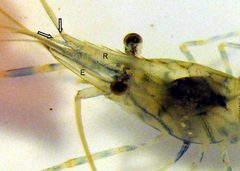
Small shrimp with typical palaemonid body plan: laterally compressed , long rostrum, and slender . Total body length in commercial catches ranges 2.3–5.3 cm. Coloration variable, generally translucent with greenish or brownish tints. Rostrum extends forward between . Antennal well developed. legs slender; chelipeds relatively small compared to some .
Habitat
Coastal marine and estuarine including rocky shores, tide pools, and vegetated areas. Tolerates wide salinity range, facilitating occurrence in brackish waters. Found in intertidal zones to shallow subtidal depths. In the Azov Sea, exploits increasing salinity conditions that have created favorable habitat where previously unsuitable.
Distribution
Native to eastern North Atlantic from Norway to Macaronesia, Baltic Sea, Mediterranean Sea, and Black Sea. Introduced and established in Caspian Sea and Aral Sea. Range expanding northward in Baltic; first recorded in Estonian coastal waters in 2011 with subsequent rapid across multiple basins. Present in Azov Sea as salinity increased. established in parts of the United States.
Diet
scavenger and opportunistic feeder. Consumes small , detritus, and . Engages in food competition with , particularly Palaemon macrodactylus where introduced ranges overlap; subordinate to this in aggressive encounters.
Life Cycle
with separate sexes. Mature females documented in newly colonized Estonian within first month of detection, indicating rapid reproductive establishment. Larval development via planktonic stages typical of caridean shrimp; specific details of larval duration and settlement cues not documented in available sources.
Behavior
Displays consistent individual behavioral differences (
Ecological Role
Native competitor in northeastern Atlantic and Mediterranean benthic . Functions as and scavenger in shallow coastal . Subject to aggressive displacement and food competition from Palaemon macrodactylus. In Azov Sea, has become major fishing target as traditional fish stocks declined.
Human Relevance
Commercial fishery target in Azov Sea with catches reaching 445 tonnes annually; 147-fold increase from 2015 to 2024 following salinity changes. Recommended catch realization at 79–81%. Considered in parts of United States. Used as comparative model in sensory physiology research.
Similar Taxa
- Palaemon serratusOverlapping distribution; distinguished by larger size and more robust chelipeds
- Palaemon longirostrisSimilar preferences; distinguished by longer rostrum
- Palaemon adspersusEcologically similar with which P. elegans competes and has displaced in some regions; subtle morphological differences require careful examination
- Palaemon macrodactylus that aggressively dominates P. elegans in food competition and may displace it
More Details
Rapid colonization capacity
Documented establishment of breeding in Estonian coastal waters within one month of first detection in 2011, with simultaneous high- occurrence across four separate water basins.
Sensory physiology research
Used as coastal comparison in studies of chemosensory and thermosensory adaptations, contrasting with deep-sea hydrothermal vent shrimp Mirocaris fortunata.
Thermal stress response
Exhibits distinct physiological, cellular and biochemical thermal stress responses compared to vertically segregated Palaemon serratus in intertidal .
Sources and further reading
- BugGuide
- Wikipedia
- GBIF taxonomy match
- iNaturalist taxon
- NCBI Taxonomy
- Catalogue of Life
- Bring on the Tourists! | Bug Squad
- More Nematodes in Outer Space? | Bug Squad
- Showcasing Animal and Plant Parasitic Nematodes | Bug Squad
- Don't Miss the Nematode Collection at UC Davis Biodiversity Museum Day Feb. 10 | Bug Squad
- Bug Eric: Wasp Wednesday: Steniolia elegans
- Uncategorized | Blog - Part 18
- Status of the Black Sea shrimp (Palaemon adspersus, Palaemon elegans) fishery in the Azov Sea
- Interspecific Aggression and Food Competition between the Global Invader Palaemon macrodactylus and the Native Palaemon elegans
- Physiological, cellular and biochemical thermal stress response of intertidal shrimps with different vertical distributions: Palaemon elegans and Palaemon serratus
- Sensory adaptations in shrimp from deep hydrothermal vents : Comparison of chemo‐ and thermo-sensory abilities in the vent species Mirocaris fortunata and the coastal species Palaemon elegans
- Zinc flux in Palaemon elegans (Crustacea: Decapoda): moulting, individual variation and tissue distribution
- Sex and the Syndrome: Individual and Population Consistency in Behaviour in Rock Pool Prawn Palaemon elegans
- The first finding of the palaemonid shrimp Palaemon elegans Rathke in the Estonian coastal sea; pp. 148–153