
Uroctonus mordax
Thorell, 1876
California forest scorpion, western forest scorpion
Uroctonus mordax is a small in the Vaejovidae, to the coastal forests of California and extending into western Oregon and southern Washington. It is strongly associated with Redwood Forests and Oak Woodlands, where it occupies a foundational ecological role. The species exhibits distinctive physical traits including a squat body, slender tail, and sexually dimorphic coloration. It is notable for its mild venom and reclusive, .
Pronunciation
How to pronounce Uroctonus mordax: //jʊˈɹɒktənəs ˈmɔːrdæks//
These audio files are automatically generated. While they are not always 100% accurate, they are a good starting point.
Identification
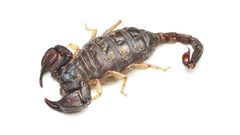
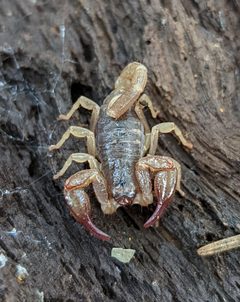
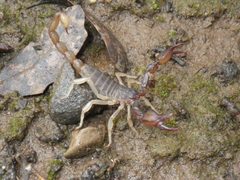
Distinguished from other scorpions by a squat body with a proportionally slender tail. are typically dark brown to black with translucent yellowish-brown legs. Males are smaller, shorter, and exhibit duller coloration than females. The fifth metasomal segment possesses a carina that forks into a 'Y' shape—a diagnostic character. Body size is notably small, described as smaller than a human pinky finger.
Images
Habitat
Restricted to moist forest environments, primarily California's Redwood Forests and Oak Woodlands. Occurs at elevations from 5 to 2000 meters. Strongly associated with south or west-facing slopes. Shelters under rocks, logs, bark, and dead trees on the ground surface. Requires higher moisture levels than most .
Distribution
to the Pacific coastal region of North America. Core range is the San Francisco Bay Area, California. Extends northward to western Oregon and southern Washington.
Seasonality
Primarily active on moonless nights. Births occur predominantly during summer months.
Diet
Preys on small ground-dwelling . Specific dietary items have not been documented.
Life Cycle
Gives birth to live young at an earlier developmental stage than many scorpions. are enveloped in a birth ; the mother holds this membrane until young can escape. Upon , young climb directly to the mother's back without their legs touching the ground. Duration of maternal carrying and subsequent development stages have not been documented.
Behavior
Strictly and highly reclusive. Hunts primarily on moonless nights. When encountered, individuals most frequently exhibit escape rather than defensive postures.
Ecological Role
Considered a foundational in Redwood Forest and Oak Woodland . Functions as a of small . Specific ecosystem contributions beyond have not been documented.
Human Relevance
Venom is milder than a honeybee sting, posing minimal medical risk to humans. Occasionally encountered by forest visitors and researchers. Not known to be kept in captivity or used commercially.
Similar Taxa
- Anuroctonus pocockiBoth are small, dark-colored scorpions in California forests, but A. pococki possesses a distinctive swollen bulb absent in U. mordax.
- Pseudouroctonus speciesRelated vaejovid scorpions in California, but U. mordax is distinguished by its 'Y'-shaped carina on the fifth metasomal segment and association with moist coastal forests rather than drier inland .
Sources and further reading
- BugGuide
- Wikipedia
- GBIF taxonomy match
- iNaturalist taxon
- NCBI Taxonomy
- Catalogue of Life
- Meet Awesome Annie, the Scorpion, at UC Davis Biodiversity Museum Day | Bug Squad
- A winter longhorned beetle | Beetles In The Bush
- Uncategorized | Blog - Part 12
- The unexpected one: A new pale nectar-feeding bat species found in Brazil | Blog
- California | Blog
- High school students help describe two new scorpion species