
Anuroctonus pococki
Soleglad & Fet, 2004
California Swollenstinger Scorpion, California swollen-stinger scorpion
Species Guides
2- Anuroctonus pococki bajae(Californian swollen stinger scorpion)
- Anuroctonus pococki pococki(Californian swollen stinger scorpion)
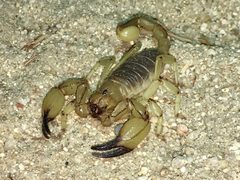
Anuroctonus pococki is a large reaching 65 mm in length, distinguished by a swollen region on the just before the stinger—most prominent in mature males—and large black-tipped . Native to the Coast Ranges of Southern California and Baja California, it is the only member of its found in Baja California. First described in 2004, this ambush constructs burrows and exhibits mildly venomous stings that are typically painful but non-serious.
Pronunciation
How to pronounce Anuroctonus pococki: /ˌæn.jʊˈrɑk.tə.nəs poʊˈkɒˌkaɪ/
These audio files are automatically generated. While they are not always 100% accurate, they are a good starting point.
Identification
Distinguished from other regional scorpions by the prominent swollen region on the immediately before the stinger, particularly visible in mature males. The combination of large body size (65 mm), large black-tipped , and this telson swelling separates it from smaller sympatric . The only member of Anuroctonus in Baja California.
Images
Appearance
Large reaching approximately 65 mm (2.6 in) in length. Possesses very large (claws) with black tips. Most distinctive feature is a swollen, bulb-like region on the (stinger-bearing tail segment) just to the stinger, which is most pronounced in mature males. fluoresces blue-green under ultraviolet light, as characteristic of scorpions.
Habitat
Coastal mountain ranges; occupies burrows in soil. Females construct deeper burrows up to 60 cm underground, while male burrows are shallower at 15–20 cm depth. Hides under stones, logs, or boards during daylight hours.
Distribution
Native to the Coast Ranges of Southern California, USA, extending into Baja California, Mexico. The sole Anuroctonus present in Baja California.
Diet
; preys on ground-dwelling insects and other small animals. In captivity, has been observed to strike crickets and immediately upon presentation.
Life Cycle
Females produce 20–30 live young. Young scorpions are carried on the female's back for 5–15 days after birth. generally live 2–3 years and do not begin reproducing until approximately one year of age.
Behavior
ambush that waits in burrows for passing prey. Exhibits aggressive predatory , striking prey items rapidly. Has been observed attacking water when poured into enclosure. Constructs and occupies permanent burrows.
Ecological Role
of ground-dwelling arthropods and small .
Human Relevance
Mildly venomous; stings are rare, usually painful but resolve within 24 hours. Stings may pose serious health risks to very young or elderly individuals, warranting medical attention. Occasionally enters homes in new housing developments that encroach upon natural . Displayed in educational settings (e.g., UC Davis Biodiversity Museum Day).
Similar Taxa
- Centruroides spp.Other in the region lack the distinctive swollen region and are generally smaller
- Arizona bark scorpion (Centruroides sculpturatus)More venomous and medically significant; lacks the swollen and large black-tipped of A. pococki
More Details
Taxonomic History
First formally described by Soleglad & Fet in 2004. Contains two recognized : A. p. pococki and A. p. bajae.
Fluorescence
Like all scorpions, exhibits bright blue-green fluorescence under ultraviolet light due to compounds in the , facilitating detection.