
Diplocentrus
Peters, 1861
Toothed Scorpions
Species Guides
5- Diplocentrus diablo
- Diplocentrus lindo(Trans-Pecos Twinspine Scorpion)
- Diplocentrus peloncillensis
- Diplocentrus spitzeri(Ruby Rock Scorpion)
- Diplocentrus whitei(Big Bend Scorpion)
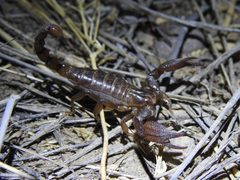
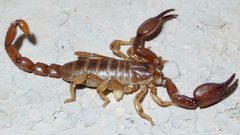
Diplocentrus is a of scorpions in the Diplocentridae, commonly known as toothed scorpions. The genus contains more than 60 described distributed primarily in Central America, Mexico, and the southwestern United States. Species in this genus are characterized by their elongated and distinctive tooth-like structures on the . The genus includes both mainland and island-dwelling species, with documented occurrences in the Chisos Mountains of Texas and Islas de la Bahía in Honduras.
Pronunciation
How to pronounce Diplocentrus: //ˌdɪploʊˈsɛntrəs//
These audio files are automatically generated. While they are not always 100% accurate, they are a good starting point.
Identification
Diplocentrus can be distinguished from other by the presence of tooth-like projections on the movable finger of the , a diagnostic feature of the Diplocentridae. The genus is further characterized by elongated with well-developed keels and a generally robust body form. -level identification requires examination of pedipalp chela , metasomal segment proportions, and pectine tooth counts.
Images
Habitat
Rocky terrain with talus slopes and boulder fields; documented from elevations of 1,200–2,000 meters in the Chisos Mountains. Specific microhabitat preferences vary by , with individuals seeking shelter under rocks during daytime.
Distribution
Central America, Mexico, and the southwestern United States. Documented localities include the Chisos Mountains of Big Bend National Park in Texas; Huejuquilla el Alto in northern Jalisco and adjacent Zacatecas, Mexico; and Islas de la Bahía in Honduras.
Seasonality
Reduced surface activity during winter months. Seasonal surface activity correlated with temperature and moisture conditions.
Life Cycle
Slow growth with extended lifespan; females of D. bigbendensis reach maturity at approximately 5 years, males at 4 years. Multiple instars occur before reaching adulthood. with females giving birth to live young.
Behavior
activity pattern with surface activity primarily at night. Individuals seek shelter under rocks during daytime. Birth has been documented in at least one (D. spitzeri).
Sources and further reading
- BugGuide
- Wikipedia
- GBIF taxonomy match
- iNaturalist taxon
- NCBI Taxonomy
- Catalogue of Life
- Diplocentrus bicolor sp. n. (Scorpiones: Diplocentridae) from Jalisco, Mexico
- The Life History of Diplocentrus bigbendensis Stahnke (Scorpiones, Diplocentridae)
- Birth Behavior and Life History of Diplocentrus spitzeri Stahnke (Scorpiones: Diplocentridae)
- Prey availability and the search behaviour of the scorpionDiplocentrus peloncillensis
- A new scorpion species of genus Diplocentrus Peters, 1861 (Scorpiones: Diplocentridae) endemic to Islas de la Bahia, Honduras
- Microhabitat Utilisation, Diet Composition, Intraguild Predation, and Diel Periodicity in Five Sympatric Species of Desert Arachnids: a Wolf Spider (Hogna carolinensis), Tarantula Spider (Aphonopelma steindachneri), Solifuge (Eremobates palpisetulosus), Giant Whipscorpion (Mastigoproctus giganteus), and Scorpion (Diplocentrus bigbendensis)