
Paroligolophus agrestis
(Meade, 1855)
harvestman, harvester
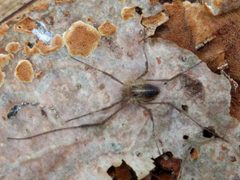
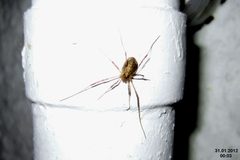
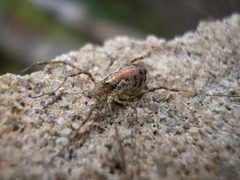
Paroligolophus agrestis is a small harvestman native to Europe, including the United Kingdom. It has been introduced to North America, where established occur in the Pacific Northwest and Nova Scotia. The species exhibits notable in body size and possesses distinctive morphological features useful for identification.
Pronunciation
How to pronounce Paroligolophus agrestis: /ˌpær.oʊˌlɪɡoʊˈlɒfəs əˈɡrɛstɪs/
These audio files are automatically generated. While they are not always 100% accurate, they are a good starting point.
Identification
Distinguished from similar harvestmen by the angular (not rounded) patellae and tibiae, the reddish tendency in coloration, the light-coloured area between the , and the notched genital plate on the underside (especially in females). The combination of body size, leg proportions, and these specific morphological details separates it from .
Images
Appearance
Mature females have bodies approximately 6 mm long, while mature males are smaller at about 4 mm. The second leg is longest, measuring 14–20 mm when fully extended. The patellae and tibiae have distinct angles rather than rounded contours. The upper body surface is usually brown with grey and red shades, featuring a line of whitish markings along the centre. The tendency toward red coloration is regarded as a useful identification character. Darker markings may occur at the rear with lighter lines across the body. The area between the is notably light in colour. On the underside, the genital plate is notched, particularly in females.
Distribution
Native to Europe, including the United Kingdom. Introduced to North America, with established in the Pacific Northwest and Nova Scotia.
Human Relevance
An introduced in North America where it has established outside its native European range. No documented economic or medical significance.
Similar Taxa
- Other Paroligolophus speciesSimilar body plan and general appearance; distinguished by specific combinations of coloration patterns, genital plate , and leg segment angularity
- Oligolophus speciesRelated within same Oligolophinae; require examination of genital and leg segment details for separation
More Details
Taxonomic history
Originally described by Meade in 1855; placement in Paroligolophus reflects refined understanding of phalangiid relationships
Invasion biology
One of relatively few European harvestmen to establish successfully in North America; mechanism of introduction unknown but likely via human commerce
Sources and further reading
- BugGuide
- Wikipedia
- GBIF taxonomy match
- iNaturalist taxon
- NCBI Taxonomy
- Catalogue of Life
- Grasshoppers of Colorado
- Grasshoppers of Colorado
- Species Records and Accounts
- Meloidae Holdings | Entomology Research Museum
- Encyrtid Holdings | Entomology Research Museum
- Crazy, snaky worms in your garden? Could be jumping worms, Amynthas spp. — Bug of the Week