
Microhexura
Crosby & Bishop, 1925
Pygmy Funnel-web Spiders, spruce-fir moss spider (M. montivaga)
Species Guides
2- Microhexura idahoana
- Microhexura montivaga(Spruce-fir moss spider)
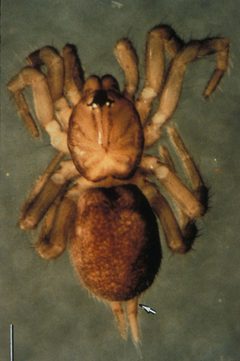
Microhexura is a of minute mygalomorph spiders to North America, containing two described : M. montivaga and M. idahoana. The genus represents the sole member of Microhexuridae. M. montivaga, the spruce-fir moss spider, is restricted to high-elevation spruce-fir forests on isolated peaks in the southern Appalachians and is federally endangered. M. idahoana occurs in old-growth coniferous forests of the Pacific Northwest and northern Rocky Mountains. Both species inhabit moss mats and are among the smallest mygalomorph spiders.


Pronunciation
How to pronounce Microhexura: //ˌmaɪkroʊˈhɛksjʊrə//
These audio files are automatically generated. While they are not always 100% accurate, they are a good starting point.
Identification
Distinguished from other mygalomorph spiders by extremely small size (3-4 mm body length) combined with mygalomorph characteristics. M. montivaga separated from M. idahoana by geography: southern Appalachians versus Pacific Northwest/Rocky Mountains. Within M. montivaga, on different mountain peaks show deep genetic divergence despite morphological similarity, making molecular identification necessary to distinguish lineages. Difiers from larger diplurid relatives by diminutive stature and moss-dwelling rather than burrow construction.
Images
Appearance
Extremely small mygalomorph spiders. M. montivaga is one of the smallest tarantula relatives, with body length approximately 3-4 mm. Possess the characteristic features of Mygalomorphae: two pairs of book lungs, fangs that move parallel to the body (paraxial), and a generally robust, compact body form. Males show morphological conservatism across genetically divergent . Coloration and detailed external poorly documented in accessible literature.
Habitat
High-elevation coniferous forests with dense moss mats. M. montivaga specifically inhabits spruce-fir forests on isolated mountain peaks above 1500 m elevation, where cool, moist conditions persist. M. idahoana occurs in old-growth forests of the Cascades, Blue Mountains, and northern Rockies. Both are associated with bryophyte (moss) layers on the forest floor, fallen logs, and rock outcrops within these forests. Microhabitat characterized by stable moisture and temperature regimes buffered by moss cover.
Distribution
to North America. M. montivaga: restricted to six on the highest peaks of the Blue Ridge Mountains in North Carolina and Tennessee, USA. M. idahoana: western North America from Mount Rainier southward through the Cascades, extending to the Blue Mountains of Oregon/Washington and northern Rocky Mountains. Disjunct distribution pattern reflects sky .
Seasonality
Activity patterns poorly documented; persistence in stable microhabitats suggests year-round presence with reduced seasonal dormancy requirements. Survey efforts for M. montivaga conducted during favorable weather windows; specific seasonal peaks not established in accessible literature.
Behavior
Constructs small silk retreats within moss mats rather than excavating burrows typical of many mygalomorphs. The has been observed to inhabit the spaces of dense bryophyte layers, using silk to reinforce moss structure. activity inferred from mygalomorph but direct behavioral observations limited.
Ecological Role
Predatory component of ground-dwelling fauna in high-elevation coniferous forests. Specific prey interactions and trophic position unstudied. Serves as for intact spruce-fir moss due to specialized microhabitat requirements.
Human Relevance
M. montivaga listed as federally endangered in the United States (1995) due to loss from decline of spruce-fir forests in the late 20th century. Subject of conservation concern and monitoring efforts; survey protocols developed to minimize disturbance to moss habitat. No known economic importance or medical significance.
Similar Taxa
- Other Dipluridae/MicrohexuridaeLarger body size; most mygalomorph relatives exceed 10 mm and construct burrows with conspicuous silk trip lines or funnel webs, whereas Microhexura is diminutive and moss-dwelling without elaborate web architecture.
- Antrodiaetus (Antrodiaetidae)Western North American mygalomorphs of similar montane distribution but substantially larger, with males possessing distinctive and leg modifications for mate searching; burrow-dwelling rather than moss-inhabiting.
More Details
Taxonomic history
Originally described in Dipluridae; elevated to family Microhexuridae based on phylogenetic analyses. NCBI retains Dipluridae placement, reflecting ongoing classification discussions.
Conservation genetics
M. montivaga exhibits extreme genetic structuring with 5-8 distinct lineages recovered by multispecies coalescent methods, contrasting with morphological uniformity. This creates tension between genetic and morphological concepts with direct management implications.
Sky island endemism
Classic example of sky island diversification where Pleistocene glacial cycles drove isolation on montane islands, with divergence times correlating with periods of spruce-fir forest persistence.
Sources and further reading
- BugGuide
- Wikipedia
- GBIF taxonomy match
- iNaturalist taxon
- NCBI Taxonomy
- Catalogue of Life
- Abiotic Microhabitat Parameters of the Spruce—Fir Moss Spider,Microhexura montivagaCrosby and Bishop (Araneae: Dipluridae)
- Effects of Surveying for the Federally Endangered Spruce-Fir Moss Spider (Microhexura montivaga Crosby & Bishop) on its Bryophyte Habitat
- Sky island diversification meets the multispecies coalescent – divergence in the spruce‐fir moss spider (Microhexura montivaga, Araneae, Mygalomorphae) on the highest peaks of southern Appalachia