
Microhexura montivaga
Crosby & Bishop, 1925
Spruce-fir moss spider
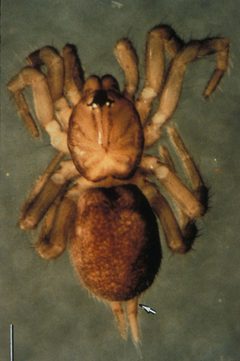
A miniature mygalomorph spider to the highest peaks of the southern Appalachian Mountains. First described in 1925, this inhabits moss growing on rocks beneath spruce-fir forest . Listed as federally endangered in 1995 due to severe declines in its montane forest . Genetic studies reveal significant fragmentation across six populations, though morphological differences remain minimal.


Pronunciation
How to pronounce Microhexura montivaga: /ˌmaɪkroʊhɛkˈsjʊərə mɒnˈtɪvəɡə/
These audio files are automatically generated. While they are not always 100% accurate, they are a good starting point.
Identification
Distinguished from other Appalachian mygalomorphs by its extremely small size—among the smallest mygalomorph spiders—and restriction to high-elevation moss microhabitats. Males show morphological conservatism across disjunct , lacking the geographic variation seen in genetic data.
Images
Habitat
High-elevation spruce-fir forests, specifically associated with bryophyte (moss) mats growing on rocks beneath the forest . Occupies cool, moist microhabitats at elevations typically above 1500 meters.
Distribution
Southern Appalachian Mountains, USA; known from six highly disjunct montane on the highest peaks of the range.
Behavior
Constructs silk-lined burrows within moss mats; details of foraging and activity patterns remain poorly documented.
Human Relevance
Listed as federally endangered in the United States in 1995. Subject to ongoing conservation concern and monitoring. Survey methods for this have been studied to minimize disturbance to its sensitive bryophyte .
Sources and further reading
- BugGuide
- GBIF taxonomy match
- iNaturalist taxon
- NCBI Taxonomy
- Catalogue of Life
- Hello There, Little Leafcutter Bee | Bug Squad
- Ever See a Leafcutter Bee Sunning Itself on a Milkweed Leaf? | Bug Squad
- Abiotic Microhabitat Parameters of the Spruce—Fir Moss Spider,Microhexura montivagaCrosby and Bishop (Araneae: Dipluridae)
- Effects of Surveying for the Federally Endangered Spruce-Fir Moss Spider (Microhexura montivaga Crosby & Bishop) on its Bryophyte Habitat
- Sky island diversification meets the multispecies coalescent – divergence in the spruce‐fir moss spider (Microhexura montivaga, Araneae, Mygalomorphae) on the highest peaks of southern Appalachia