
Antrodiaetus pacificus
(Simon, 1884)
Pacific Foldingdoor Spider
Antrodiaetus pacificus is a mygalomorph spider native to the Pacific Northwest of North America, ranging from San Francisco Bay to Alaska. It is the northernmost mygalomorph spider on the continent. The was first described by Eugène Louis Simon in 1884 under the name Brachybothrium pacificum. It constructs burrows in soft substrates and exhibits year-round activity with peak mating season between early June and late November.
Pronunciation
How to pronounce Antrodiaetus pacificus: /ænˌtroʊdiˈiːtəs pəˈsɪfɪkəs/
These audio files are automatically generated. While they are not always 100% accurate, they are a good starting point.
Identification
Distinguished from other Antrodiaetus by geographic distribution along the Pacific coast. The combination of dark , sclerotized abdominal patches, and burrow-building in cool, damp forest supports identification. Molecular data may be required to distinguish from cryptic species in the A. unicolor complex where ranges overlap.
Images
Appearance
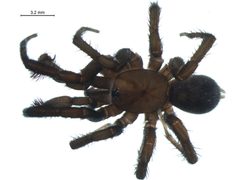
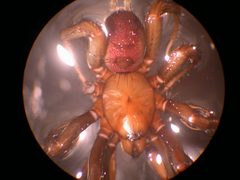
dark brown to black. bears two to three sclerotized patches. Females approximately 13 mm in length; males approximately 11 mm in length.
Habitat
Cool, damp forest environments. Constructs burrows in soft substrates including sand, moss, or decaying wood.
Distribution
Pacific coast of North America from San Francisco Bay, California north to Alaska.
Seasonality
Active year-round with peak activity between late July and early September. Mating season occurs between early June and late November.
Diet
Predominantly beetles. Prey captured by waiting at burrow entrance after dark.
Life Cycle
brooded within burrow. occurs in burrow.
Behavior
ambush . Closes burrow entrance during daylight hours. Opens burrow at dusk and waits at entrance for prey. Constructs and maintains burrows in soft substrates.
Ecological Role
of ground-dwelling insects, particularly beetles. Burrowing activity may contribute to soil aeration and nutrient cycling in forest .
Similar Taxa
- Antrodiaetus unicolor complexMorphologically similar mygalomorph spiders; distinguished by geographic range (A. unicolor complex primarily in eastern and central North America) and molecular data.
More Details
Etymology
name from Greek 'antrodiaitos' (αντροδιαιτος), meaning 'living in caves', combining 'antron' (αντρον, 'cave') and 'diaita' (διαιτα, 'way of life, dwelling'). Specific epithet 'pacificus' refers to Pacific coast distribution.
Historical taxonomy
Originally described as Brachybothrium pacificum by Simon in 1884.
Sources and further reading
- BugGuide
- Wikipedia
- GBIF taxonomy match
- iNaturalist taxon
- NCBI Taxonomy
- Catalogue of Life
- From Students to University Professionals: A Gathering of Arachnologists at UC Davis | Bug Squad
- Congrats to UC Davis Doctoral Students Who Study Spiders: AAS Awards | Bug Squad
- Jill Oberski: Why Museum Collections Matter | Bug Squad
- Spring Conditions Predict Following Year's Tick Activity in Northern California
- Cold-Season Temperature and Rainfall Drive Climate Suitability for Ticks in California
- CDC Study Shares County Maps of 7 Diseases Spread by Blacklegged Ticks