
Trogloraptor marchingtoni
Griswold, Audisio & Ledford, 2012
cave robber spider
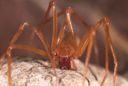
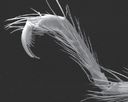
Trogloraptor marchingtoni is a large cave-dwelling spider and the sole in the Trogloraptoridae, the first new spider family described from North America since the 1890s. Discovered in 2010 in caves of southwestern Oregon, this species is distinguished by extraordinary hook-like claws on its legs used to capture prey. It represents a remarkable evolutionary lineage with no close known relatives among living spiders. The species name honors Neil Marchington, the deputy sheriff and amateur biologist who first brought the spiders to scientific attention.
Pronunciation
How to pronounce Trogloraptor marchingtoni: /ˌtrɒɡloʊˈræptər ˌmɑːrtʃɪŋˈtoʊnaɪ/
These audio files are automatically generated. While they are not always 100% accurate, they are a good starting point.
Identification
The combination of large size, cave , six , and especially the unique sickle-shaped claws on the leg tips distinguishes this from all other North American spiders. No other spider possesses comparable leg claws. The overall appearance is superficially similar to some large orb-weavers or huntsman spiders, but the cave habitat and extraordinary claws are diagnostic.
Images
Habitat
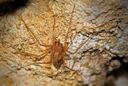
Strictly cave-dwelling, found on ceilings of caves in coniferous forest regions. The spiders construct minimal webs and hang suspended upside down while waiting for prey. The cave environment is characterized by darkness, stable temperature, and high humidity. The appears dependent on intact cave with minimal human disturbance.
Distribution
Known only from caves in southwestern Oregon, USA. Reports suggesting northern California and British Columbia in the distribution appear to be unconfirmed or erroneous. The has a highly restricted range with isolated cave .
Diet
Believed to prey on small flying insects that enter caves. The claws are used to hook prey that come within range of the spider's lanky legs. Live specimens in laboratory conditions refused to eat, suggesting highly specialized feeding requirements or stress in captivity.
Behavior
Constructs small, minimalist webs on cave ceilings. Hangs upside down in a suspended posture, waiting for prey to come within striking distance. Uses the unique hook-like claws to capture flying insects. When disturbed, may retreat or remain motionless. Laboratory observations indicate reluctance to feed in artificial conditions.
Ecological Role
As a specialized cave , likely contributes to regulation of insect within cave . The represents a unique evolutionary lineage that occupies a distinctive as a ceiling-dwelling, hook-clawed predator with no known ecological equivalents.
Human Relevance
Named in honor of Neil Marchington, an amateur biologist and cave conservation advocate who first documented the . The discovery highlighted the importance of cave conservation and the Western Cave Conservancy's efforts. The species has captured public imagination, being described as the "spider version of Bigfoot" due to its large size and elusive nature. Media coverage has helped raise awareness about cave biodiversity and the vulnerability of cave .
Similar Taxa
- Dysdera spp. (woodlouse spiders)Also have elongated bodies and specialized jaws, but lack the distinctive leg claws and have different preferences.
- Large orb-weaving spiders (Araneidae)May approach similar leg span but possess eight , build characteristic orb webs rather than minimalist cave webs, and lack the extraordinary hook claws.
- Huntsman spiders (Sparassidae)Similar large size and long legs, but have flattened bodies adapted for hiding under bark, eight , and lack the specialized claws.
Misconceptions
Some press reports exaggerated the geographic distribution to include northern California and British Columbia; the is confirmed only from Oregon. The common nickname "Bigfoot spider" is a media creation emphasizing its large size and elusive nature, not a formal .
More Details
Taxonomic significance
The erection of Trogloraptoridae represents the first new spider described from North America since the 1890s, and only the second new family established worldwide since 1990. Molecular and morphological analyses indicate no close relationship to any known spider family, making it a remarkable example of evolutionary divergence.
Conservation concerns
Cave-dwelling organisms are inherently vulnerable due to small sizes, specialized requirements, and sensitivity to environmental changes. Threats include groundwater from surface development, physical damage from irresponsible spelunking, and climate impacts on cave microclimates.
Research challenges
The has proven difficult to study due to its cave , apparent dietary specialization, and failure to thrive in laboratory conditions. Only 11 observations are recorded in citizen science databases, reflecting its rarity and restricted distribution.