
Xysticus funestus
Keyserling, 1880
mournful ground crab spider, sad ground crab spider, deadly ground crab spider
Xysticus funestus is a ground crab spider in the Thomisidae, native to North America. It is one of many ambush-hunting crab spiders that rely on elongated front legs to capture prey. The has been documented in field observations as an in early spring and has been recorded as prey for the spider wasp Dipogon calipterus. Despite its alarming "deadly ground crab spider," it poses no medical threat to humans.
Pronunciation
How to pronounce Xysticus funestus: //ˈzɪs.tɪ.kʊs fjuːˈnɛs.tʊs//
These audio files are automatically generated. While they are not always 100% accurate, they are a good starting point.
Identification
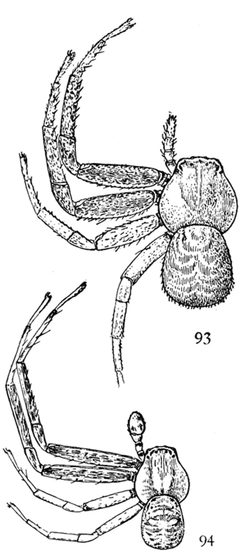
As a member of Xysticus, this possesses characteristically elongated first and second pairs of legs adapted for grasping prey, with spines lining the inner surfaces of these legs to secure captured insects. The body form is typical of ground crab spiders: somewhat flattened with the capacity to move sideways in crab-like fashion. Specific diagnostic features distinguishing X. funestus from are not documented in available sources.
Images
Habitat
Ground-dwelling; observed in forested areas and on man-made structures including concrete paths, mailbox posts, and building exteriors. Overwinters as or in sheltered locations such as leaf litter, grass tussocks, or debris.
Distribution
North America. Specific documented locations include Colorado Springs, Colorado and Door County, Wisconsin in the United States.
Seasonality
active in early spring (March documented in Colorado). as adults or immatures. One observation records a gravid female in early March, indicating pre-reproductive activity at that time.
Behavior
Ambush that waits motionless for prey to come within reach, then seizes it with elongated front legs. Has been observed ballooning—standing on tiptoe on elevated surfaces to catch wind for . Exhibits rapid escape when disturbed, retreating into cracks or behind cover. Females construct silken retreats to guard sacs.
Ecological Role
of insects; serves as prey for spider wasps (Pompilidae), specifically documented as prey for Dipogon calipterus.
Human Relevance
Bites to humans are extremely rare due to the spider's avoidance . Bites are not medically significant, typically causing only minor local swelling and redness. The "deadly ground crab spider" is misleading and does not reflect actual risk.
Similar Taxa
- Xysticus spp. (congeners)Other ground crab spiders in the same share the elongated front legs, crab-like locomotion, and ambush hunting strategy. Specific separation of X. funestus from other Xysticus requires examination and is not covered in general sources.
- Philodromidae (running crab spiders)Running crab spiders such as Thanatus spp. share similar body plans and are active in similar and seasons, but differ in leg proportions and hunting —running crab spiders are more active pursuers rather than ambush hunters.
Misconceptions
The "deadly ground crab spider" suggests medical danger to humans, which is false. No Thomisidae possess venom medically significant to humans, and bites from this species are rare and cause only minor local .
Sources and further reading
- BugGuide
- Wikipedia
- GBIF taxonomy match
- NCBI Taxonomy
- Catalogue of Life
- Anopheles Mosquitoes as Vectors of Malaria in East Africa: Bed Nets and Beyond
- Bug Eric: ArachNovember?
- The Sweetest Snack: Research Details Mosquitoes' Nectar Preferences
- Bug Eric: Spider wasp, Dipogon calipterus
- Bug Eric: Spider Sunday: Spring Spiders
- Bug Eric: One Night, One House, Seventeen Spider Species