
Xysticus cristatus
(Clerck, 1757)
common crab spider
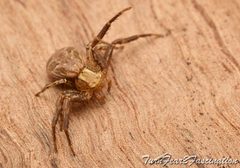
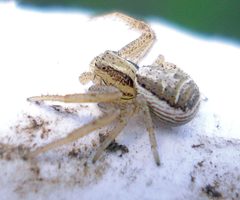
Xysticus cristatus, commonly known as the common crab spider, is a small ambush in the Thomisidae. Females reach 6–8 mm body length, while males are smaller at 3–5 mm. The exhibits cryptic coloration ranging from light cream to dark brown or greyish, with distinct patterning that blends with dried leaf litter. It hunts by waiting motionless with forelegs spread wide, capturing insects that blunder within reach. The species has a broad Palearctic distribution and has been introduced to North America.
Pronunciation
How to pronounce Xysticus cristatus: //ˈzɪstɪkəs krɪˈstɑːtəs//
These audio files are automatically generated. While they are not always 100% accurate, they are a good starting point.
Identification
Distinguished from similar Xysticus by the combination of: broad whitish band on with brown triangle and sharp black macula; dark leaf pattern on opisthosoma with white-edged markings and lateral light transverse stripes. Male coloration is notably darker and more contrasting than female. The cryptic ground-dwelling habit and preference for open separates it from woodland-associated . Examination of genitalia may be required for definitive identification from closely related species.
Images
Appearance
Small crab spider with sexually dimorphic size. Females 6–8 mm, males 3–5 mm. Coloration highly variable: light cream, dark brown, to greyish, with males typically darker and more contrasting. bears broad whitish band containing brown triangle pointing posteriorly, ending in sharp black macula. Opisthosoma dorsum displays dark leaf pattern with white edges and light transverse stripes on each side. Legs adapted for crab-like sideways movement.
Habitat
Found in low vegetation and on ground surface. Shade intolerant; avoids woodland and closed . Occupies nearly every other habitat type including grasslands, meadows, open fields, and disturbed areas. Frequently encountered on dried leaf litter where cryptic coloration provides camouflage.
Distribution
Palearctic distribution throughout Europe (including Iceland), east to South Siberia, Turkey, Caucasus, Russia, Kazakhstan, Iran, Central Asia, China, Korea, and Japan. Introduced to Canada and United States. Also recorded from Nepal.
Seasonality
Active recorded February through December in Great Britain. Peak male activity in May and June. Spiderlings balloon primarily July to September. develop in flat white ovisacs guarded by females until hatching.
Diet
ambush . Prey composition varies with hunting position: flying insects including bees and butterflies when hunting at vegetation tips; ants, spiders, and soft-bodied prey when hunting on ground. Documented to capture prey substantially larger than itself.
Life Cycle
Mating involves male grasping female's leg until she ceases struggling, then using silk to restrain her on ground before mating from beneath. Female constructs flat white ovisac attached to vegetation, guards it until spiderlings emerge. Spiderlings disperse by ballooning on silk threads. Development includes , spiderling, and stages.
Behavior
Ambush hunter that remains motionless for extended periods with forelegs spread wide to capture passing prey. Adopts flexible hunting positions: at tips of vegetation such as flowerheads, or on ground surface. Sometimes moves in crab-like sideways fashion. Female guards sac until hatching.
Ecological Role
of insects and other arthropods. Documented prey item for the spider wasp Dipogon bifasciatus in Britain. increases may respond to availability of prey such as stink bugs in introduced range.
Human Relevance
Non-aggressive toward humans; bite not considered medically significant. Potential agent for pest insects in agricultural and horticultural settings. Introduced in North America may contribute to suppression of pests.
Similar Taxa
- Other Xysticus speciesMany share crab spider and cryptic habits; require examination of genitalia or detailed pattern analysis for separation
- Thomisus onustusAnother European crab spider that hunts on flowers; differs in more pronounced and flower-associated rather than ground-dwelling
More Details
Dispersal
Spiderlings balloon primarily between July and September in Great Britain, using silk threads to become airborne and disperse to new .
Mating behavior
Male restraint of female using silk prior to mating is a notable behavioral trait that reduces female aggression and enables successful copulation.
Sources and further reading
- BugGuide
- Wikipedia
- GBIF taxonomy match
- iNaturalist taxon
- NCBI Taxonomy
- Catalogue of Life
- Bug vs. bug - Assassinating stink bugs is the game of the wheel bug, Arilus cristatus — Bug of the Week
- Death of a stink bug, Part 2: Bug vs. Bug - Brown Marmorated Stink Bug, Halyomorpha halys, meets the wheel bug, Arilus cristatus — Bug of the Week
- To eat a stink bug, part 3 - Bug vs Bug, Brown Marmorated Stink Bug, Halyomorpha halys, meets the wheel bug, Arilus cristatus — Bug of the Week
- Bugs in orange and black: Three assassins - milkweed assassin bug, Zelus longipes; orange assassin bug, Pselliopus barberi; and wheel bug, Arilus cristatus — Bug of the Week
- Bugs in Orange and Black III – Argus tortoise beetle, Chelymorpha cassidea; oleander caterpillar, Syntomeida epilais; and wheel bug, Arilus cristatus (MISSING LINKS) — Bug of the Week
- Wheel Bug Takes a Spin, Arilus cristatus — Bug of the Week