
Zygoballus sexpunctatus
(Hentz, 1845)
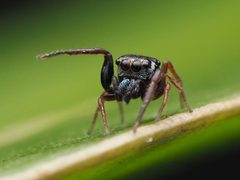
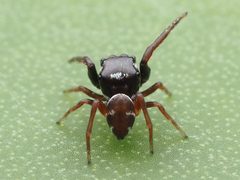
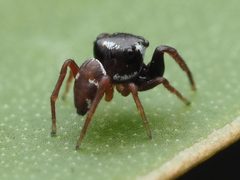
Zygoballus sexpunctatus is a small jumping spider (3–4.5 mm) found in grassy of the southeastern United States. Males possess enlarged and front , and exhibit elaborate courtship and agonistic displays involving leg-raising and abdominal vibration. The name refers to the six abdominal spots typically present in males, though these may be reduced or absent. First described by Hentz in 1845, it was later transferred to the Zygoballus by the Peckhams in 1888.
Pronunciation
How to pronounce Zygoballus sexpunctatus: /ˌzaɪɡoʊˈbæləs sɛksˌpʌŋkˈteɪtəs/
These audio files are automatically generated. While they are not always 100% accurate, they are a good starting point.
Identification
Males distinguished from the sympatric Zygoballus rufipes by a large spot of white at the beginning of the thoracic slope (absent in Z. rufipes) and by palpal bulb shape. Females best separated by epigyne structure. The six abdominal spots (when present) and enlarged male are diagnostic for the . The box-like shape is characteristic of the Zygoballus.
Images
Appearance
measure 3–4.5 mm in body length; females (3.5–4.5 mm) are slightly larger than males (3–3.5 mm). The and are bronze to black. The cephalothorax is box-shaped, widest at the lateral . The and are covered with white or pale blue that extend around the sides of the . Males have greatly enlarged, obliquely oriented chelicerae with a prominent inner tooth and long curved fang. Legs are reddish brown to yellowish; the are darker and enlarged, especially in males. The abdomen has a white basal band and two white transverse bands, often broken into six spots (the source of the specific epithet), though spots may be lacking.
Habitat
Occurs in grassy herb stratum of old fields, river terrace forests, flatwoods, Florida Sand Pine scrub, Slash Pine forests, Appalachian grass balds, and rice fields. Frequently collected in broomsedge fields of the southeastern Piedmont. Typically found among grasses and short vegetation, accessible by sweep netting.
Distribution
Southeastern United States, from New Jersey to Florida and west to Texas. Most common in southern states. Documented from North Carolina, Florida, Texas, Louisiana, Mississippi, and Tennessee.
Seasonality
Spiderlings hatch in mid-summer, hibernate in form through winter, and reach sexual maturity in late April. active primarily spring through summer.
Diet
Opportunistic of small . Prey includes aphids, young caterpillars, mosquitoes, and small spiders.
Life Cycle
sacs produce spiderlings in mid-summer. spiders overwinter, with sexual maturity reached the following late April. Presumably with single per year, though detailed remains incompletely documented.
Behavior
Males perform elaborate : approach females with first pair of legs raised and spread, vibrating the . Receptive females may reciprocate with abdominal vibration. Males exhibit ritualized agonistic toward other males, involving similar leg-raising, abdominal vibration, and extension of and fangs; lethal combat is rare. Visual signaling appears important in both contexts.
Ecological Role
controlling of small insects and other arthropods. Serves as prey for mud dauber (Sphecidae), which paralyze spiders as larval food.
Human Relevance
No direct economic or medical significance. Subject of behavioral research on jumping spider courtship and agonistic displays. Occasionally encountered by sweep sampling in ecological surveys.
Similar Taxa
- Zygoballus rufipesOverlapping range; distinguished by absence of white spot on thoracic slope in males and different palpal bulb/epigyne structure.
- Other Zygoballus speciesShare box-like ; require examination of male cheliceral and genitalic structures for definitive identification.
More Details
Type specimens
No are known to exist. Original description based on specimen collected in North Carolina by Hentz.
Etymology
Specific epithet from Latin sex (six) + punctum (spot), referring to the six abdominal spots characteristic of males.
Taxonomic history
Originally described as Attus sexpunctatus by Hentz (1845) in subgeneric group Pugnatoriae; transferred to Zygoballus by Peckham & Peckham (1888).
Abundance
Reported as 'uncommon' in western Mississippi surveys and 'rare' in Alachua County, Florida, suggesting localized or patchy distribution even within range.