
Zygoballus
G. W. Peckham & E. G. Peckham, 1885
Species Guides
3- Zygoballus nervosus
- Zygoballus rufipes(Hammer-jawed Jumping Spider)
- Zygoballus sexpunctatus
Zygoballus is a of jumping spiders in the Salticidae, established in 1885 by George and Elizabeth Peckham. The genus is characterized by a distinctive high, roughly square and enlarged legs adapted for jumping. occur throughout the Americas from Canada to Argentina, with males of at least one species (Z. rufipes) exhibiting body-size dimorphism associated with alternative life-history strategies.
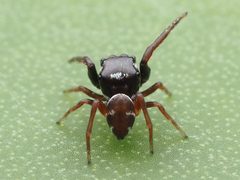
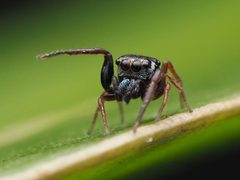
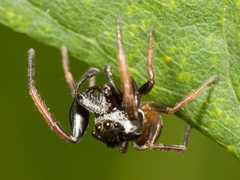
Pronunciation
How to pronounce Zygoballus: //zaɪ.ɡoʊˈbæl.əs//
These audio files are automatically generated. While they are not always 100% accurate, they are a good starting point.
Identification
high and roughly square in view, widest at ; ocular quadrangle occupies approximately three-fifths of cephalothorax. Cephalothorax slopes steeply behind posterior eyes with nearly vertical sides. as long or longer than wide. legs largest, with three pairs of spines on tibial surface. Males with obliquely oriented and long fangs. Color, size, and markings vary widely among and within .
Images
Distribution
New World distribution from Canada to Argentina. documented in USA, Canada, Panama, Guatemala, Rica, Jamaica, Cuba, Guyana, Suriname, and Argentina.
Life Cycle
In Zygoballus rufipes, males exhibit body-size dimorphism with bimodal weight distribution, suggesting maturation at two different instars. females are . This dimorphism is consistent with two size-based alternative life-history strategies.
Similar Taxa
- MessuaPreviously synonymized with Zygoballus but restored as valid in 1996; distinguished by differences in that Simon considered less pronounced than Peckhams' description suggested
- AmerotritteSynonymized with Zygoballus in 1980; of type reidentified as Zygoballus