
Phidippus adumbratus
Gertsch, 1934
California Red Jumping Spider
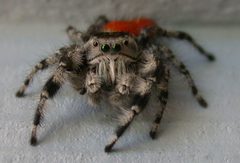
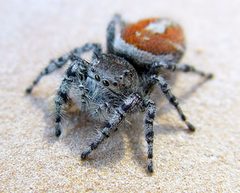
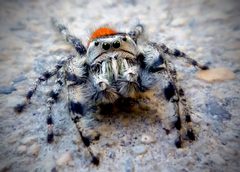
Phidippus adumbratus is a jumping spider in the Salticidae, commonly known as the California Red Jumping Spider. It belongs to the insignarius group within the Phidippus. The species was first described by Gertsch in 1934 from a collected in Los Angeles. Its specific epithet derives from Latin adumbratus, meaning 'secret' or 'in the dark,' possibly alluding to the missing of the specimen.
Pronunciation
How to pronounce Phidippus adumbratus: /ˈfɪdɪpəs ædʌmˈbreɪtəs/
These audio files are automatically generated. While they are not always 100% accurate, they are a good starting point.
Identification
As a member of the Phidippus insignarius group, P. adumbratus may share coloration patterns with related in this complex. Definitive identification requires examination of external genitalia under a microscope. Visual identification alone is unreliable due to variation and overlap in color patterns among Phidippus species.
Images
Habitat
Within the United States, occurs in the California Floristic Province in native chaparral and oak-sycamore-chaparral woodland at elevations of 500–3,700 ft (150–1,130 m). Has been observed in coastal sage scrub in the San Diego area.
Distribution
United States (California Floristic Province) and Mexico. In Mexico, documented from Baja California's Central Desert ecoregion including Sierra Blanca, Ensenada Municipality, Mesa Escondido, and San Antonio de Las Minas.
Similar Taxa
- Phidippus apacheanusBoth are large, colorful Phidippus with red/orange and black coloration; however, P. apacheanus occurs in grasslands and prairies across much of the central and southern United States, not in California chaparral, and males have black venter with bright orange dorsum rather than the pattern typical of P. adumbratus
- Phidippus insignarius group speciesMultiple in this group share similar body plans and color patterns; microscopic examination of genitalia is required for reliable separation
Sources and further reading
- BugGuide
- Wikipedia
- GBIF taxonomy match
- iNaturalist taxon
- NCBI Taxonomy
- Catalogue of Life
- Bug Eric: Spider Sunday: Phidippus octopunctatus
- Bug Eric: Spider Sunday: Phidippus asotus
- Eriopis connexa on soybean in Argentina | Beetles In The Bush
- Bichos Argentinos #6 – Jumping Spider | Beetles In The Bush
- Bug Eric: Spider Sunday: Apache Jumping Spider
- quiz | Beetles In The Bush | Page 2