
Phidippus insignarius
C.L. Koch, 1846
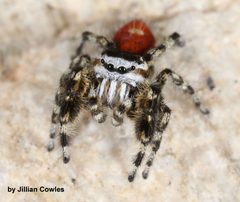
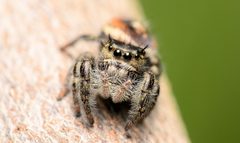
Phidippus insignarius is a of jumping spider in the Salticidae. Mature males average just under 5 millimeters in body length, females 5.45 millimeters. The species ranges across much of the eastern and central United States, from Colorado eastward through the Great Plains and into the Northeast. It inhabits open woodlands, prairies, and oak thickets with scattered vegetation. The male displays distinctive bright white hairs on the , legs, and palps, while females lack these markings but share the bushy "eyebrows" characteristic of many Phidippus species.

Pronunciation
How to pronounce Phidippus insignarius: /ˈfɪdɪpəs ˌɪnsɪɡˈnɛəriəs/
These audio files are automatically generated. While they are not always 100% accurate, they are a good starting point.
Identification
Distinguished from other Phidippus by small body size (under 5.5 mm), presence of bushy eyebrow tufts, and in males, bright white hairs on and legs. Differs from P. audax by smaller size and specific hair pattern. Differs from P. apacheanus by lack of bright red/orange coloration. Definitive identification requires examination of genitalia under microscope. specimens may be difficult to distinguish from other small Phidippus species.
Images
Appearance
Small jumping spider with sexually dimorphic coloration. Males have bright white hairs on the , legs, and palps. Both sexes possess prominent bushy tufts above the , creating "eyebrow" appearance. Body compact and densely hairy typical of . Female coloration similar to male but without bright white hair markings. pattern muted compared to some . not described as metallic in this .
Habitat
Understory of open woodlands, prairies, and oak thickets with scattered pines or other vegetation. Found in grassy areas with shrub cover. In Colorado, observed in oak thickets within otherwise grassland .
Distribution
United States: Colorado, Nebraska, Iowa, Kansas, eastern Oklahoma, Missouri, southeast Minnesota, Illinois, Indiana, Kentucky, Tennessee, Pennsylvania, southern New England, New Jersey, Virginia, and North Carolina. Western limit appears to be eastern Colorado.
Seasonality
active during warmer months. One observation from early June in Colorado. Specific not well documented.
Behavior
Active hunter. Has been observed prowling dead vegetation stalks and branches. Uses typical salticid jumping locomotion and visual stalking of prey. Alert to human approach, may turn to observer.
Ecological Role
of small arthropods in grassland and woodland understory .
Human Relevance
Not considered medically significant. Bite unlikely unless spider is handled or pinched. No documented economic importance.
Similar Taxa
- Phidippus audaxLarger size (typically 8-15 mm), bold black and white or yellow markings, lacks white hair pattern of P. insignarius males
- Phidippus apacheanusBright red/orange and black coloration, larger size, western grassland distribution overlaps in some areas
- Other small Phidippus speciesOverlap in general ; genital examination required for definitive separation
More Details
Collection method
Beating sheet technique effective for sampling: place sheet beneath shrub or tree branch and strike branch sharply to dislodge spiders and other arthropods.
Taxonomic note
described by C.L. Koch in 1846. Part of diverse Phidippus containing many visually similar species.
Sources and further reading
- BugGuide
- Wikipedia
- GBIF taxonomy match
- iNaturalist taxon
- Catalogue of Life
- Bug Eric: June 2016
- Bug Eric: Spider Sunday: Phidippus octopunctatus
- Bug Eric: Spider Sunday: Phidippus asotus
- Eriopis connexa on soybean in Argentina | Beetles In The Bush
- Bichos Argentinos #6 – Jumping Spider | Beetles In The Bush
- Bug Eric: Spider Sunday: Apache Jumping Spider