Phidippus apacheanus
Chamberlin & Gertsch, 1929
Apache Jumping Spider
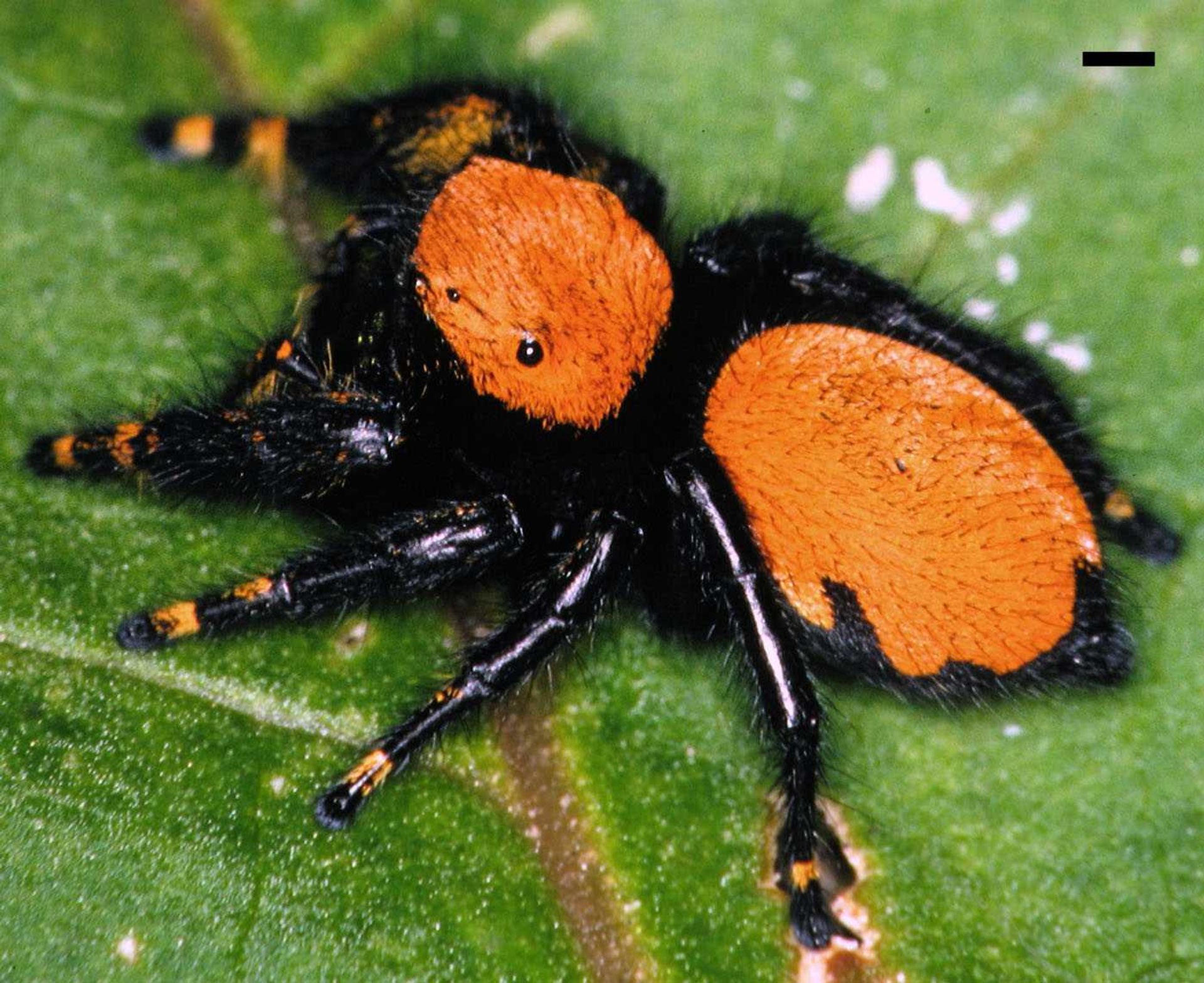
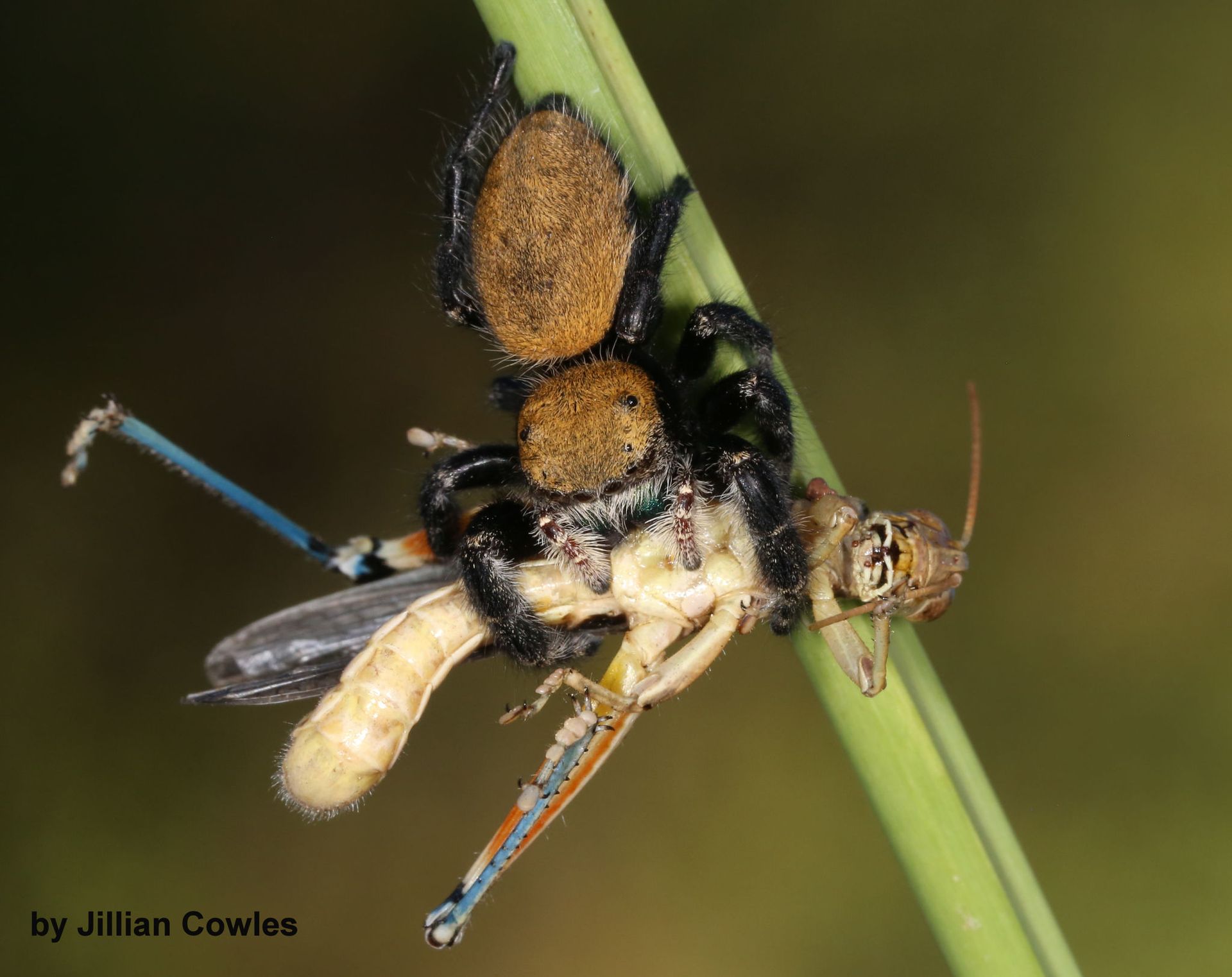
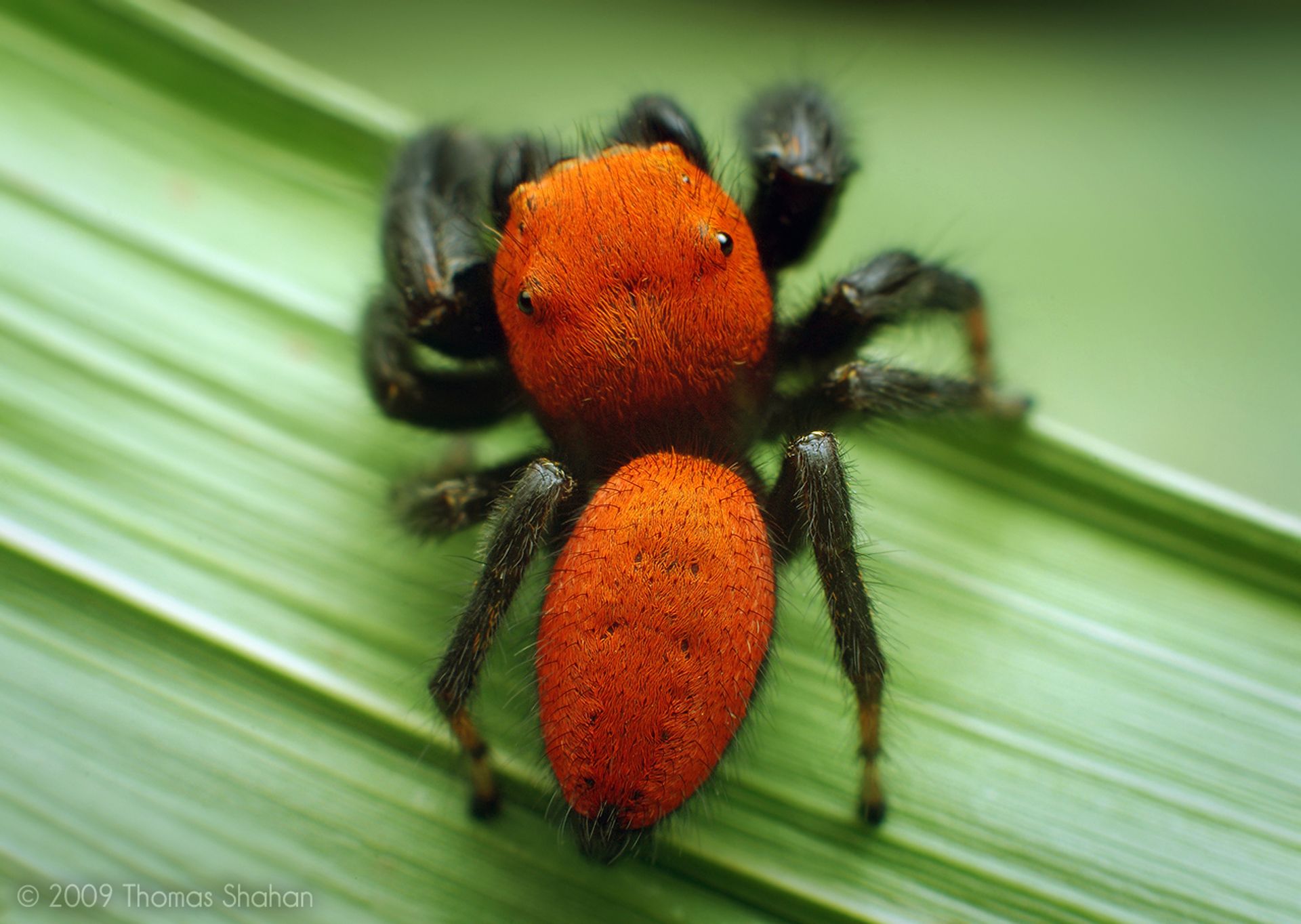
Phidippus apacheanus is a medium-to-large jumping spider in the Salticidae, notable for its striking black and orange-red coloration. Males exhibit bright orange-red surfaces with black legs and venter, while females are larger with a characteristic dark dorsal stripe on the . The is hypothesized to be a Müllerian or Batesian mimic of velvet ants (Mutillidae), particularly Dasymutilla flammifera, matching both their aposematic coloration and general body shape. It occupies grassland and prairie across much of the United States, Mexico, and Cuba, with males most frequently encountered in autumn.
Pronunciation
How to pronounce Phidippus apacheanus: /fɪˈdɪpəs əˌpætʃiˈeɪnəs/
These audio files are automatically generated. While they are not always 100% accurate, they are a good starting point.
Identification
Distinguished from similar Phidippus by the combination of iridescent green , orange-red coloration extending across both and in males, and absence of abdominal markings found in . P. cardinalis males are more orange than red with lighter, potentially silvery setae and often show light abdominal markings—an band and sometimes small dorsal spots—that are absent in P. apacheanus. P. clarus has a black with bright abdominal markings, not the uniform orange-red dorsum of P. apacheanus. Females are more challenging to identify; the dark dorsal abdominal stripe is suggestive but not definitive. Positive identification requires examination of genitalia under microscope. specimens cannot be reliably identified to species.
Images
Habitat
Grasslands, prairies, plains, dry fields, and desert grasslands. Found on diverse vegetation including shrubs, perennials, cacti, yucca, and forbs—particularly goldenrod (Solidago spp.) and thoroughwort (Eupatorium altissimum). In tallgrass prairie, occupies lower vertical positions on vegetation (mean height ~17 cm) compared to sympatric . Elevation range approximately 500–1,800 m, with records up to 6,000 feet (~1,800 m).
Distribution
United States (widespread except absent from New England and Pacific coast states), Mexico, and Cuba. Most records from southern half of the United States. Caribbean and Middle America presence confirmed.
Seasonality
Mature individuals can be found year-round, with males most abundant in autumn (September–October). Activity period extends across warmer months with peak male visibility in fall.
Diet
Active of insects and other small arthropods. Documented capturing crabronid and other hymenopterans. Specific dietary breadth not quantified in published studies.
Life Cycle
Females construct sacs in protected such as beneath bark on oak logs, where they guard the sac and emerging spiderlings. Detailed developmental stages and not documented in available sources.
Behavior
Complex visual described in detail: males elevate , shift laterally, and raise first pair of legs while advancing in zigzag pattern toward females. During approach, males flick up and down, initially held widely separated then gradually brought together until tips touch and form circle. Females perform acceptance dance with pedipalps elevated and separated, abdomen shifted to side, and swaying motion before permitting male approach. Males cautiously mount females and use pedipalps to assist in turning female abdomen for sperm transfer. Foraging involves stalking and pouncing on prey from vegetation perches. Exhibits strong microhabitat preference for forbs over grasses, with active selection of lower vegetation positions. Frequently observed basking or waiting in ambush on sunflower plants and other elevated perches.
Ecological Role
in grassland and prairie . Hypothesized Müllerian or Batesian mimic of velvet ants (Mutillidae), potentially gaining protection from predators through aposematic coloration matching. May contribute to partitioning with sympatric through differential microhabitat use—specifically vertical stratification and plant-type preferences.
Human Relevance
Popular subject for macrophotography due to striking coloration and approachable . Occasionally enters human dwellings. Not considered dangerously venomous to humans, though can bite if handled roughly. Bites typically cause only localized pain without effects in healthy individuals. Sometimes maintained in captivity by arachnid enthusiasts.
Similar Taxa
- Phidippus cardinalisMales similar in general appearance but more orange than red, with lighter setae that may appear silvery; typically shows light abdominal markings ( band and small spots) absent in P. apacheanus
- Phidippus clarusHas black with bright abdominal markings rather than uniform orange-red dorsum; occupies higher vertical positions in prairie vegetation
- Dasymutilla flammifera (velvet ant)Wingless female that P. apacheanus is hypothesized to mimic; shares aposematic black-orange coloration and general body form, but is a hymenopteran with very different and
More Details
Mimicry Hypothesis
The is thought to mimic velvet ants (Mutillidae), particularly Dasymutilla flammifera or the as a whole, matching both their aposematic coloration and general body shape. This hypothesis remains to be experimentally tested.
Microhabitat Specialization
Research in Kansas tallgrass prairie demonstrates strong preference for forbs over grasses and occupation of significantly lower vegetation positions (mean 16.9 cm) compared to sympatric P. clarus (mean 27.6 cm), suggesting fine- partitioning.
Sources and further reading
- BugGuide
- Wikipedia
- GBIF taxonomy match
- iNaturalist taxon
- NCBI Taxonomy
- Catalogue of Life
- Bug Eric: Spider Sunday: Apache Jumping Spider
- BitB Top 10 of 2010 | Beetles In The Bush
- jumping spiders | Beetles In The Bush
- spiders | Beetles In The Bush | Page 6
- Bug Eric: Wasp Wednesday: Dasymutilla bioculata
- Bug Eric: The Tarantula Hunt
- Microhabitat Selection of the Jumping Spiders Phidippus clarus Keyserling and Phidippus apacheanus Chamberlin and Gertsch (Araneae: Salticidae) in Northeastern Kansas