
Habronattus elegans
(G. W. Peckham & E. G. Peckham, 1901)
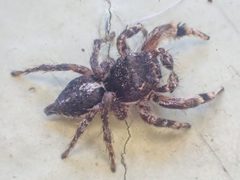
Habronattus elegans is a of jumping spider in the Salticidae. It is found in the United States and Mexico. Like other members of the Habronattus, males are known for elaborate involving visual signals and vibratory communication. The genus Habronattus is one of the most diverse groups of jumping spiders in North America, with approximately 100 species.
Pronunciation
How to pronounce Habronattus elegans: /hæˈbrɒnætəs ˈɛləɡænz/
These audio files are automatically generated. While they are not always 100% accurate, they are a good starting point.
Identification
Males of Habronattus , including H. elegans, can be distinguished from many other jumping spider by modified third legs used in . These legs often feature enlarged spurs or striking color patterns that are presented to females during visual signaling. Females are generally more cryptically colored than males. Definitive identification to species level requires examination of genitalia under magnification, as color patterns alone can be unreliable due to similarity with .
Images
Habitat
Members of the Habronattus are typically found on the ground in areas of scattered vegetation, where they prowl on stones or amid leaf litter.
Distribution
United States and Mexico. Records indicate presence in North America and Middle America.
Behavior
Male Habronattus jumping spiders perform complex multimodal combining visual signals with vibratory drumming or tapping transmitted through the substrate. Males often adopt a characteristic crouching posture to maximize visibility of leg ornamentation to females. These displays have been described as among the most elaborate of any terrestrial .
Ecological Role
As a small predatory spider, Habronattus elegans contributes to in ground-level . It serves as prey for larger arthropods, birds, and other vertebrate .
Similar Taxa
- Other Habronattus speciesMany share similar size, preferences, and male courtship . -level identification requires genital examination.
- Phidippus apacheanusAnother colorful jumping spider found in similar , but Phidippus lacks the modified third legs characteristic of Habronattus males.
More Details
Genus characteristics
Habronattus is a large of approximately 100 , most occurring in North America with additional species in the neotropics. Maximum diversity occurs in the southwestern United States, though species range from Florida to above the Arctic Circle and east to coastal Canada.
Sources and further reading
- BugGuide
- Wikipedia
- GBIF taxonomy match
- iNaturalist taxon
- NCBI Taxonomy
- Catalogue of Life
- Bring on the Tourists! | Bug Squad
- More Nematodes in Outer Space? | Bug Squad
- Showcasing Animal and Plant Parasitic Nematodes | Bug Squad
- Bug Eric: Wasp Wednesday: Steniolia elegans
- Bug Eric: What a Spider!
- Bug Eric: September 2012