
Habronattus brunneus
(G. W. Peckham & E. G. Peckham, 1901)
Habronattus brunneus is a of jumping spider in the Salticidae, first described by George and Elizabeth Peckham in 1901. It occurs in the United States and Caribbean, including the Bahamas, Dominican Republic, Haiti, Hispaniola, and the Virgin Islands. Males discriminate between substrate-borne cues from females based on age and mating status, spending more time exploring cues from mature, non-mated females. exhibit differing prey colour biases, with some showing strong avoidance of red prey and others showing no colour .
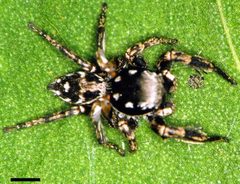
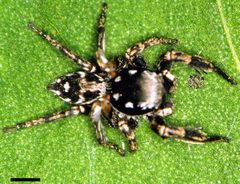
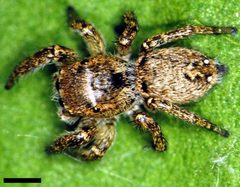
Pronunciation
How to pronounce Habronattus brunneus: /hæbrəˈnætəs ˈbrʌniəs/
These audio files are automatically generated. While they are not always 100% accurate, they are a good starting point.
Images
Habitat
Natural areas with scattered vegetation; ground-dwelling in areas with grass, leaf litter, and bare ground. Laboratory studies used 13:11 h light:dark with ~43% relative humidity.
Distribution
United States and Caribbean; recorded from the Bahamas, Dominican Republic, Haiti, Hispaniola Island, and the Virgin Islands.
Diet
Crickets (Gryllodes sigillatus) in laboratory settings; prey selection involves colour-based biases that vary by , with some populations exhibiting against red prey.
Life Cycle
males develop a reddish after the first few moults, a trait absent in juvenile females, allowing sex determination. Females mature with of the , which becomes hardened, dark, and shiny after the final moult.
Behavior
Males use substrate-borne cues (silk and excreta) to discriminate female age and mating status, preferring cues from mature, non-mated females. Courtship involves extending the first pair of legs and raising ornamented portions of the third pair of legs. Males produce dragline silk. Visual courtship uses vibrant pigments and structures on body , accompanied by vibratory cues. Males may misdirect courtship toward visually similar heterospecific females.
Ecological Role
Voracious ; males risk of precopulatory sexual from females.
Similar Taxa
- Habronattus cuspidatusBoth are ground-dwelling Habronattus with modified third legs used in , but H. cuspidatus males have a conspicuous spur on the knee joint of the third leg.
- Habronattus calcaratusRelated with similar crouching courtship posture and use of third leg ornamentation for visual signaling.
Sources and further reading
- BugGuide
- Wikipedia
- GBIF taxonomy match
- iNaturalist taxon
- NCBI Taxonomy
- Catalogue of Life
- Grasshoppers of Colorado
- Grasshoppers of Colorado
- Grasshoppers of Colorado
- Species Records and Accounts
- Bug Eric: What a Spider!
- Bug Eric: September 2012
- Prey colour biases in jumping spiders (Habronattus brunneus) differ across populations
- Males discriminate between substrate-borne cues of conspecific females based on age and mating status in the jumping spider, Habronattus brunneus