
Gryllodes sigillatus
(Walker, 1869)
Tropical house cricket, Indian house cricket, banded cricket
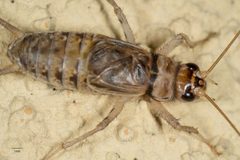
Gryllodes sigillatus is a small widely farmed for human consumption and animal feed, particularly as a sustainable protein source. Native to Southwestern Asia, it has spread throughout tropical regions worldwide and is commonly associated with human habitations. The species has gained prominence in commercial insect farming due to its resistance to Acheta domesticus densovirus (AdDNV), which devastated of the common house cricket. It serves as a model organism in behavioral and evolutionary research, particularly for studies on mating systems, , and neurobiology.


Pronunciation
How to pronounce Gryllodes sigillatus: /ˈɡrɪloʊdiːz sɪdʒɪˈleɪtəs/
These audio files are automatically generated. While they are not always 100% accurate, they are a good starting point.
Images
Habitat
Tropical climates; strongly associated with human habitations and urban environments. Often found indoors, particularly in buildings. Shows narrow compared to other , preferring the types of environments created by human activity.
Distribution
Probably native to Southwestern Asia; now distributed throughout tropical regions worldwide. Documented in North America (Arizona, California), Caribbean (Cayman Islands), and East Asia (China Southeast, Manchuria). First reported from Colombia in 2011, representing expansion in South America.
Life Cycle
Hatch to adulthood in approximately 35 days under optimal conditions. development time is a key trait for colony management. Body size and mass increase weekly through nymphal development. supplementation (15% w/w) increases probability of reaching adulthood and optimizes female body mass at approximately 17% w/w concentration.
Behavior
Males produce a unique calling song characterized by short pulses. Females prefer short pulse durations associated with larger males. Males transfer sperm via a accompanied by a large gelatinous that females consume during copulation; larger gifts prolong sperm transfer time and increase paternity. Postcopulatory mate guarding occurs; males guard females to prevent rival males from displacing their spermatophores, though guarding declines when multiple rival males have free contact with the pair. Males abandon guarding when exposed to multiple other females. Wind-evoked escape responses involve sensory detection of air currents and specific motor patterns for avoidance. Decapitated specimens retain stimulus-specific foreleg responses (extension, withdrawal, lift, jump) controlled by the T1 thoracic ganglion, demonstrating decentralized neural control of .
Human Relevance
Widely farmed commercially for human consumption as an alternative protein source and for feeding reptiles, birds, amphibians, and insectivorous arthropods. Promoted as a sustainable livestock alternative with lower carbon footprint than traditional meat production. USDA has issued permits for sale and transport in the United States. Considered a lower invasion risk than other imported to replace Acheta domesticus due to narrow , though occasional indoor occurrences require management.
Similar Taxa
- Acheta domesticusCommon house cricket; primary commercial feeder before AdDNV . G. sigillatus has replaced it in many operations due to virus resistance. A. domesticus females have wings that do not extend past the tip, whereas G. sigillatus females have wings extending beyond the abdomen.
- Gryllus assimilisNative U.S. field cricket also imported as AdDNV- replacement; USDA-approved for sale. G. sigillatus is smaller, associated with human habitations rather than field , and has a distinct calling song.
- Gryllus bimaculatusEuropean widespread across three continents; illegal to sell in the U.S. G. sigillatus is smaller, has different coloration (banded pattern), and occupies tropical rather than temperate to subtropical zones.
- Gryllus locorojoUndescribed species discovered in pet trade, named after its 'crazy red' ; aggressive . G. sigillatus is more docile, established in scientific literature, and has narrower .
More Details
Commercial farming characteristics
Mass-rearing protocols emphasize understanding of traits to optimize growth and reduce yield variability. supplementation increases female by 67% more and 30% greater body mass, with sex-specific responses to dietary enhancement. -assisted breeding targets have been identified through comparative to accelerate selective breeding for agricultural traits.
Neurobiological significance
Research on decapitated specimens has contributed to concepts of 'decapitated body intelligence' (DBI) or 'extrabrain intelligence' (EI), challenging brain-centric views of insect cognition by demonstrating that thoracic ganglia can independently process sensory information and coordinate appropriate motor responses.
Sources and further reading
- BugGuide
- GBIF taxonomy match
- iNaturalist taxon
- NCBI Taxonomy
- Catalogue of Life
- Encyrtid Holdings | Entomology Research Museum
- Cricket Virus Leads to Illegal Importation of Foreign Species for Pet Food
- Gifts from Male Crickets May Make Females Less Receptive to Future Mating
- Gryllodes sigillatus Archives - Entomology Today
- Gryllodes-sigillatus - Entomology Today
- Tropical House Cricket, Gryllodes sigillatus (F. Walker)
- Behavioral Analyses of Wind-evoked Escape of the Cricket, Gryllodes sigillatus
- Decapitated body intelligence (DBI) in cricket Gryllodes sigillatus
- Fruitful female fecundity after feeding Gryllodes sigillatus royal jelly
- Growth, development, and life history of a mass-reared edible insect, Gryllodes sigillatus (Orthoptera: Gryllidae)
- Female Mate Choice, Calling Song and Genetic Variance in the Cricket,Gryllodes sigillatus
- Mate Guarding in the Cricket Gryllodes sigillatus: Influence of Multiple Potential Partners
- Fruitful female fecundity after feeding Gryllodes sigillatus (Orthoptera: Gryllidae) royal jelly
- A new genus of cricket near to Miogryllus and Kazuemba from the Colombian Atlantic coast and the first report of Gryllodes sigillatus from Colombia (Orthoptera: Gryllidae: Gryllinae: Modicogryllini)
- Observations on the Mating Behaviour of <i>Gryllodes sigillatus</i> (Walker) (Insecta: Orthoptera: Gryllidae)
- A high-quality reference genome and comparative genomics of the widely-farmed banded cricket ( Gryllodes sigillatus ) identifies selective breeding targets
- The identical topography of the distribution of alkaline phosphatase and neurosecretory material in the neuroendocrine organs of Gryllodes sigillatus (walk), (orthoptera, gryllidae)