
Smeringopus pallidus
(Blackwall, 1858)
Pale Daddy-Long-Leg, Pale Cellar Spider
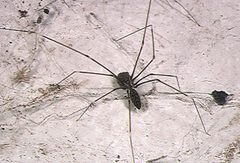
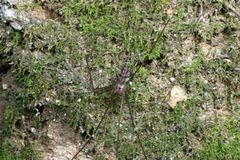
Smeringopus pallidus is a cosmopolitan cellar spider ( Pholcidae) known for its distinctive pale coloration and extremely long, slender legs. The builds irregular, three-dimensional cobwebs in sheltered locations and exhibits specialized anti- defenses including rapid leg waving, leg with continued movement of detached legs as visual distraction, and (death feigning). Originally described from Africa, it has been introduced to tropical and subtropical regions worldwide including South America, the Caribbean, Sri Lanka, Southeast Asia, Australia, and Pacific islands. The species reaches body lengths up to 7 mm with females larger than males, and is characterized by purple spots along the and a dark sternal stripe.
Pronunciation
How to pronounce Smeringopus pallidus: //smɛˈrɪŋɡəpəs ˈpælɪdəs//
These audio files are automatically generated. While they are not always 100% accurate, they are a good starting point.
Identification
Distinguished from other pholcid spiders by the combination of: pale coloration with purple abdominal spots; dark sternal stripe; simple female without pockets; and extremely long, spineless legs with few vertical hairs. Distinguished from the similar Pholcus phalangioides by body proportions and color pattern. The ' pantropical distribution and habits also aid identification. Molecular or detailed genitalic examination may be required to distinguish from congeneric species.
Images
Habitat
found in sheltered, dark locations. Builds webs in dusty corners of houses, under covered drains, and on mud walls in gardens and rural areas. In natural settings, occurs in tropical forests and similar sheltered microhabitats. Web placement in protected, shaded locations appears consistent across introduced and native ranges.
Distribution
Native to Africa; introduced and established throughout tropical and subtropical regions worldwide. Recorded from South America, the Caribbean, Sri Lanka, China, Laos, Philippines, Indonesia, Australia, and Pacific islands. distribution due to human-mediated transport.
Diet
Captures small insects and other spiders in irregular cobwebs. Prey items include various small arthropods that become entangled in the three-dimensional web structure.
Behavior
Builds irregular, three-dimensional tangled cobwebs with no obvious capture spiral. When disturbed, hangs upside down in web and vibrates vigorously to confuse intruders. Exhibits specialized anti- defenses: rapid leg waving when disturbed; leg (self-amputation at - joint) with detached legs continuing to move for up to one hour as visual distraction; (death feigning) as secondary defense. Whirling —rapid circular body movement with legs remaining on silk—elicited by forceful tactile and air movement stimuli. Tactile stimulation more effective than air movement in eliciting defensive responses. Less responsive to chemical stimuli from potential predators.
Ecological Role
of small insects and spiders; serves as prey for web-invading jumping spiders (Salticidae) and other predators. Anti-predator defenses including and whirling represent significant behavioral adaptations. Web-building activities contribute to structure in sheltered microhabitats.
Human Relevance
commonly found in human dwellings. Considered beneficial as of small household insects and other spiders. No known medical importance; not considered dangerous to humans. May cause minor nuisance when webs accumulate in corners of buildings. Introduction to new regions facilitated by human transport.
Similar Taxa
- Pholcus phalangioidesSimilar long-legged pholcid spider with irregular web-building habits; distinguished by body proportions, coloration patterns, and genitalic . S. pallidus has distinctive purple abdominal spots and dark sternal stripe not present in P. phalangioides.
- Psilochorus sphaeroidesAnother tropical pholcid spider that exhibits whirling defense ; studied alongside S. pallidus in -prey interaction research. Distinguished by geographic distribution (Australia) and specific morphological features.
More Details
Predator-Prey Interactions
Laboratory studies demonstrate that S. pallidus is vulnerable to specialized web-invading jumping spiders, particularly Portia fimbriata, which uses to approach without stimulating whirling defense. Whirling is highly effective when elicited; artificially induced whirling prevented capture by salticid in experimental conditions.
Defensive Autotomy
Leg in S. pallidus occurs at the - joint. Detached legs continue rhythmic movement for extended periods (up to one hour), serving as visual distraction to divert attention from the spider's body. This represents an elaborate evolutionary among pholcid spiders.
Sources and further reading
- BugGuide
- Wikipedia
- GBIF taxonomy match
- iNaturalist taxon
- NCBI Taxonomy
- Catalogue of Life
- Encyrtid Holdings | Entomology Research Museum
- Don't Bet Your Hedges: IPM Guide Outlines Ficus Whitefly Management
- Araneae | Beetles In The Bush | Page 5
- Bibliography | Beetles In The Bush
- Anti‐predator defences of Psilochorus sphaeroides and Smeringopus pallidus (Araneae, Pholcidae), tropical web‐building spiders
- Predator‐prey interactions between web‐invading jumping spiders and two species of tropical web‐building pholcid spiders, Psilochorus sphaeroides and Smeringopus pallidus