
Smeringopus
Simon, 1890
cellar spiders
Species Guides
1- Smeringopus pallidus(Pale Daddy-Long-Leg)
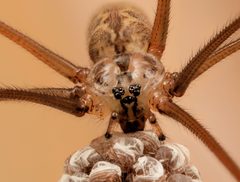
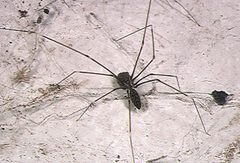
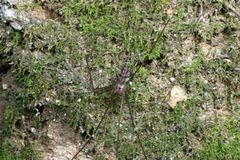
Smeringopus is a of cellar spiders ( Pholcidae) comprising 55 , making it the most species-rich pholcid genus in Africa. First described by Eugène Simon in 1890, the genus is largely restricted to central, southern, and eastern Africa, though some species occur in South America, Asia, Australia, and Pacific Islands. Members include some of the largest and most conspicuous pholcid spiders in their range. The genus is divided into twelve operational species groups based on morphological and geographic patterns. Smeringopus is the sister to the western and central African genus Smeringopina.
Pronunciation
How to pronounce Smeringopus: /ˌsmɛrɪŋˈɡoʊpəs/
These audio files are automatically generated. While they are not always 100% accurate, they are a good starting point.
Identification
Smeringopus can be distinguished from other pholcid by morphological features used to define the twelve operational species groups within the genus, though specific diagnostic characters require examination of and genitalia. The genus includes notably large-bodied pholcids compared to many . Cladistic analysis supports Smeringopus as distinct from its sister genus Smeringopina. Species-level identification relies on detailed morphological examination per the taxonomic revision.
Images
Habitat
Tropical environments; builds irregular three-dimensional webs.
Distribution
Largely restricted to central, southern, and eastern Africa; also present in South America, Asia, Australia, and Pacific Islands.
Behavior
Web-building; exhibits rapid circular whirling when disturbed, with legs remaining on silk—this is the most frequent anti- response of to tactile and air movement stimuli. Whirling is an effective defense against web-invading jumping spiders (Salticidae); artificially induced whirling prevents even when predators are present. S. pallidus has been observed to display (death feigning) when captured. Activity is .
Similar Taxa
- SmeringopinaSister to Smeringopus; distinguished by geographic distribution (western and central Africa vs. central, southern, and eastern Africa for Smeringopus) and morphological synapomorphies.
- Pholcus phalangioides pholcid that also exhibits whirling , but differs in distribution and body proportions; Smeringopus are generally larger and more conspicuous.
- PsilochorusShares web-building habit and whirling defense , but Smeringopus exhibits more pronounced shaking responses and in at least some .
More Details
Taxonomic History
Crossopriza cylindrogaster Simon, 1907 was transferred to Smeringopus. Three were synonymized with S. pallidus: S. excavatus, S. pholcicus, and S. buehleri. Smeringopus madagascariensis was synonymized with S. carli.
Predator Interactions
Laboratory studies demonstrate that Portia jumping spiders are more efficient of Smeringopus pallidus than Euryattus, but Portia are less inclined to stimulate whirling , which is the primary defense. Portia fimbriata is more consistent in using and more efficient at capture than P. labiata.
Sources and further reading
- BugGuide
- Wikipedia
- GBIF taxonomy match
- iNaturalist taxon
- NCBI Taxonomy
- Catalogue of Life
- Revision and cladistic analysis of the Afrotropical endemic genus Smeringopus Simon, 1890 (Araneae: Pholcidae)
- Anti‐predator defences of Psilochorus sphaeroides and Smeringopus pallidus (Araneae, Pholcidae), tropical web‐building spiders
- Predator‐prey interactions between web‐invading jumping spiders and two species of tropical web‐building pholcid spiders, Psilochorus sphaeroides and Smeringopus pallidus