
Tibellus maritimus
(Menge, 1875)
Maritime Running Crab Spider
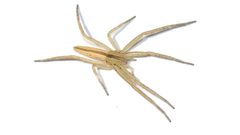
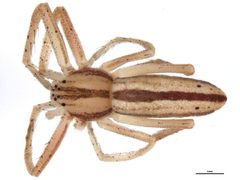
Tibellus maritimus is a of running crab spider in the Philodromidae, characterized by its slender body and vertical striped pattern that provides effective camouflage on grasses and foliage. The species is notable within its for lacking the two dark spots on the that distinguish related species such as T. oblongus and T. asiaticus. It is the only Tibellus species in the Canadian portion of its range without these spots. The spider hunts by ambush, lying flattened on vegetation to capture prey.
Pronunciation
How to pronounce Tibellus maritimus: /tɪˈbɛləs məˈrɪtɪməs/
These audio files are automatically generated. While they are not always 100% accurate, they are a good starting point.
Identification
Tibellus maritimus can be reliably distinguished from T. oblongus and T. asiaticus by the absence of two dark spots on the . In the Canadian portion of its range, it is the only Tibellus lacking these spots. The species shares the -typical slender body form and vertical striped patterning with other Tibellus species, requiring careful examination of abdominal markings for definitive identification.
Images
Habitat
Found on grasses, stems, stalks, grassblades, and leaves where it lies in ambush. The occupies vegetation in open and semi-open including grasslands, meadows, and disturbed areas with herbaceous growth.
Distribution
North America, Europe, Caucasus, Russia (Europe to Far East), Central Asia, and China. In North America, present in Canada and the United States.
Life Cycle
Females construct flattened that they guard until spiderlings emerge. The egg case is typically attached to vegetation.
Behavior
Hunts by lying in ambush on vegetation, relying on camouflage from its slender body and vertical striped pattern. When disturbed, females guarding remain motionless and do not readily abandon their position.
Ecological Role
Ambush on vegetation, likely contributing to control of small in grassland and meadow .
Similar Taxa
- Tibellus oblongusSimilar slender body form and vertical striping, but distinguished by presence of two dark spots on
- Tibellus asiaticusSimilar overall appearance and use, but distinguished by presence of two dark spots on
- Thanatus spp.Also in Philodromidae with similar size and striping, but more robust body form and hunts primarily on ground amid grasses rather than on stems and leaves
- Pisaurina miraSimilar resting posture and overlap, but more robust and hairier with different arrangement; larger at maturity (12.5-16.5 mm females versus 6-11 mm for Tibellus)
- Oxyopes salticusSimilar grass-mimicking appearance, but has very long spines on legs, more scrunched posture, and longer ''; belongs to different (Oxyopidae)