
Teminius
Keyserling, 1887
Species Guides
2- Teminius affinis(prowling spider)
- Teminius insularis
Teminius is a of spiders in the Miturgidae, first described by Keyserling in 1887. The genus contains four recognized distributed across the Americas, from the United States through Central America and the Caribbean to Argentina. Teminius species are long-legged wandering spiders that do not build permanent webs for prey capture.
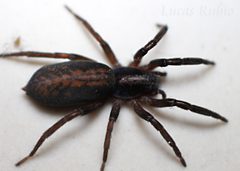
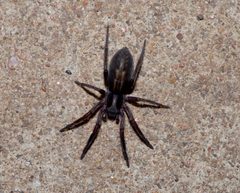
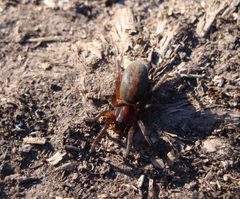
Pronunciation
How to pronounce Teminius: /tɛˈmɪniʊs/
These audio files are automatically generated. While they are not always 100% accurate, they are a good starting point.
Identification
Teminius can be distinguished from other Miturgidae by a combination of arrangement and leg proportions. Members of this genus possess the characteristic eye pattern of Miturgidae, with two rows of four eyes each. The genus is further characterized by elongated legs relative to body size and a somewhat flattened . -level identification requires examination of genitalia, particularly the male and female epigyne.
Images
Habitat
in this occupy a range of terrestrial including forests, scrublands, and disturbed areas. They are ground-dwelling or low vegetation hunters. Teminius hirsutus has been recorded from sea level to mid-elevations in its broad Neotropical range.
Distribution
The is distributed across the Americas. Teminius affinis occurs in the United States and Mexico. Teminius agalenoides is found in Paraguay and Argentina. Teminius hirsutus ranges from Mexico through Central America to Venezuela and throughout the Caribbean. Teminius insularis has the broadest distribution, occurring in the United States, the Greater Antilles, and South America to Argentina.
Behavior
Teminius are wandering hunters that do not construct permanent webs for prey capture. They are nocturnally active, seeking prey through active pursuit. During daylight hours, they shelter under debris, bark, or within vegetation.
Ecological Role
As , Teminius contribute to in their . Their presence across diverse from temperate to tropical zones indicates adaptability to varying prey .
Similar Taxa
- CheiracanthiumBoth contain long-legged, wandering spiders with similar overall body proportions, but Cheiracanthium belongs to Cheiracanthiidae and has a different arrangement with a recurved eye row.
- MiturgaA congeneric in Miturgidae that shares the -typical arrangement and wandering habit, but differs in genitalic and geographic distribution, with Miturga primarily occurring in the Old World.
More Details
Taxonomic History
The was established by Eugen von Keyserling in 1887. The number of included has remained stable, with four species currently recognized following revisions. The genus name has been consistently placed in Miturgidae, though -level relationships within the RTA clade have undergone revision in recent molecular phylogenetic studies.
Species Diversity
The four recognized show substantial geographic range variation, with T. insularis and T. hirsutus having broad Neotropical distributions while T. affinis and T. agalenoides have more restricted ranges. No new species have been described since the mid-20th century, suggesting either genuine low diversity or lack of recent taxonomic attention.