
Pirata piraticus
(Clerck, 1757)
Pirate Otter Spider
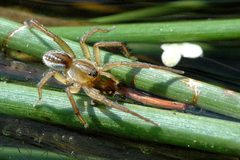
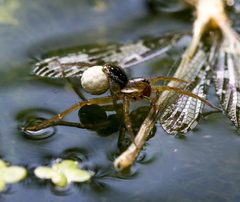
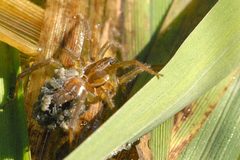
Pirata piraticus is a wolf spider in the Lycosidae with a Holarctic distribution spanning North America, Europe, and Asia. Unlike the wandering hunting strategy typical of many wolf spiders, this constructs small sheet webs with retreat tubes in moist Sphagnum moss . It exhibits complex variation with two reproductive cohorts: early-emerging individuals mature and reproduce in the same year, while late-emerging individuals overwinter and reproduce the following spring.
Pronunciation
How to pronounce Pirata piraticus: /pɪˈrɑːtə pɪˈrætɪkəs/
These audio files are automatically generated. While they are not always 100% accurate, they are a good starting point.
Identification
Distinguished from other wolf spiders by its web-building in Sphagnum moss —constructing small sheet webs with retreat tubes rather than hunting freely. The of mature females shows paired symmetrical openings characteristic of the . Separated from congeneric Pirata species by microhabitat preferences and web structure details; from Lycosa and other wandering Lycosidae by its sit-and-wait hunting strategy within a constructed web.
Images
Habitat
Moist Sphagnum moss carpets in bogs and wetlands, particularly in wetter depressions and along margins of small pools. Occupies the vertical structure of Sphagnum moss, showing vertical following water table fluctuations.
Distribution
Holarctic: North America, Europe, Turkey, Caucasus, Russia (European to Far East), Kazakhstan, Iran, Central Asia, China, and Japan.
Seasonality
present from May/June to September/October; peak adult activity in June-July. Spiderlings emerge in spring (April-May).
Life Cycle
Overwinters as immatures; matures in spring. Two distinct cohort strategies: early-emerging spiders reproduce in same year, late-emerging individuals overwinter again and reproduce following spring. Females carry sacs attached to from May to July; egg sacs observed from late June through August.
Behavior
Constructs small sheet webs with retreat tubes in Sphagnum moss, sitting in the retreat waiting for prey vibrations. Shows vertical within Sphagnum layer tracking water table changes. Active hunter within web structure rather than free-roaming; captures prey that contact the web sheet.
Ecological Role
in Sphagnum bog ; occupies a distinct microhabitat from wandering wolf spiders, contributing to predator partitioning in wetland .
Similar Taxa
- Lycosa pullataSympatric wandering wolf spider in same Sphagnum bog ; distinguished by free-roaming hunting without web construction
- Other Pirata speciesCongeneric spiders with similar ; separated by subtle differences in structure and microhabitat preferences
More Details
Reproductive plasticity
The shows remarkable year-to-year variation in reproductive timing and success linked to and weather conditions, representing an adaptive strategy in unpredictable environments.
Web architecture
The web consists of a horizontal sheet with a tubular retreat at one edge; the spider positions itself in the retreat with legs extending onto the sheet to detect vibrations from contacting prey.
Sources and further reading
- BugGuide
- Wikipedia
- GBIF taxonomy match
- iNaturalist taxon
- NCBI Taxonomy
- Catalogue of Life
- Bug Eric: Spider Sunday: Spider Sex Ed
- Bug Eric: 2011
- Uncategorized | Blog - Part 37
- The pirate ant: A new species from the Philippines with a bizarre pigmentation pattern | Blog
- On the Ecology of Two Lycosid Spiders (Pirata piraticus and Lycosa pullata) from a Danish Sphagnum bog
- LIFE CYCLE, REPRODUCTIVE PATTERNS AND THEIR YEAR-TO-YEAR VARIATION IN A FIELD POPULATION OF THE WOLF SPIDER PIRATA PIRATICUS (ARANEAE, LYCOSIDAE)