
Hogna lenta
(Hentz, 1844)
Field Wolf Spider
Hogna lenta is a of wolf spider in the Lycosidae, commonly known as the Field Wolf Spider. It is native to the southeastern United States, with particular abundance in Florida. This large, ground-dwelling spider constructs vertical burrows in sandy substrates and hunts using vibration detection. The species has been used in neuroanatomical research to study catecholaminergic distribution in spider .
Pronunciation
How to pronounce Hogna lenta: /ˈhɒɡ.nə ˈlɛn.tə/
These audio files are automatically generated. While they are not always 100% accurate, they are a good starting point.
Identification
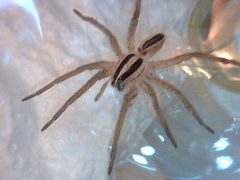
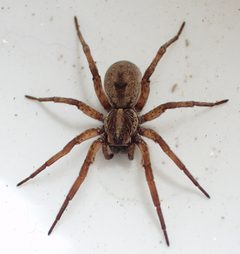
Large wolf spider with body diameter approximately the size of a 50-cent coin. Distinguished from similar Hogna by geographic range (southeastern US, especially Florida) and preference for sandy sediments. Mature individuals are robust with stout legs adapted for digging. The front of the is elevated compared to the rear portion. arrangement typical of Lycosidae: two large eyes that reflect light at night, producing a blue-green glow when illuminated by headlamps or flashlights.
Images
Habitat
Primarily found in sandy sediments and open areas with sparse ground litter. Constructs vertical burrow shafts in soil, often incorporating a turret of silk mixed with debris at the burrow mouth. Sometimes uses a thick layer of silk and sediment as a trap door. Occupies a variety of but shows strong association with sandy substrates.
Distribution
Southeastern United States, particularly Florida. Records from GBIF and other sources confirm presence in USA and North America broadly, with highest concentration in the Southeast.
Diet
Primarily feeds on small insects including crickets, waxworms, and . Will consume beetles when preferred prey is unavailable. Newly emerged spiderlings can eat small fruit flies. Hunts using vibrations to detect prey approaching the burrow entrance.
Life Cycle
Mating occurs shortly before sac construction. Female constructs a large white egg sac larger than her within 1–2 weeks after mating. Carries egg sac attached to on abdomen. Spiderlings develop inside eggs for 5–8 weeks before hatching. Newly emerged spiderlings are extremely small (described as about the size of a small LED light) and remain on mother's abdomen for 1–4 weeks. Upon leaving the mother, young spiders are highly agile. Many die within days of ; survivors , with young spiders capable of molting up to three times per month. Spiderlings grow slowly and molt repeatedly, shedding old skin as new skin remains malleable to allow growth.
Behavior
hunter that remains in burrow and uses vibrations to detect prey at the burrow entrance. When threatened, raises front legs in the air to appear larger. If this display fails, lunges directly in front of the attacker to startle them. Biting is a final defensive response. Possesses delivered through fangs that paralyzes prey while the spider consumes .
Ecological Role
of small insects in sandy terrestrial . Burrowing activity may contribute to soil aeration and mixing. Serves as prey for spider wasps in the Pompilidae, including in the Priocnemis and Anoplius.
Human Relevance
Venom poses no serious threat to healthy humans; bites reported to feel comparable to a sting. Sometimes encountered by humans in sandy areas, particularly when using headlamps at night due to reflective . Has been used in scientific research on spider neuroanatomy and catecholaminergic .
Similar Taxa
- Hogna carolinensisSimilar large size and wolf spider , but H. carolinensis has broader distribution and different preferences; H. lenta is specifically associated with Florida and sandy substrates
- Arctosa littoralisAlso a burrowing wolf spider found in sandy , but A. littoralis occupies beach and shoreline habitats rather than inland sandy areas, and has different geographic distribution
- Geolycosa missouriensisAnother burrowing wolf spider with similar burrow construction, but G. missouriensis is centered in the Great Plains rather than the Southeast, and has different body proportions with more pronounced elevation
Sources and further reading
- BugGuide
- Wikipedia
- GBIF taxonomy match
- iNaturalist taxon
- NCBI Taxonomy
- Catalogue of Life
- Bug Eric: Spider Sunday: Burrowing Wolf Spider
- ID Challenge #20 | Beetles In The Bush
- Bug Eric: Wasp Wednesday: Anoplius aethiops
- Miridae | Beetles In The Bush
- Tyrosine hydroxylase immunolabeling reveals the distribution of catecholaminergic neurons in the central nervous systems of the spiders Hogna lenta (Araneae: Lycosidae) and Phidippus regius (Araneae: Salticidae)