
Bathyphantes
Menge, 1866
dwarf spiders, sheetweb weavers
Species Guides
9- Bathyphantes alascensis(Three-spined Shield Sheetweaver)
- Bathyphantes alboventris(Notch-tipped Shield Sheetweaver)
- Bathyphantes brevipes(Grey Sheetweb Weaver)
- Bathyphantes brevis(Short Sheetweb Weaver)
- Bathyphantes canadensis(Canada Sheetweb Weaver)
- Bathyphantes keeni(Hump-headed Shield Sheetweaver)
- Bathyphantes orica(Short Shield Sheetweaver)
- Bathyphantes pallidus(Pale Sheetweb Weaver)
- Bathyphantes weyeri(Wide Shield Sheetweaver)
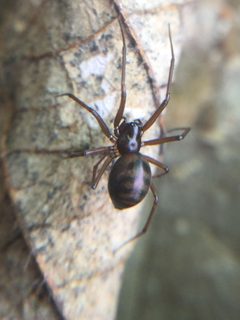
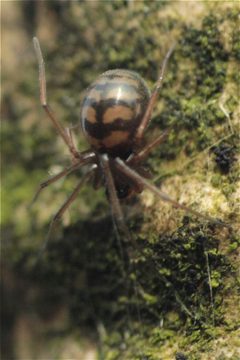
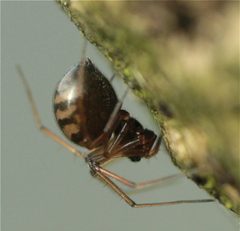
Bathyphantes is a of dwarf spiders ( Linyphiidae) comprising approximately 57 distributed across the Holarctic region, with additional species in South America, Africa, Asia, and Oceania. These small spiders construct sheet webs and are characterized by complex male and female used for species identification. The genus was first described by Anton Menge in 1866. At least one species, Bathyphantes simillimus, exhibits a triennial potentially adapted to cooler environments.
Pronunciation
How to pronounce Bathyphantes: //ˌbæθɪˈfæntiːz//
These audio files are automatically generated. While they are not always 100% accurate, they are a good starting point.
Identification
Identification to requires examination of genitalia. Males possess complex with an embolus, bulb, and cymbium that function as species-specific 'keys' to female 'locks.' Females have a sclerotized on the with paired openings. External alone is insufficient for reliable species determination within this .
Images
Habitat
occupy diverse microhabitats including deep sandstone rock crevices, forest edges, pine woodlands, and human-modified environments. Some species construct webs beneath stones, in rock wall crevices, or under loose bark on trees and logs.
Distribution
Holarctic distribution with in North America (USA, Canada, Alaska), Europe, Russia (Europe to Far East), and northern Asia (China, Korea, Japan, Kazakhstan). Additional species occur in Angola, Argentina, Australia (Queensland, Lord Howe Island), Borneo, Karakorum, Laos, Myanmar, New Caledonia, Philippines, Samoa, St. Helena, Sumatra, Thailand, and Vietnam.
Life Cycle
At least one (B. simillimus) exhibits a triennial : new individuals emerge in summer, overwinter, mature and breed throughout the following year, survive a second winter, breed again, and die in the year following their second winter. This extended cycle may represent an to cooler environmental conditions.
Behavior
Constructs sheet webs for prey capture. Males wander to locate mates even in where females are web-bound. Sperm transfer involves males spinning a sperm web, depositing semen, and sucking it into prior to seeking females.
Similar Taxa
- FrontinellaBoth are linyphiid sheetweb weavers; Frontinella is distinguished by its distinctive bowl-and-doily web architecture (Bathyphantes constructs simple sheet webs)
- NerieneBoth linyphiid with dome or sheet webs; Neriene typically have different abdominal patterning and epigynal structure
- PimoaRelated linyphiid mentioned in Wikipedia 'See also' section; likely similar in general habitus but distinguished by genitalic and web characteristics
More Details
Taxonomic note
The has undergone recent placement revisions. Formerly placed in Amaurobiidae (1986-2023), it has returned to Linyphiidae based on the absence of a cribellum, a defining feature of Amaurobiidae.