
Sergiolus unimaculatus
Emerton, 1915
Sergiolus unimaculatus is a ground spider in the Gnaphosidae, first described by Emerton in 1915. Like other members of its , it is a nomadic, hunter that does not construct webs for prey capture. The exhibits the characteristic bold coloration of Sergiolus, though specific pattern details for S. unimaculatus are less documented than for such as S. capulatus. It is one of approximately sixteen Sergiolus species known from north of Mexico.
Pronunciation
How to pronounce Sergiolus unimaculatus: //sərˈdʒiːələs juːnɪˌmækjʊˈleɪtəs//
These audio files are automatically generated. While they are not always 100% accurate, they are a good starting point.
Identification
Distinguished from other Sergiolus by subtle genitalic characters: male structure and female . The specific epithet suggests a single distinct abdominal marking, potentially separating it from more variegated like S. capulatus. Separation from gnaphosids in related (e.g., Callilepis) requires examination of genitalia. The cylindrical help distinguish it from colorful spiders in non-gnaphosid .
Images
Appearance
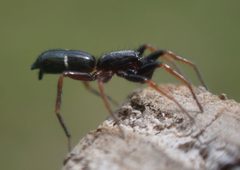
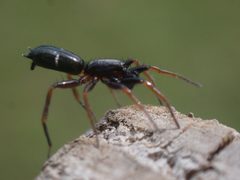
Medium-sized spider with body length likely falling within the range of 5.5–10 mm (males smaller than females). As a member of Sergiolus, expected to display bold, contrasting coloration—typically combinations of red, black, and white markings. Possesses the diagnostic cylindrical at the characteristic of Gnaphosidae. Specific pattern of S. unimaculatus distinguished by a single prominent spot or marking (implied by specific epithet "unimaculatus," meaning "one-spotted"), though detailed descriptions are sparse in accessible literature.
Habitat
Expected to occupy similar to : leaf litter in deciduous forests, sun-dappled forest floors, gardens, meadows, and lawns. May be found under stones and debris in dry situations. Also recorded as an occasional indoor wanderer.
Distribution
Recorded from USA and Canada. Specific range details poorly documented compared to more frequently encountered ; likely occurs in eastern or central North America based on Emerton's type locality and distribution patterns of related .
Seasonality
likely active year-round with peak activity during warmer months. probably occurs in retreats.
Life Cycle
Constructs silk retreats for molting, sac guarding by females, and . Does not build prey-capture webs. Lifespan likely exceeds one year based on -level patterns.
Behavior
and nomadic, actively prowling rather than waiting in webs. Highly agile, especially when fleeing disturbance. Good climber, frequently found on foliage and walls despite "ground spider" for . Reclusive but may reappear after fleeing if observer remains still.
Ecological Role
contributing to in forest floor and ground-level . Potential Batesian mimic of velvet ants (Mutillidae), though this hypothesis remains unconfirmed for S. unimaculatus specifically.
Human Relevance
Occasional indoor visitor, sometimes provoking alarm due to -like appearance. Easily maintained in captivity with minimal requirements; feeds on small insects. Not considered medically significant.
Similar Taxa
- Sergiolus capulatusMore abundant and widely reported eastern with variegated (multi-spotted) pattern resembling velvet ants in Timulla; S. unimaculatus distinguished by simpler, single-marked
- Sergiolus montanusWestern North American ; geographic separation and subtle pattern differences
- Callilepis spp.Related gnaphosids requiring genitalic examination for reliable separation
- Mutillidae (velvet ants)Wingless that S. unimaculatus may mimic in appearance; distinguished by six legs, , and lack of
More Details
Taxonomic history
Some Sergiolus were formerly placed in the Poecilochroa; older references may use this synonymy.