
Calymmaria emertoni
(Simon, 1897)
Calymmaria emertoni is a small true spider in the Cybaeidae (formerly Hahniidae). It is one of approximately 31 Calymmaria found north of Mexico, with most species restricted to the Pacific coast region. This species is notable for its distinctive basket-shaped web and habits.
Pronunciation
How to pronounce Calymmaria emertoni: /kəˌlɪməˈriə ɪˈmɜrtəni/
These audio files are automatically generated. While they are not always 100% accurate, they are a good starting point.
Identification
Definitive identification requires microscopic examination of specimens, particularly males, due to subtle genitalia differences from the nearly identical C. bifurcata. Females of C. bifurcata are slightly larger on average (5.89–8.25 mm versus 5.02–7.95 mm for C. emertoni). Field identification to level is unreliable without specimen collection.
Images
Appearance
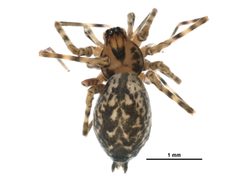
have a body length of 5.02–7.95 mm. The is morphologically similar to Calymmaria bifurcata, with females distinguished primarily by subtle differences in genitalia and slightly smaller average size.
Habitat
Builds webs under loose bark, in bark furrows, beneath moss on rocks or logs, amid rocks by streams, under cliff overhangs, at cave entrances, and on buildings. Prefers dark, sheltered microhabitats with high humidity.
Distribution
Found in the United States and Canada. Within this range, the occurs in the Pacific Northwest region, including Oregon.
Seasonality
have been observed active during winter months (December–January) in the Pacific Northwest, suggesting year-round activity in suitable conditions.
Diet
Feeds on small insects, particularly flies. Prey is attacked, bitten, and the spider retreats, possibly multiple times, before hauling the victim to the platform web to feed.
Behavior
. The spider emerges at night to hang beneath the sheet portion of its web, positioned above the inverted cone. It may occasionally venture onto the exterior of the cone. Web-building occurs in sheltered, dark locations.
Ecological Role
of small flying insects; contributes to insect in moist, sheltered microhabitats.
Human Relevance
No documented medical or economic significance. Non-aggressive; poses no known threat to humans.
Similar Taxa
- Calymmaria bifurcataNearly identical ; distinguished only by subtle genitalia differences and slightly larger average female size (5.89–8.25 mm vs. 5.02–7.95 mm).
- Tegenaria spp.Similar body size and general appearance; distinguished by web structure (basket-web vs. funnel-web) and taxonomic .
More Details
Family classification
Calymmaria has been classified in both Hahniidae and Cybaeidae. Current sources show Cybaeidae as the accepted , though NCBI retains Hahniidae. The was formerly placed in Agelenidae, with some even assigned to Tegenaria.
Web structure
The basket-web consists of an inverted cone anchored to substrate above and below, with a thin sheet woven close to the object from which the cone is suspended. This structure is unique among North American spiders and gives the group its of 'basket-web weavers'.