
Caponiidae
Simon, 1890
Bright Lungless Spiders
Genus Guides
2Caponiidae is a of ecribellate haplogyne spiders distinguished by several unusual morphological traits. Members lack book lungs, instead respiring through . The are anteriorly displaced, forming a transverse row with the lateral spinnerets—a unique arrangement among spiders. Most possess only two , though eye number varies remarkably within the family, with some species having four, six, or eight eyes; in certain species, eye number increases through ontogeny. The family comprises 21 and approximately 157 species, predominantly distributed in the Americas and Africa.

Pronunciation
How to pronounce Caponiidae: //kæˌpoʊˈnaɪɪˌdiː//
These audio files are automatically generated. While they are not always 100% accurate, they are a good starting point.
Identification
Distinguished from other spider by the combination of: (1) absence of book lungs; (2) anteriorly displaced forming transverse row with lateral spinnerets; and (3) typically reduced number (two eyes in most ). Resembles Dysderidae in general habitus but differs in spinneret arrangement and . Within Haplogynae, the unique spinneret configuration and variable eye counts separate Caponiidae from ecribellate relatives such as Dysderidae, Oonopidae, and Tetrablemmidae.
Images
Appearance
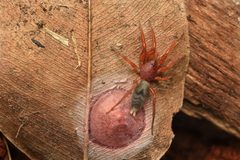
Small spiders, 2–5 mm in body length. typically orange; light gray. Resemble faded woodlouse hunter spiders (Dysdera). number highly variable: most with two eyes positioned -medially on carapace; some with four, six, or eight eyes. In some species, paired eyes meet at the midline, creating an effectively odd number. Lack book lungs. unusual: spinnerets displaced anteriorly to form transverse row with anterior lateral spinnerets.
Habitat
Ground-dwelling spiders found under rocks, in burrows, and in leaf litter. In China, collected from leaf litter in karst/limestone areas at 230–310 m elevation. Some appear drought-, with collections during dry season suggesting to arid conditions.
Distribution
Disjunct distribution in Africa and the Americas, from Argentina to the United States. Absent from Australia and New Zealand. Asian records sparse: previously known from Laos and Vietnam, with first Chinese record from Guangxi (2019). Highest in the Neotropical region, particularly the Wider Caribbean Region including Central America and northern Colombia/Venezuela.
Seasonality
specimens collected October–November in China during dry season; possible mating period October–March/April inferred from seasonal collection patterns, though not confirmed.
Diet
Spider hunters: at least some known to prey on other spiders. Specific prey preferences otherwise undocumented.
Behavior
Wandering hunters; collected by sieving leaf litter or using pitfall traps. Not web-builders. Some show apparent drought resistance capability.
Human Relevance
Calponia harrisonfordi named in honor of Harrison Ford for his support of the American Museum of Natural History. Some named with playful etymology: Notnops, Taintnops, Tisentnops emphasize Chile's lack of Nopinae members; Roddenberryus and epithets sargi and spock reference Star Trek. No known economic or medical significance.
Similar Taxa
- DysderidaeSimilar general appearance (woodlouse hunter-like habitus), but Caponiidae lacks book lungs and has unique anteriorly displaced ; Dysderidae retain book lungs and normal spinneret arrangement.
- TetrablemmidaeBoth are ecribellate haplogynes with reduced numbers, but Caponiidae differs in configuration and phylogenetic analyses place them as separate lineages.
More Details
Phylogenetic position
Long considered enigmatic; molecular and morphological analyses indicate probable sister group relationship to Tetrablemmidae plus the four of superfamily Dysderoidea. Nopinae ( Nops, Nopsides, Orthonops, Tarsonops, Medionops, Cubanops, Nyetnops, Nopsma, etc.) is well-supported; remaining genera unlikely to form a . Calponia harrisonfordi from California appears to be the most primitive member of the family.
Eye number variation
Unprecedented intrafamilial variation in number: eight eyes (Calponia, Caponia), six eyes (Iraponia, Caponina), four eyes (Nopsides, Notnops), two eyes (Cubanops, Diploglena, Laoponia, Medionops, Nops, Nopsma, Nyetnops, Orthonops, Taintnops, Tarsonops, Tisentnops). Some Caponia polymorphic with two, three, four, or 'five' eyes. In some species, eye number increases during post-embryonic development.
Leg modifications in Nopinae
Nopinae possess distinctive membranous translucent leg modifications: crista ( translucent keel on ), gladius (translucent extension between anterior metatarsi and ), and (membranous globose lobe associated with elongated, dorsally reflexed unpaired claw on all tarsi). These structures show varying degrees of development across genera and appear functionally related to locomotion on particular substrates.
Sources and further reading
- BugGuide
- Wikipedia
- GBIF taxonomy match
- iNaturalist taxon
- NCBI Taxonomy
- Catalogue of Life
- Update in the Peruvian Caponiidae: New records and new species of Nyetnops Platnick & Lise, 2007 (Araneae: Caponiidae)
- A new record of the spider family Caponiidae from China (Arachnida, Araneae)
- Three new species of the spider genus Nopsma (Araneae, Caponiidae, Nopinae) from Colombia
- A new species of the genus Nops MacLeay (Araneae: Caponiidae), from the Colombian Andes
- A new genus with seven species of the Subfamily Nopinae (Araneae, Caponiidae) from the Neotropical region
- Four new species of Nopsma Sánchez-Ruiz, Brescovit & Bonaldo, 2020 (Arachnida: Caponiidae) from Peru
- An update on the spider genus Caponina Simon (Araneae: Caponiidae) with descriptions of three new six-eyed species from Colombia
- A revision of the Neotropical spider genus Nops MacLeay (Araneae: Caponiidae) with the first phylogenetic hypothesis for the Nopinae genera
- CHAPTER 20. Ghosts, Goblins, Pirates, and Other Wandering Hunters: Mimetidae, Corrinidae, Trachelidae, Gnaphosidae, Caponiidae, Dysderidae, Oonopidae, Anyphaenidae, Miturgidae, Eutichuridae, and Liocranidae
- Four new spider species of Cubanops Sánchez-Ruiz, Platnick & Dupérré from Eastern Cuba (Araneae: Caponiidae)
- The spider genus Medionops Sánchez-Ruiz & Brescovit (Araneae: Caponiidae) in Colombia, with the description of four new species
- Four new caponiids species (Araneae, Caponiidae) from the West Indies and redescription of Nops blandus (Bryant)
- Notes on a small caponiid spider collection (Araneae: Caponiidae) from Mexico, with the description of a new species of Aamunops Galán-Sánchez & Álvarez-Padilla, 2022