
Oonopidae
Simon, 1890
Goblin spiders
Genus Guides
5- Escaphiella
- Heteroonops
- Opopaea(goblin spiders)
- Orchestina(goblin spiders)
- Tapinesthis(Ivy parchment spider)
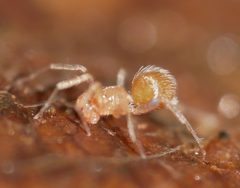
Oonopidae, commonly known as goblin spiders, is a diverse of minute spiders comprising approximately 2,000 described across 115 worldwide, with total estimated at 2,000–2,500. These spiders are characterized by their tiny size (typically 1–3 mm), reduced number (usually six, though some species have four, two, or are completely eyeless), and frequently exhibit unusual morphological modifications in males. The family shows remarkable morphological diversity including hardened abdominal plates (), modified mouthparts, sternal pouches, and elaborate structures. Goblin spiders are predominantly ground-dwelling, inhabiting leaf litter, soil, and rock crevices, with some lineages adapted to , caves, or nests. The family has an extensive fossil record in amber deposits dating back over 100 million years, with Orchestina already widespread by the end of the Cretaceous.
Pronunciation
How to pronounce Oonopidae: /oʊˈnɒpɪdeɪ/
These audio files are automatically generated. While they are not always 100% accurate, they are a good starting point.
Identification
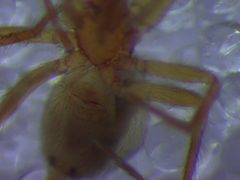
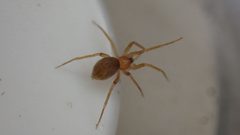
Goblin spiders are distinguished from other spider by their minute size (1–3 mm), reduced number (typically six or fewer), and the frequent presence of hardened abdominal plates (). They differ from similarly small Linyphiidae (sheet-web weavers) by body shape and eye arrangement. The family is morphologically heterogeneous, making generic identification challenging; male structure is typically required for -level determination. Some are immediately recognizable by distinctive features: Orchestina by enlarged fourth associated with jumping ability; eyeless or reduced-eye genera (Cousinea, Blanioonops, Diblemma, Coxapopha) by their troglomorphic adaptations. The family Ochyroceratidae (midget ground weavers) can be confused with Oonopidae but differs in structure and eye arrangement.
Images
Habitat
Primarily terrestrial microhabitats including leaf litter, soil, and under rocks; also occurs in tropical rainforest . Some lineages exhibit specialized associations: three blind Afrotropical (Anophthalmoonops, Caecoonops, Termitoonops) are exclusively -nest inhabitants; several genera contain cave-dwelling with reduced or absent (Cousinea, Blanioonops). The shows broad ecological flexibility across forested habitats from ground level to canopy.
Distribution
Worldwide distribution with approximately 2,000 described in 115 . Particularly diverse in tropical regions. Documented from all major biogeographic regions including the Neotropics, Afrotropics, Indomalaya, Australasia, and Palearctic. Specific documented localities include Sri Lanka (45 species in 13 genera), China (Yunnan, Xizang, Xishuangbanna), Philippines, Sumatra, Japan, and numerous other localities across tropical and subtropical regions.
Behavior
Members of the Orchestina are capable of jumping, facilitated by greatly enlarged on the fourth leg pair in both sexes. Some are thought to be parthenogenetic, including the pantropical Heteroonops spinimanus and Triaeris stenaspis, as no males have been collected. Cave-dwelling species exhibit slow, deliberate movements typical of troglobionts. The is generally secretive and seldom encountered due to small size and cryptic habits.
Ecological Role
Component of soil and leaf litter ; presumed small . In tropical rainforest , constitutes a significant component of spider fauna. -nest associated may have commensal or mutualistic relationships with their .
Human Relevance
Of minimal direct human importance due to small size and cryptic habits. Some have been used as indicators for monitoring forest quality and climate change effects, particularly the short-range species in Sri Lanka. The has substantial scientific value for understanding spider evolution, morphological diversification, and , with an exceptional fossil record providing insights into Cretaceous spider faunas.
Similar Taxa
- OchyroceratidaeMidget ground weavers of similar small size and ground-dwelling habits; distinguished by different structure and arrangement
- LinyphiidaeSheet-web weavers include minute of comparable size; distinguished by web-building , different arrangement, and typically eight eyes
- TelemidaeLong-legged cave spiders include small, -reduced ; distinguished by elongated legs and different body proportions
More Details
Fossil Record
Oonopidae have the richest fossil record of any spider in amber deposits, with specimens dating back over 100 million years to the Cretaceous. This abundance is attributed to their small size, widespread distribution, and wandering . Most fossil oonopids belong to the extant Orchestina, indicating this lineage was already globally distributed by the end of the Cretaceous. Sedimentary fossils are unknown.
Morphological Diversity
The exhibits exceptional morphological diversity, particularly in male secondary sexual characteristics. Examples include: heavily modified mouthparts in Coxapopha and Xyccarph; sternal pouches (holsters) in Grymeus; extensions in Ferchestina and Unicorn; and completely sclerotized pitch-black in male Ischnothyreus. Many of these traits are -specific and functionally enigmatic.
Taxonomic Activity
The is taxonomically active with numerous new described recently, including nine new species from Sri Lanka in 2018 and multiple new species from China (Yunnan, Xizang, Xishuangbanna) in 2024–2025. Phylogenetic relationships remain partially unresolved; molecular and morphological analyses suggest some (e.g., Xestaspis) may be junior synonyms of others (Gamasomorpha).
Sources and further reading
- BugGuide
- Wikipedia
- GBIF taxonomy match
- iNaturalist taxon
- NCBI Taxonomy
- Catalogue of Life
- mythology | Blog
- rainforests | Blog
- biodiversity | Blog - Part 36
- arachnology | Blog - Part 2
- new species | Blog - Part 22
- Evolutionary Systematics | Blog - Part 5
- The Goblin spider genus Xestaspis in Sri Lanka (Araneae: Oonopidae)
- Female genital morphology and mating behavior of Orchestina (Arachnida: Araneae: Oonopidae)
- A new species of Gamasomorpha Karsch, 1881 (Araneae, Oonopidae) from Yunnan Province, China.
- Two new species of the genus Trilacuna Tong & Li, 2007 (Araneae, Oonopidae) from the Nangunhe Nature Reserve, Yunnan Province, China.
- Three new species of the genus Gamasomorpha Karsch, 1881 (Araneae, Oonopidae) from the Philippines and Sumatra, Indonesia.
- A survey of Orchestina Simon, 1882 (Araneae, Oonopidae) from Xishuangbanna, China, with descriptions of eight new species.
- Two new species of Trilacuna Tong & Li, 2007 (Araneae, Oonopidae) from Yunnan Province, China, with a key to all known Trilacuna species of Yunnan.
- Three new species of Orchestina Simon, 1882 (Araneae, Oonopidae) from Xizang, China.
- Alien spiders in a palm house with the first report of parthenogenetic Triaeris stenaspis (Araneae: Oonopidae) infected by Wolbachia from new supergroup X.
- First record of the genus Trilacuna Tong & Li, 2007 (Araneae, Oonopidae) from Xizang, China, with descriptions of three new species and one newly recorded species.
- Four new species of the genus Trilacuna Tong & Li, 2007 (Araneae, Oonopidae) from China.