
Telemidae
Fage, 1913
long-legged cave spiders
Genus Guides
1- Usofila(American long-legged cave spiders)
Telemidae is a of small haplogyne spiders comprising approximately 100-113 described across sixteen . Members are predominantly cave-dwelling, with most species possessing six and some entirely eyeless. They are characterized by exceptionally long, slender legs and tracheal respiration rather than book lungs. The family occupies a disjunct distribution across tropical karst regions worldwide.
Pronunciation
How to pronounce Telemidae: //tɛˈlɛ.mɪˌdae̯//
These audio files are automatically generated. While they are not always 100% accurate, they are a good starting point.
Identification
Distinguished from other haplogyne by combination of: (1) extremely long, slender legs without ; (2) three pairs of with pair longest; (3) tracheal replacing book lungs; (4) hardened zigzag ridge on above ; (5) reduced number (0-6). Resembles Leptonetidae but differs in leg proportions, spinneret arrangement, and respiratory structures. Cave-dwelling habit and tropical distribution further narrow identification.
Images
Appearance
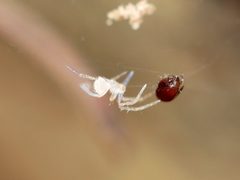
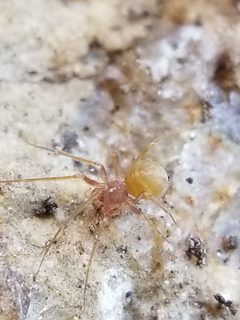
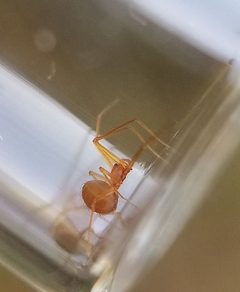
Small-bodied spiders with extremely long, thin, relatively spineless legs lacking . elongate with a hardened, zigzag-patterned ridge above the , more pronounced in males. Possess three pairs of , with the pair longest. Respiration via two pairs of tracheal ; book lungs absent. number variable: typically six eyes arranged in three diads, though some completely eyeless.
Habitat
Predominantly tropical rainforest karst caves; also recorded from leaf litter and under rocks in cave vicinity. Associated with humid, dark microenvironments. Lowland forest records confirmed for some .
Distribution
Southern Holarctic, Neotropical, Australasian (excluding Australia and New Zealand), Oriental, and Ethiopian biogeographic realms. Notable distribution gap in Central Africa recently filled by record from Democratic Republic of Congo. Disjunct pattern with concentrations in Southeast Asian karst, Madagascar, and Neotropical caves.
Similar Taxa
- LeptonetidaeAlso small haplogyne spiders with reduced and cave-dwelling habits; distinguished by shorter legs with , different proportions, and presence of book lungs
More Details
Taxonomic note
established by Fage in 1913. count varies between sources (~60 to 113) due to ongoing revisions and newly described ; sixteen currently recognized as of 2025.
Morphological specializations
Tracheal respiration and reduced represent convergent adaptations to hypogean environments shared with other cave spider lineages.