
Leptonetidae
Simon, 1890
cave spiders
Leptonetidae is a of small, primitive haplogyne spiders first described by Eugène Simon in 1890. The family comprises approximately 22 and 400 , though taxonomic boundaries have been revised recently with elevation of Archoleptonetinae to family rank (Archoleptonetidae). Leptonetids are characterized by their small size (2-5 mm), reduced number, and to dark, moist microhabitats. They represent a relict fauna with origins dating to the Cretaceous period and exhibit complex biogeographic patterns across the Holarctic.
Pronunciation
How to pronounce Leptonetidae: //ˌlɛptəˈnɛtɪdiː//
These audio files are automatically generated. While they are not always 100% accurate, they are a good starting point.
Identification
Distinguished from other small haplogyne spiders by the six- arrangement with pair set back from the semicircle. The greenish or bluish cuticular shine is distinctive. Separation from Archoleptonetidae (formerly Archoleptonetinae) requires examination of spinning organs: Archoleptonetidae includes both cribellate (with cribellum and calamistrum) and ecribellate forms, whereas Leptonetidae (sensu stricto) lacks cribellum. Difficult to identify to due to simple body plan, , and lack of diagnostic characters; increasingly used, with 4.2% genetic divergence threshold applied for species differentiation.
Images
Appearance
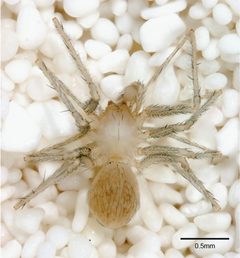
Small spiders, 2-5 mm in total body length. Generally pale in coloration with a distinctive greenish or bluish iridescent shine caused by microscopic texture on the . Six arranged in a characteristic pattern: four eyes in a semicircle anteriorly with two eyes set back from the main group. Some are eyeless or have further reduced eye numbers. (voluntary leg loss) occurs between the patella and tibia rather than at the / joint. Body form relatively simple with reduced typical of haplogyne spiders.
Habitat
Dark, moist microhabitats including caves (troglobitic and troglophilic ), leaf litter, rock piles, and subterranean spaces. Many species are microhabitat with narrow ecological requirements. Epigean (surface-dwelling) occur in mesic forest environments, particularly under stones and in accumulated litter. Cave-dwelling species often restricted to specific cave systems with high humidity and stable temperatures.
Distribution
Disjunct Holarctic distribution with two major centers: Mediterranean region (southern Europe, North Africa, Middle East) and eastern Asia (China, Japan, Korea, Vietnam). Present in North America though formerly attributed (Archoleptoneta, Darkoneta) now placed in Archoleptonetidae. High with many short-range restricted to single cave systems or localities. In China, documented from Jiangxi, Fujian, Hunan, Jilin, and other provinces. In Korea, widespread with documented sympatry among multiple species.
Ecological Role
Microhabitat in dark, moist . As relict fauna potentially formerly associated with Boreotropical forest ecosystems. High degree of short-range suggests important role as indicators of paleogeographic and microhabitat continuity. Cryptic diversity indicates underestimated contribution to diversity in cave and mesic forest systems.
Human Relevance
Subject of taxonomic and phylogenetic research due to primitive characteristics and biogeographic significance. Interest from cave biologists and conservation biologists due to high and vulnerability of cave-dwelling to disturbance. No known economic importance or medical significance.
Similar Taxa
- ArcholeptonetidaeFormerly classified as Archoleptonetinae within Leptonetidae; distinguished by presence of cribellum and calamistrum in some (cribellate condition) versus ecribellate condition in Leptonetidae sensu stricto
- OchyroceratidaeSimilar small haplogyne spiders with six ; distinguished by different eye arrangement and geographic distribution primarily in tropical regions
- TelemidaeSmall cave-dwelling haplogyne spiders; distinguished by different reduction patterns and shape
More Details
Taxonomic revision
Recent phylogenomic studies (2020) elevated Archoleptonetinae to rank as Archoleptonetidae, restricting Leptonetidae to Leptonetinae. This split is supported by molecular data and morphological characters of spinning organs. The family now contains four well-supported lineages: Calileptoneta group, Leptoneta group, Paraleptoneta group, and Protoleptoneta group.
Biogeographic history
Molecular dating places origin of Leptonetidae in the Cretaceous. Disjunct distribution hypothesized to result from vicariance from formerly widespread Holarctic range, possibly associated with Boreotropical forest . Ancestral area reconstructions indicate Mediterranean Europe as origin for Leptoneta and Paraleptoneta groups, with broader distributions including North America and East Asia for Calileptoneta and Protoleptoneta groups.
Cryptic diversity
studies in Korea revealed extensive cryptic diversity, with delimitation methods consistent with for only 61-65% of morphospecies. Sympatry more common than previously recognized, particularly among epigean species.
Phylogenetic position
Position within Haplogynae uncertain; morphological characters of spinning organs, , and genitalia suggest need for reevaluation of higher-level relationships.
Sources and further reading
- BugGuide
- Wikipedia
- GBIF taxonomy match
- iNaturalist taxon
- NCBI Taxonomy
- Catalogue of Life
- A study of the subfamily Archoleptonetinae (Araneae, Leptonetidae) with a review of the morphology and relationships for the Leptonetidae
- Phylogenomics and biogeography of leptonetid spiders (Araneae : Leptonetidae)
- Midget cave spiders (Araneae, Leptonetidae) from Jiangxi and Fujian Province, China
- DNA barcodes revealed population dependent cryptic diversity and various sympatry of Korean leptonetid spider (Araneae: Leptonetidae)
- Six new epigean species of the genus Falcileptoneta Komatsu, 1970 (Araneae: Leptonetidae) from South Korea
- Redescription of types of three species of Leptonetidae Simon, 1890 from China (Arachnida, Araneae)
- DNA barcodes reveal population-dependent cryptic diversity and various cases of sympatry of Korean leptonetid spiders (Araneae: Leptonetidae)
- Preliminary survey of midget cave spiders (Araneae, Leptonetidae) from forest ecosystems in southern China with the description of three new species.
- A new species of the genus Falcileptoneta Komatsu, 1970 (Araneae, Leptonetidae) from Jilin, China.