
Otobius megnini
Dugès, 1883
spinose ear tick
Otobius megnini, commonly known as the spinose ear tick, is a soft-bodied in the Argasidae. Only the larval and nymphal stages are parasitic, residing deep within the external ear canals of mammals. are non-feeding and free-living. The has a worldwide distribution and is a significant veterinary pest of horses, cattle, sheep, goats, and dogs, causing otitis, irritation, and occasionally secondary complications such as muscle spasms or colic in horses.
Pronunciation
How to pronounce Otobius megnini: /ˈɔ.toʊ.bi.əs ˈmɛɡ.nəˌni/
These audio files are automatically generated. While they are not always 100% accurate, they are a good starting point.
Identification
Distinguished from hard ticks (Ixodidae) by the absence of a and the position of mouthparts. The spinose nymphal stage is diagnostic compared to other Otobius . In ear canal , identification is supported by the location deep within the external auditory canal and the presence of multiple life stages simultaneously due to the extended nymphal residence period.
Images
Appearance
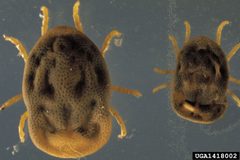
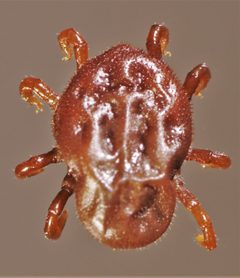
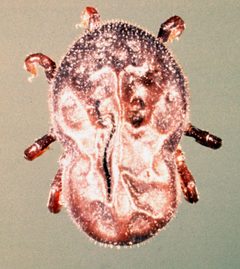
Soft-bodied lacking a . Nymphs are somewhat violin-shaped and covered with tiny backward-projecting spines, giving the its . reach approximately 10 mm in length, are brown in coloration, and possess a slightly body . Males and females are similar in appearance. Mouthparts are not visible from the view, located beneath the body typical of soft ticks.
Habitat
Larval and nymphal stages occupy the external ear canals of definitive . Free-living and engorged nymphs exiting hosts seek dry, protected microhabitats such as cracks and crevices in stable structures, beneath logs, or under fence posts. The is generally associated with semiarid to arid environments but has expanded to other climates through animal transportation.
Distribution
Worldwide distribution. Documented from North America, South America (Argentina, Bolivia, Brazil, Chile, Colombia, Peru, Venezuela), Central America (Cuba, Guatemala, Mexico), Africa (Democratic Republic of Congo, Lesotho, Madagascar, Malawi, South Africa, Sudan, Zambia, Zimbabwe), and Asia (Sri Lanka). In the United States, particularly associated with the Southwestern region.
Diet
Larvae and nymphs are obligate blood-feeders. do not feed; they absorb atmospheric water for survival.
Host Associations
- horses - primary Frequently infested; muscle spasms and colic reported in heavy
- cattle - Bos primigenius taurus confirmed
- sheep -
- goats -
- dogs -
- humans - occasional Several cases of reported
- South American camelids - Argentina records
Life Cycle
Single- lifecycle. hatch on or near ground in 18+ days. Unfed larvae climb vegetation or structures to quest for hosts and can survive >2 months without feeding. Upon host contact, larvae migrate to ears and feed for 5–10 days, then to nymphs within the ear canal. Nymphs feed for approximately one month and can remain in the ear for 1–7 months total. Engorged nymphs exit the host, molt to on the ground. Adults are free-living, non-feeding, and can produce eggs for up to 6 months. Multiple nymphal instars may be present simultaneously in host ears.
Behavior
Larvae exhibit -seeking by climbing vertical surfaces. Nymphs remain sedentary within ear canals for extended periods. actively burrow into substrate when seeking shelter. Heavy cause hosts to shake , rub ears, and exhibit signs of intense irritation.
Ecological Role
Veterinary causing direct harm through blood loss, tissue damage, and secondary . Documented of Q fever (Coxiella burnetii). Serves as prey for ants (Tapinoma melanocephalum, Monomorium spp., Pheidole sp., Crematogaster sp.), which may act as bio-suppressors of non-parasitic stages.
Human Relevance
Significant veterinary pest causing economic losses through reduced animal productivity, hide damage, and treatment costs. Rarely infests humans. Control relies on acaricides, , and environmental management of free-living stages.
Similar Taxa
- Ixodidae (hard ticks)O. megnini lacks the characteristic of hard ticks and has ventrally positioned mouthparts
- Other Otobius speciesO. megnini distinguished by spinose nymphal and specific association with ear canals
- Otobius lagophilusRabbit ear with similar but different specificity and geographic range
More Details
Ant predation
Five have been documented preying on O. megnini in Sri Lanka: Tapinoma melanocephalum, two Monomorium species, one Pheidole species, and one Crematogaster species. Ants feed on , larvae, and but notably avoid nymphal stages. T. melanocephalum is the most effective , targeting non-parasitic stages.
Clinical signs in horses
Beyond localized ear irritation, heavy have been associated with signs including muscle spasms, myotonia, and colic, possibly related to toxin effects or severe irritation.
Sources and further reading
- BugGuide
- Wikipedia
- GBIF taxonomy match
- iNaturalist taxon
- NCBI Taxonomy
- Catalogue of Life
- Managing External Parasites of Texas Cattle - AgriLife Extension Entomology
- Muscle spasms associated with ear tick (Otobius megnini) infestations in five horses
- Ants as predators of the Spinose Ear Tick, Otobius megnini (Dugès) in Sri Lanka
- First Record of Otobius Megnini (Dugés, 1883) (Ixodida: Argasidae) Found on Bos Primigenius Taurus in San Juan Province, Argentina
- Seasonal dynamics of spinose ear tick Otobius megnini associated with horse otoacariasis in Sri Lanka
- Life cycle of Spinose ear tick, Otobius megnini (Acari: Argasidae) infesting the race horses in Nuwara Eliya, Sri Lanka
- Myotonia and Colic Associated with the Spinose Ear Tick, Otobius megnini, in a Horse in Northern Mexico
- Spatial and temporal distributions of the Spinose Ear Tick,Otobius megnini, within animal shelters at Fossil Rim Wildlife Center