
Tapinoma melanocephalum
(Fabricius, 1793)
Ghost ant
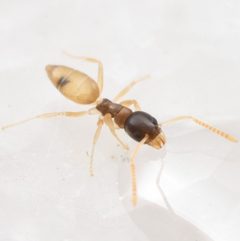
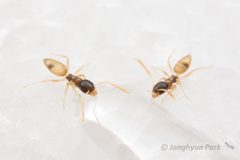
Tapinoma melanocephalum, commonly known as the ghost , is a minute ant recognized by its distinctive bicolored appearance: dark brown and contrasting with pale, translucent legs, , and . Native to tropical regions of Africa and Asia, it has become a globally distributed "tramp" species through human commerce, establishing in greenhouses, heated buildings, and tropical urban environments worldwide. The species is considered a significant household pest, particularly in Florida and Hawaii, where it nests indoors and forages for sweet foods. Recent taxonomic revision has revealed that what was long considered T. melanocephalum actually comprises two cryptic species, with T. pithecorum described as new in 2020.
Pronunciation
How to pronounce Tapinoma melanocephalum: //ˌtæpɪˈnoʊmə ˌmɛlənəˈsɛfələm//
These audio files are automatically generated. While they are not always 100% accurate, they are a good starting point.
Identification
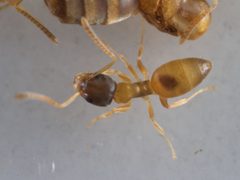
The ghost is readily distinguished from other small ants by its extreme bicolored pattern: dark and sharply contrasting with pale, almost transparent appendages and . This combination is unique among temperate and tropical tramp ants. Similar-sized such as Plagiolepis alluaudi (uniform yellow), Paratrechina longicornis (uniform dark with long ), and Brachymyrmex species (uniform pale) lack this stark color dichotomy. Tapinoma sessile (odorous house ant) is larger, uniformly dark brown, and produces a distinctive coconut-like odor when crushed. Wasmannia auropunctata (little fire ant) is slightly larger, uniformly reddish-brown, and possesses a painful sting. Careful examination under magnification is required to separate T. melanocephalum from the recently described cryptic species T. pithecorum, which requires morphometric analysis or molecular methods for reliable identification.
Images
Appearance
are extremely small, measuring 1.3–2.0 mm in length. The and (mesosoma) are dark brown to blackish, while the , legs, and are pale milky white to translucent. This striking color contrast creates a visual effect that makes the appear even smaller and more difficult to detect. The antennae possess 12 segments that thicken toward the tip. The thorax lacks spines, and the gaster is hairless with a slit-like terminal opening. The abdominal consists of a single segment typically concealed by the gaster. The lacks a functional stinger. Queens are larger (approximately 2.5 mm), with an enlarged alitrunk, but share the worker's bicolored pattern. Males have dark heads and dorsa with light-colored gasters that may bear dark markings.
Habitat
Primarily associated with human-modified environments in tropical and subtropical regions. Outdoors, nests occur in soil, leaf litter, rotten wood, and under stones in warm, moist . Indoors, colonies establish in wall voids, electrical appliances, potted plants, and structural crevices. In temperate regions, survival depends on heated greenhouses, buildings, and other artificial refugia; a colony has been documented in an apartment building in Canada. The shows a documented ecological shift from undisturbed natural habitats to urban environments, which has facilitated its global spread.
Distribution
Presumed native to tropical Africa and Oriental regions, though exact origin obscured by centuries of human-mediated . Now established in at least 154 geographical areas worldwide. In the United States, well established in Hawaii and Florida (where it is considered a key pest), with records from Washington, D.C. (1894, earliest record) and subsequent spread to at least 20 states including Maine, New York, Texas, California, and Arizona. Also present in U.S. territories (Puerto Rico, U.S. Virgin Islands). Documented from the Galápagos Islands, Germany (greenhouses), and throughout tropical Asia, the Pacific, and the Caribbean. Cannot survive outdoors in cold climates.
Seasonality
Year-round activity in tropical climates where temperatures remain favorable. In temperate regions, confined to heated indoor environments with continuous activity. Outdoor colonies in subtropical areas show increased foraging during warmer months; spring and early summer often bring heightened indoor activity as natural food sources fluctuate and indoor resources become attractive.
Diet
with strong preference for , particularly sugars and honeydew. actively tend honeydew-producing hemipterans including aphids, scale insects, and , establishing chemical trails to these resources. Laboratory studies demonstrate that sucrose specifically triggers honeydew foraging preference. Will also consume proteins and fats, including household foods, dead insects, and other small organic matter.
Host Associations
- Phenacoccus solenopsis - tendsNative T. melanocephalum in China improves survival of this mealybug by defending it from Aenasius bambawalei
- Aenasius bambawalei - of associate of ; attacked by ghost ants when attempting to oviposit
- Hibiscus rosa-sinensis - foraging substrateChinese hibiscus plants support mealybug colonies tended by ants
Life Cycle
Holometabolous development with complete . Colony foundation by single or multiple queens. Queens exhibit high , producing an average of 7.1 per 24 hours (range 1–18 eggs) under laboratory conditions. Larvae pass through three instars, all naked and with reduced mouthparts. Laboratory colonies maintained for four months with ad libitum feeding showed 70% increase in larvae, pupae, and . Colonies are polygynous (multiple queens) and may achieve unicolonial structure in some . Reproductive produced seasonally in established colonies.
Behavior
Highly opportunistic foraging with rapid recruitment to food sources via trails. display characteristic erratic, rapid movement that contributes to their "ghost-like" appearance and difficulty in tracking. Strong tendency to nest in small, concealed cavities including electrical equipment, wall voids, and household items. worker with no physical specialization. Foraging activity increases significantly with colony growth. Defensive includes direct attack on natural enemies of tended hemipterans; workers have been observed physically confronting to protect honeydew sources. No stinging capability; defense relies on speed, concealment, and chemical communication.
Ecological Role
In native range, functions as and scavenger in tropical . As , primarily acts as ecological follower rather than ecosystem engineer. Mutualistic relationships with honeydew-producing insects can elevate pest status of agricultural hemipterans by protecting them from agents. Documented case in China shows facilitation of mealybug spread through interference. May contribute to local nutrient cycling through soil nesting and foraging activities. Does not appear to competitively displace native fauna in undisturbed but achieves dominance in urban and disturbed environments.
Human Relevance
Significant household pest in tropical and subtropical regions, particularly Florida where it ranks among the most important house-infesting ants. Nests in structural voids, electrical appliances, and household items; forages extensively for sweet foods in kitchens and food storage areas. Agricultural pest in greenhouses where it tends crop-damaging hemipterans and interferes with programs. Documented presence in hospitals raises concerns about transmission, though specific capacity requires further study. Some individuals experience mild cutaneous irritation following contact. Listed on ISSG Global Database. Control relies on liquid baits containing slow-acting that distribute to queens and colony members.
Similar Taxa
- Tapinoma pithecorumCryptic sister recently separated from T. melanocephalum; morphologically similar but genetically and morphometrically distinct; requires expert examination for identification
- Tapinoma sessileSimilar and preference but larger (2–3 mm), uniformly dark brown, and produces distinctive coconut odor when crushed
- Plagiolepis alluaudiSimilar size and tramp but uniformly yellow without dark ; native to Madagascar
- Brachymyrmex obscuriorSimilar small size and pale coloration but lacks dark ; uniformly colored; nine-segmented versus twelve in Tapinoma
- Paratrechina longicornisSimilar and size but dark-colored throughout with characteristically long and rapid, jerky movement
More Details
Taxonomic Complexity
The ghost has undergone significant taxonomic revision. A 2020 study revealed that 'T. melanocephalum' comprised two cryptic , with T. pithecorum described as new. Multiple historical names (T. pellucida, T. coronatum, T. malesianum, T. australis, T. australe, T. luffae, T. wallacei, T. jerdoni) have been synonymized under T. melanocephalum. A neotype was designated due to loss of the original type material.
Phylogeographic History
Phylogenomic analysis using ultraconserved element (UCE) loci indicates the Tapinoma originated in the middle Eocene (49.4–34.4 Ma). T. melanocephalum diverged from T. jandai approximately 12 million years ago. genetic analyses reveal substantial molecular divergence among global populations with weak isolation-by-distance patterns, consistent with human-mediated jump rather than natural range expansion.
Medical Concerns
The has been documented in hospital environments where its small size and cryptic habits may facilitate access to sterile areas. While specific transmission capability is not fully quantified, its presence in medical facilities has prompted concerns about potential microbial carriage. Contact dermatitis (slight red irritation) has been reported in sensitive individuals.
Control Challenges
Effective management requires liquid baits with slow-acting that permit trophallactic transfer to queens and . Fast-acting contact are generally ineffective due to colony fragmentation and rapid . acceptance varies; sucrose-based are preferred. Colony location in inaccessible voids and electrical equipment complicates direct nest treatment.
Sources and further reading
- BugGuide
- Wikipedia
- GBIF taxonomy match
- iNaturalist taxon
- NCBI Taxonomy
- Catalogue of Life
- Got an Ant Question? | Bug Squad
- Just Buggin' Ya! The Good, The Bad and the Bugly | Bug Squad
- During Quarantine, an Entomologist Takes a Closer Look at a New Invasive Ant Species
- Some move out, others move in - Odorous house ants, Tapinoma sessile — Bug of the Week
- Turing back the invasion – Odorous house ants, Tapinoma sessile (MISSING VIDEOS) — Bug of the Week
- A holiday brunch with my ants. Odorous house ant, Tapinoma sessile — Bug of the Week
- Tapinoma melanocephalum (ghost ant)
- Tapinoma melanocephalum (ghost ant).
- Tapinoma melanocephalum (ghost ant)
- Ghost Ant, Tapinoma melanocephalum (Fabricius) (Insecta: Hymenoptera: Formicidae)
- The previous concept of the cosmopolitan pest ant Tapinoma melanocephalum (Fabricius, 1793) includes two species (Hymenoptera: Formicidae: Tapinoma)
- Strategies for controlling the ghost ant, Tapinoma melanocephalum (Hymenoptera: Formicidae) with liquid bait
- Taxonomic identity of the ghost ant, Tapinoma melanocephalum (Fabricius, 1793) (Formicidae: Dolichoderinae)
- Molecular identification of the ghost ant,Tapinoma melanocephalum(Fabricius): A preliminary study
- A phylogenomic overview of the ant genus Tapinoma Foerster, 1850 (Formicidae: Dolichoderinae), with the phylogeographic history of the ghost ant Tapinoma melanocephalum
- First Report of the Ghost Ant, Tapinoma melanocephalum (Hymenoptera: Formicidae), from Alabama
- The native ant, Tapinoma melanocephalum, improves the survival of an invasive mealybug, Phenacoccus solenopsis, by defending it from parasitoids
- Sucrose Triggers Honeydew Preference in the Ghost Ant,Tapinoma melanocephalum(Hymenoptera: Formicidae)
- Elemental Composition of Non-Nest Soil, Nest Soil, and Ant Bodies in Globally Invasive Ant Species Solenopsis Invicta and Tapinoma Melanocephalum Across Various Habitats
- The Ghost Ant Tapinoma Melanocephalum (Hym: Formicidae): Queen Fecundity and Development of Experimental Colonies
- Gland Origin and Electroantennogram Activity of Volatile Compounds in Ghost Ants, Tapinoma melanocephalum (Hymenoptera: Formicidae) and Behavioral Response to (Z)-9-Nonadecene